Gram Equivalent Weight Calculator Online
Calculate gram equivalent weight from molar mass and n-factor. Get the result in g/eq for chemistry and equivalent-weight calculations.
Please complete this field to continue.
Please complete this field to continue.
Results
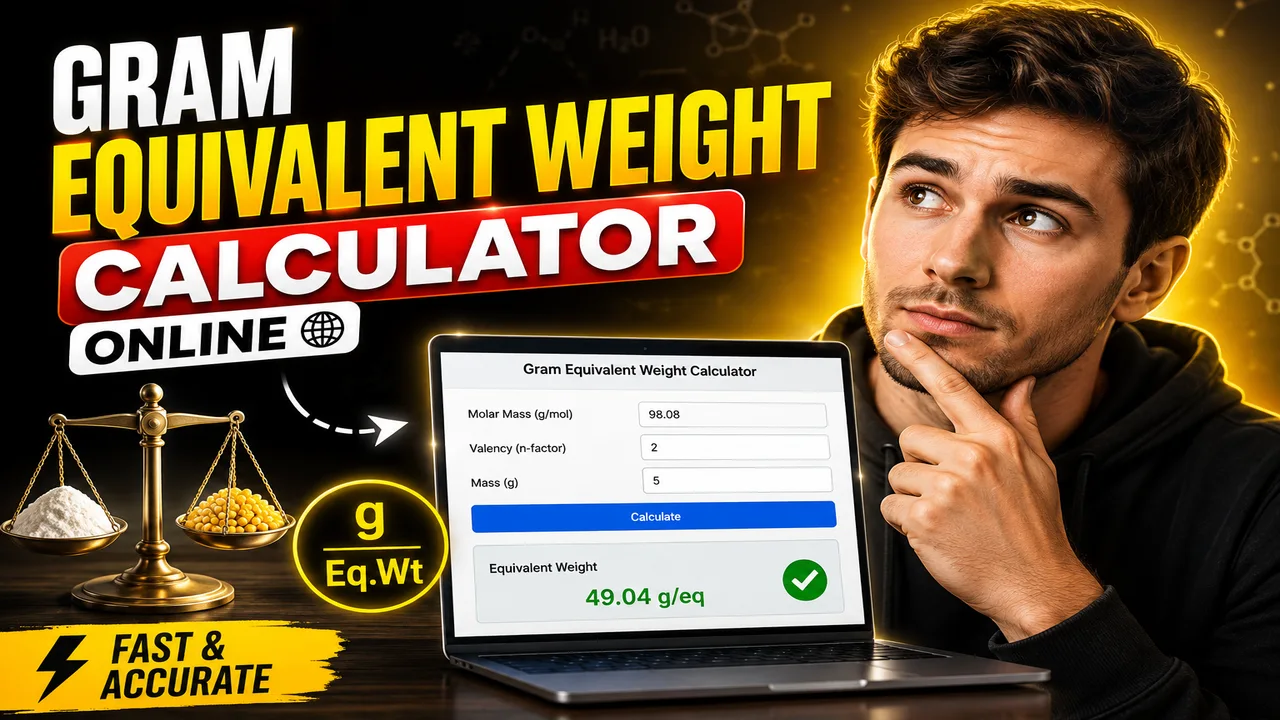
Gram Equivalent Weight Calculator Online
TL;DR Summary
The Gram Equivalent Weight Calculator Online calculates the mass of one chemical equivalent from a substance's molar mass and n-factor. It uses the standard relationship between formula weight and the number of equivalents; use the result as a chemistry calculation aid and confirm the correct n-factor for the specific reaction or process. The supplied tool information does not document a specific data-storage or upload policy, so avoid entering sensitive information.
About This Tool
The Gram Equivalent Weight Calculator Online is a chemistry calculator for finding the gram equivalent weight of a substance when its molar mass and n-factor are known. Equivalent weight is useful when chemical quantities are compared on an equivalent basis rather than only by moles. This concept appears in acid-base reactions, redox reactions, precipitation reactions, and other chemical calculations where the number of reacting equivalents matters.
The main calculation is simple: divide the molar mass by the n-factor, also called the equivalence factor in many chemistry references. The result is the mass corresponding to one equivalent and is normally expressed in grams per equivalent, or g/eq. Chemistry references describe equivalent weight as the formula weight divided by the number of equivalents, written as EW = FW/n. The n-factor depends on how the substance participates in the reaction, so the same chemical substance can have different equivalent weights under different reaction conditions. :contentReference[oaicite:3]{index=3}
This calculator is useful for students, teachers, laboratory learners, and anyone working through chemistry problems involving equivalents. It can also help when checking hand calculations for titration, normality, acid-base chemistry, or oxidation-reduction problems. The calculator does not identify the correct n-factor from a chemical formula or reaction. You must supply an n-factor that is appropriate for the chemical process being considered.
What You Enter
- Molar Mass: Enter the substance's molar mass in grams per mole (g/mol).
- n-Factor / Equivalence Factor: Enter the number of equivalents represented by one mole for the reaction or chemical process.
The calculator keeps the input requirements focused on the two quantities needed for the standard formula. It does not require a chemical name, chemical formula, reaction equation, sample mass, solution volume, molarity, or normality because those values are not necessary for this direct equivalent-weight calculation.
What You Get
The main result is the gram equivalent weight in grams per equivalent (g/eq). The calculator also identifies the formula used: molar mass divided by n-factor. The result is displayed to four decimal places so that useful numerical precision is retained in the displayed answer.
How to Use
- Step 1: Find the molar mass of the substance and enter it in g/mol.
- Step 2: Determine the correct n-factor for the chemical reaction or process and enter it in the n-factor field.
- Step 3: Review the calculated gram equivalent weight in g/eq.
- Step 4: Check that the selected n-factor matches the reaction conditions before using the result in a laboratory or chemistry calculation.
Technical Explanation and Formula
The standard formula used for equivalent weight is:
Gram Equivalent Weight = Molar Mass / n-Factor
In symbols:
EW = M / n
| Variable | Meaning | Unit |
|---|---|---|
| EW | Equivalent weight or gram equivalent weight | g/eq |
| M | Molar mass or formula weight | g/mol |
| n | n-factor or number of equivalents per mole | eq/mol |
Because the n-factor describes the chemical reaction or process, it cannot always be determined from molar mass alone. For an acid-base reaction, the reaction unit can be based on the number of protons donated or accepted. In redox chemistry, the reaction unit can be based on electrons transferred. Chemistry references therefore emphasize that determining the number of equivalents requires understanding how the chemical species reacts. :contentReference[oaicite:4]{index=4}
For example, sulfuric acid, H2SO4, has a molar mass of about 98.08 g/mol. If the reaction uses an n-factor of 2, the equivalent weight is:
EW = 98.08 g/mol ÷ 2 = 49.04 g/eq
This illustrates why the n-factor matters. A substance's equivalent weight is not necessarily a single fixed number independent of the reaction. For sulfuric acid in an acid-base context where two protons are neutralized, the equivalent weight is half its molar mass. :contentReference[oaicite:5]{index=5}
Understanding the n-Factor
The n-factor is the key chemical input in this calculator. It represents the number of equivalents associated with one mole of the substance for the reaction being considered. In acid-base chemistry, it can correspond to the number of protons donated or accepted. In oxidation-reduction chemistry, it can correspond to the number of electrons transferred. For other reactions, the reaction unit must be defined from the chemistry involved. :contentReference[oaicite:6]{index=6}
This means you should not automatically use the total number of hydrogen atoms, oxygen atoms, or the charge shown in a formula without considering the actual reaction. For example, an acid may have more than one ionizable hydrogen, but the effective n-factor can depend on the reaction and the equivalence point being considered.
Preset Example
| Molar Mass | n-Factor | Calculation | Gram Equivalent Weight |
|---|---|---|---|
| 98.08 g/mol | 2 | 98.08 ÷ 2 | 49.04 g/eq |
| 40.08 g/mol | 2 | 40.08 ÷ 2 | 20.04 g/eq |
| 58.44 g/mol | 1 | 58.44 ÷ 1 | 58.44 g/eq |
The examples above demonstrate the mathematical operation only. The appropriate n-factor must still be selected from the chemistry of the reaction. The standard equivalent-weight relationship is supported by chemistry references, including Chemistry LibreTexts and educational chemistry materials. :contentReference[oaicite:7]{index=7}
Why Units Matter
Molar mass is normally expressed as g/mol, while equivalent weight is expressed as g/eq. The division works because the n-factor represents equivalents per mole. Keeping the units visible helps prevent a common mistake: reporting the result as g/mol instead of g/eq.
Why Use This Gram Equivalent Weight Calculator Online & How Our Gram Equivalent Weight Calculator Online Compares
| Method | Ease of Use | Calculation Speed | Best For | Limitations |
|---|---|---|---|---|
| Toolhox Calculator | Enter molar mass and n-factor | Direct calculation | Quick equivalent-weight calculations | Does not determine the correct n-factor for you |
| Manual Calculation | Requires the formula to be applied by hand | Depends on the user | Learning and checking the calculation | More opportunity for arithmetic or unit errors |
| Spreadsheet Calculation | Requires a spreadsheet setup | Depends on the setup | Repeated calculations or custom worksheets | Requires formulas and cells to be configured correctly |
| Professional Chemistry Software | May require more setup | Depends on the software and workflow | Broader chemistry modeling and analysis | May provide capabilities beyond a simple equivalent-weight calculation |
The practical difference is scope. This calculator is designed around the direct relationship between molar mass and n-factor. Manual work, spreadsheets, and larger chemistry applications can be useful when a problem requires additional calculations or reaction analysis. The calculator should not be treated as a replacement for determining the chemistry behind the n-factor.
Assumptions and Limitations
The calculator assumes that the molar mass is entered correctly and that the supplied n-factor is appropriate for the reaction or chemical process. It performs the standard division of molar mass by n-factor. It does not analyze a chemical equation, determine oxidation states, identify titratable protons, or infer the reaction-specific equivalence factor from a chemical formula.
Equivalent weight can depend on the reaction being considered. This is especially important in acid-base and redox chemistry. A chemical species may have different equivalent-weight values under different reaction conditions because its number of reacting equivalents can change. :contentReference[oaicite:8]{index=8}
The result is therefore a calculation based on the values you provide. If the n-factor is uncertain, determine it from the balanced reaction, the relevant equivalence point, or an appropriate chemistry reference before relying on the result. For laboratory work, regulated procedures, or high-stakes chemical decisions, use the applicable method or professional guidance in addition to this calculator.
The tool information supplied for this page does not establish a specific privacy, storage, or server-processing policy. Avoid entering sensitive information unless the page clearly explains how submitted information is handled.
Key Takeaway
The core calculation is straightforward: divide molar mass by the appropriate n-factor to obtain gram equivalent weight. The arithmetic is simple, but choosing the correct n-factor is the important chemistry step. When that factor is known, the calculator provides a direct way to convert molar mass into equivalent weight in g/eq.