Grams To Deciliters Converter
Convert grams to deciliters using mass and density. Enter grams and g/mL density to calculate the equivalent volume in dL.
Please complete this field to continue.
Please complete this field to continue.
Results
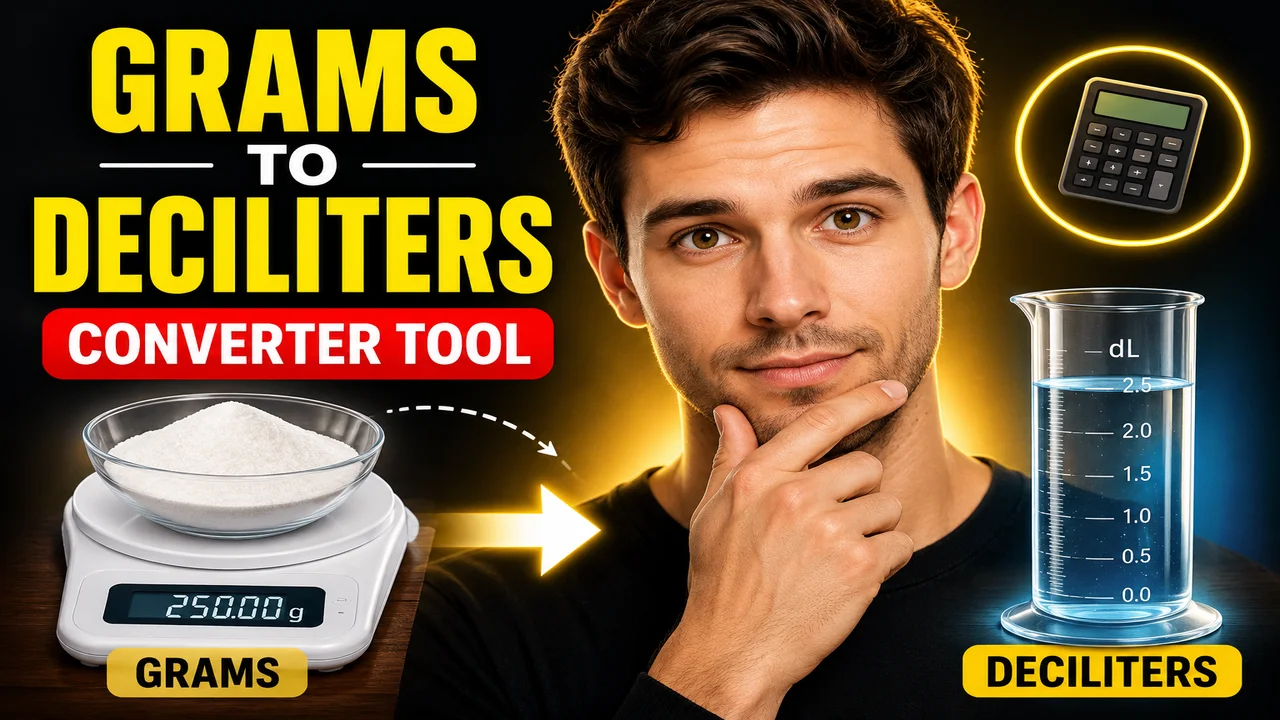
Grams To Deciliters Converter Tool
TL;DR Summary
The Grams To Deciliters Converter Tool converts a mass measured in grams into a volume measured in deciliters by using the material's density. Use it for a quick conversion or estimate; results depend on the density you enter, and the available tool information does not specify how entered data is stored or processed.
About the Grams To Deciliters Converter Tool
The Grams To Deciliters Converter Tool helps convert between two different types of measurement: mass and volume. Grams (g) measure how much mass a substance has, while deciliters (dL) measure volume. Because mass and volume are not directly interchangeable for most substances, the conversion requires density.
This distinction is important when working with ingredients, liquids, powders, chemicals, laboratory materials, or other substances. The same number of grams can occupy different amounts of space depending on the material. For example, a dense substance and a light substance can have the same mass while taking up different volumes.
The tool uses two main inputs: the amount in grams and the density in grams per milliliter (g/mL). After you enter both values, the calculator determines the equivalent volume in milliliters and then converts that volume into deciliters. The primary result is displayed in dL, with the milliliter value also provided as a useful reference.
What Does This Converter Calculate?
The basic purpose is to answer a question such as: “How many deciliters are equal to this number of grams?” The answer depends on the density of the substance being measured.
If you already know the material's density, enter that density in g/mL. If you are working with a particular food, ingredient, powder, or liquid, make sure the density value represents that specific material and, when relevant, its physical condition. Density can vary with temperature, composition, moisture, packing, and other factors.
The tool does not treat grams and deciliters as interchangeable units by themselves. Instead, it applies the standard relationship between mass, density, and volume. This makes the converter different from a simple fixed conversion such as meters to centimeters, where the conversion factor never changes.
Inputs Required
- Weight in grams: Enter the mass you want to convert. Values may include decimals, such as 50.5 grams.
- Density in g/mL: Enter the density of the substance. This value is required because grams alone do not determine volume.
The density field accepts a positive value. A density of zero cannot be used because division by zero is undefined. Negative density is also not valid for this conversion.
What Does the Tool Output?
The main result is the calculated volume in deciliters (dL). The tool also shows the corresponding volume in milliliters (mL) and the density used in the calculation. Showing both volume units makes it easier to check and reuse the result.
One deciliter equals 100 milliliters. Therefore, once the volume in milliliters is known, dividing that value by 100 gives the volume in deciliters.
How to Use the Grams To Deciliters Converter Tool
- Step 1: Enter the mass you want to convert in the Weight in Grams field.
- Step 2: Enter the substance's density in grams per milliliter (g/mL).
- Step 3: Check the calculated volume shown in deciliters (dL).
- Step 4: Use the displayed milliliter value as a secondary volume reference when needed.
Technical Explanation and Formula
The standard mass-to-volume relationship is:
Volume = Mass ÷ Density
When mass is entered in grams and density is entered in grams per milliliter, the first result is in milliliters:
Volume (mL) = Mass (g) ÷ Density (g/mL)
Because one deciliter contains 100 milliliters, the final conversion is:
Volume (dL) = Mass (g) ÷ Density (g/mL) ÷ 100
For example, if a substance has a mass of 100 grams and a density of 1.000 g/mL:
Volume = 100 ÷ 1.000 = 100 mL
Then:
100 mL ÷ 100 = 1 dL
So 100 grams of a substance with a density of 1.000 g/mL corresponds to 1 dL.
| Variable | Meaning | Unit |
|---|---|---|
| Mass | Amount of substance being converted | g |
| Density | Mass contained in each milliliter | g/mL |
| Volume | Calculated volume | mL or dL |
Why Density Matters
Density is the key value in a grams-to-deciliters conversion. A gram is a mass unit, while a deciliter is a volume unit. Without density, there is no single volume that can be assigned to a given mass.
For example, 100 grams of one substance may occupy 100 mL, while 100 grams of another substance may occupy substantially more or less than 100 mL. The converter therefore requires the density rather than assuming that every material has the same density.
For food and cooking applications, this is especially important. A recipe ingredient may have a density that differs from water, and dry ingredients can also vary depending on how tightly they are packed. For scientific or technical work, use a density value that matches the material and the conditions of the measurement.
Preset Examples and Quick Reference
| Mass | Density | Calculated Volume |
|---|---|---|
| 100 g | 1.000 g/mL | 1.0000 dL |
| 50 g | 1.000 g/mL | 0.5000 dL |
| 250 g | 1.000 g/mL | 2.5000 dL |
| 100 g | 0.800 g/mL | 1.2500 dL |
| 100 g | 1.250 g/mL | 0.8000 dL |
These examples illustrate the formula rather than providing universal density values for particular ingredients. If you are converting a real material, use an appropriate density value for that material instead of selecting a value simply because it appears in an example.
Rounding and Precision
The calculation itself should use the entered values without unnecessary intermediate rounding. The displayed deciliter result is formatted to four decimal places, while the milliliter result is displayed to two decimal places. The displayed precision should therefore be treated as a presentation choice rather than proof that the underlying density is known to that many significant digits.
Common Uses
A grams-to-deciliters conversion can be useful when a recipe, specification, experiment, or measurement uses mass but the receiving instruction uses volume. It can also help when comparing measurements written in different unit systems.
Home cooks may use the conversion when a recipe gives an ingredient by weight but a container or measuring instruction is expressed in volume. Students can use it to understand the relationship between mass, density, and volume. Technical users can use it as a simple mass-to-volume calculation when the density of the material is already known.
Why Use This Grams To Deciliters Converter Tool & How Our Grams To Deciliters Converter Tool Beats the Competition
| Method | Ease of Use | Calculation Speed | Best For | Limitations |
|---|---|---|---|---|
| Toolhox Grams To Deciliters Converter Tool | Enter grams and density directly | Immediate calculated result | Quick mass-to-volume conversions | Requires a suitable density value |
| Manual Calculation | Requires applying the formula yourself | Depends on manual calculation | Checking the conversion formula | More opportunity for arithmetic or unit mistakes |
| Spreadsheet Calculation | Requires setting up cells and formulas | Useful for repeated calculations | Batch or custom calculations | Requires spreadsheet setup and maintenance |
| Professional Technical Software | Often requires more setup | Depends on the software and workflow | Broader technical analysis | May provide capabilities beyond a simple conversion |
The practical benefit of this tool is that the conversion formula is presented as a direct input-and-result workflow. You do not need to manually divide the mass by density and then convert milliliters to deciliters. At the same time, a simple converter is not a replacement for a larger measurement, laboratory, food-production, or engineering system when additional variables are important.
Assumptions and Limitations
The calculation assumes that the density entered by the user is appropriate for the substance being converted. The tool does not independently identify the material or verify the density value. It also does not determine how density changes with temperature, pressure, moisture content, concentration, particle packing, or other physical conditions.
The result is therefore only as reliable as the input data. A highly precise-looking result does not mean that the source density is equally precise. If the density is approximate, the converted volume is also an estimate.
Do not rely on the result alone when an exact measurement is required for a laboratory procedure, regulated process, industrial specification, medical application, commercial formulation, or other situation where measurement accuracy has important consequences. In those cases, use the appropriate technical data and follow the applicable measurement procedure.
The available tool specification does not document a particular ingredient database or automatic density lookup. For that reason, this converter should be understood as a mass-to-volume calculator that requires the density value as an input, rather than as an ingredient-specific conversion database.
Privacy and Data Use
The supplied tool specifications do not document whether entered values are processed locally, transmitted to a server, or stored. Avoid entering sensitive or confidential information unless the page clearly explains how that information is handled.