Daily Fiber Intake Calculator
Calculate daily fiber intake by age and sex in grams per day using established U.S. dietary fiber reference values.
Please complete this field to continue.
Please complete this field to continue.
Results
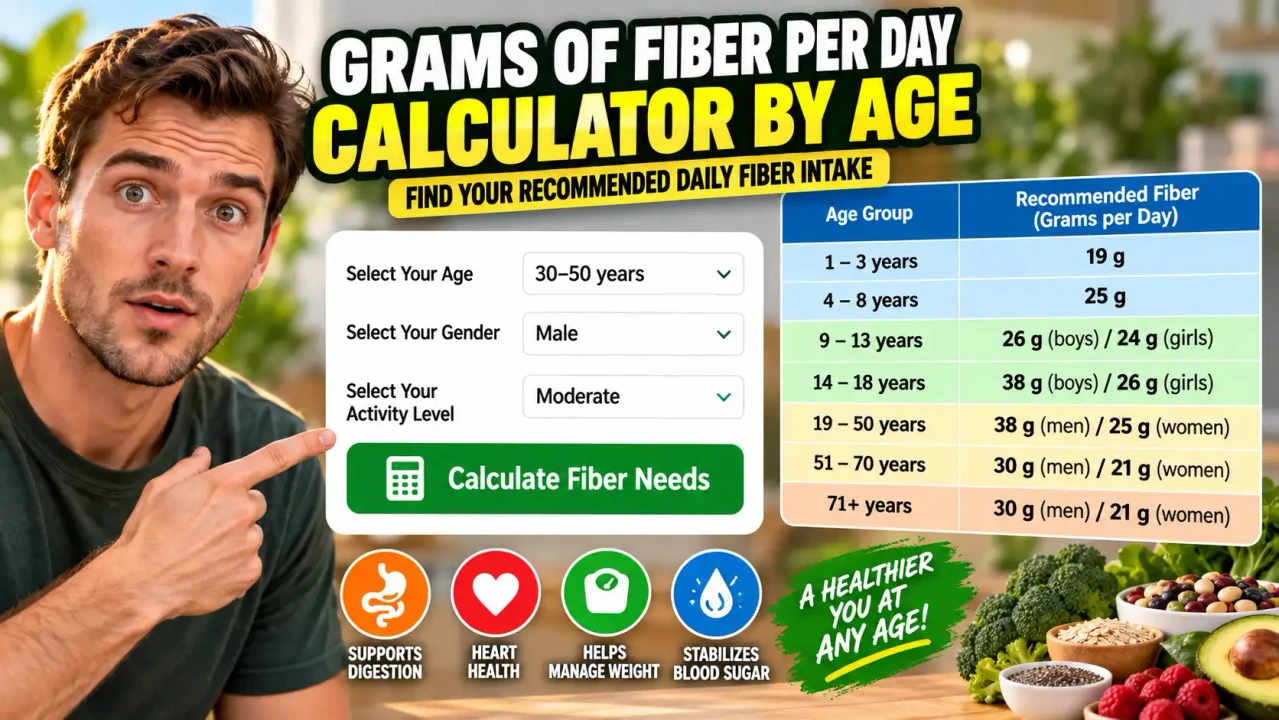
Daily Fiber Intake Calculator By Age Grams Per Day
TL;DR Summary
The Daily Fiber Intake Calculator By Age Grams Per Day provides an age-based estimate of daily dietary fiber needs in grams per day using established U.S. nutrition reference guidance. Use the result as a general nutrition reference rather than a personalized medical recommendation; the supplied tool information does not specify how entered data is stored or processed, so avoid entering sensitive information unless the page explains its data handling.
About This Tool
The Daily Fiber Intake Calculator By Age Grams Per Day is designed to help users understand how much dietary fiber they may need each day based on age. Fiber is a type of carbohydrate found naturally in plant foods and is commonly associated with foods such as vegetables, fruits, whole grains, beans, peas, nuts, and seeds. The calculator presents the result in grams per day, making it easier to compare a general daily target with the amount of fiber listed on food labels or nutrition records.
This tool is useful for adults, parents, caregivers, students, health-conscious users, and anyone who wants a simple age-based reference for daily fiber intake. Instead of searching through several nutrition tables, a user can enter the relevant age information and use the resulting grams-per-day figure as a starting point for meal planning and nutrition tracking.
Dietary fiber recommendations can depend on age, sex, energy intake, and life stage. The National Academies established an Adequate Intake for total fiber of 14 grams per 1,000 calories. U.S. dietary guidance has also used this relationship as an important basis for fiber goals. Current federal nutrition guidance for 2025–2030 remains the applicable U.S. dietary framework in 2026, while the underlying fiber Dietary Reference Intake is still based on the established macronutrient DRI framework.
Because the exact internal inputs and calculation implementation were not supplied with the tool request, this page describes the calculator according to its stated purpose: providing an age-based daily fiber reference in grams. If the live calculator includes additional choices, such as sex or life stage, those selections can further distinguish the reference value. The visible result should always be interpreted according to the inputs actually provided to the calculator.
What Does the Calculator Calculate?
The main output is a recommended or reference amount of dietary fiber expressed as grams per day (g/day). The word “recommended” should be understood carefully. Dietary Reference Intakes include different types of reference values, including Recommended Dietary Allowances and Adequate Intakes. Fiber is commonly expressed using an Adequate Intake framework rather than a conventional RDA.
An age-based calculator is helpful because fiber needs are not identical across all stages of life. Children, teenagers, younger adults, middle-aged adults, and older adults can have different reference amounts. Some established reference tables also distinguish males and females at certain ages. Pregnancy and lactation can create additional life-stage considerations.
What Information Do You Need?
The primary information indicated by the tool name is age. Depending on the actual calculator interface, an additional sex or life-stage selection may be used when the reference values differ. The calculation does not require you to enter individual foods unless the live tool specifically provides those fields.
The result is expressed in grams per day rather than calories, ounces, servings, or percentages. This is useful because Nutrition Facts labels generally list dietary fiber in grams. For example, if a food provides 5 grams of dietary fiber per serving, you can compare that amount with a daily reference target in grams.
How to Use
- Step 1: Enter the person's age using the age field provided by the calculator.
- Step 2: If the calculator provides additional options such as sex or life stage, select the option that applies to the person being assessed.
- Step 3: Review the calculated daily fiber reference shown in grams per day.
- Step 4: Compare the result with dietary fiber amounts listed on food labels or nutrition records.
- Step 5: Use the result as a general planning reference and consider individual dietary needs, health conditions, and advice from a qualified health professional when appropriate.
Technical Explanation and Formula
The underlying fiber reference is commonly expressed using the following standard relationship:
Fiber target = Daily energy intake × 14 g ÷ 1,000 kcal
In this formula, daily energy intake is measured in kilocalories per day, and the resulting fiber target is measured in grams per day. The factor of 14 grams per 1,000 calories comes from the established Adequate Intake framework for total fiber.
An age-based calculator may instead use published age- and life-stage reference values derived from this broader framework. When a fixed age-based value is used, the calculator can select the appropriate reference value rather than asking the user to calculate daily calorie needs separately.
For example, using the standard 14 grams per 1,000 calories relationship, a person consuming 2,000 calories per day would have a reference calculation of:
2,000 × 14 ÷ 1,000 = 28 grams of fiber per day
This example illustrates the standard DRI relationship. It does not establish that every person should consume exactly 28 grams of fiber. Individual energy needs and life stage affect the appropriate reference, and an age-based calculator may use a published age-specific value instead.
Understanding Grams of Fiber Per Day
Grams per day are a practical unit because dietary fiber is reported in grams on U.S. Nutrition Facts labels. If a cereal contains 6 grams of fiber per serving and a person's reference target is 25 grams per day, three servings would provide 18 grams, assuming the servings are actually consumed. Other foods eaten during the day would contribute additional fiber.
Fiber comes from a wide range of plant foods. Whole grains, beans, peas, vegetables, fruits, nuts, and seeds can all contribute to total dietary fiber intake. A balanced eating pattern can provide fiber from several food groups rather than relying on a single food or supplement.
Quick Reference
| Item | What It Means |
|---|---|
| Primary input | Age |
| Possible additional input | Sex or life stage, if provided by the calculator |
| Primary output | Daily dietary fiber reference |
| Output unit | Grams per day (g/day) |
| Standard DRI relationship | 14 grams of fiber per 1,000 calories |
| Use case | General nutrition planning and comparison with food-label fiber values |
Why Fiber Intake Matters
Fiber is part of an overall healthy eating pattern. Foods that provide fiber can also supply vitamins, minerals, and other nutrients. Increasing fiber intake is therefore generally considered in the context of the overall quality and variety of the diet rather than as an isolated number.
At the same time, a fiber target should not be treated as a guarantee of health outcomes. Eating more fiber does not automatically make an eating pattern nutritionally complete. Total food choices, fluid intake, energy needs, medical conditions, medications, and individual tolerance can all matter.
Why Use This Daily Fiber Intake Calculator By Age Grams Per Day & How Our Calculator Beats the Competition
The practical advantage of an age-based calculator is that it turns a nutrition reference into a simple user-facing result. Different methods can still be useful depending on the user's needs.
| Method | Ease of Use | Calculation Process | Best For | Limitations |
|---|---|---|---|---|
| Toolhox Calculator | Simple | Enter the relevant age information and review the displayed grams-per-day reference | Quick age-based nutrition reference | Does not replace individualized nutrition assessment |
| Manual Calculation | Requires more work | Apply the appropriate nutrition reference or the 14 g/1,000 kcal relationship | Users who want to understand the calculation | Requires finding and interpreting the correct reference values |
| Spreadsheet | Moderate | Reference values and formulas must be entered and maintained | Repeated calculations or personal tracking | Setup and maintenance are required |
| Professional Nutrition Software | Varies | May combine several nutrition inputs and reference systems | Detailed dietary assessment | May be more complex than needed for a simple fiber reference |
This comparison is about practical use rather than accuracy rankings. A simple calculator is useful for a quick reference, while detailed dietary planning may require more information than age alone.
Assumptions and Limitations
The calculator should be treated as a general nutrition reference rather than a diagnosis or individualized medical plan. The result may not account for a person's complete diet, calorie needs, medical history, digestive conditions, medications, pregnancy, breastfeeding, or other factors unless those factors are explicitly included in the calculator.
The exact internal formula, field list, rounding method, and privacy behavior were not provided in the supplied tool context. Therefore, this page does not claim that the calculator performs a particular hidden calculation beyond its stated age-based purpose.
People with digestive disorders, swallowing difficulties, bowel conditions, dietary restrictions, or other health concerns may need individualized advice. A sudden increase in fiber can also feel uncomfortable for some people. When a medical condition or therapeutic diet is involved, use the calculator only as a reference and follow advice from an appropriate health professional.
For general nutrition planning, the result can be useful alongside food labels and dietary records. It should not be used as the sole basis for making medical or clinical decisions.