How Much Solar Energy Does My Roof Get Calculator
Use the How Much Solar Energy Does My Roof Get Calculator to estimate roof solar energy from area, sunlight, shading, and orientation as an early planning tool.
Please complete this field to continue.
Please complete this field to continue.
Please complete this field to continue.
Please complete this field to continue.
Results
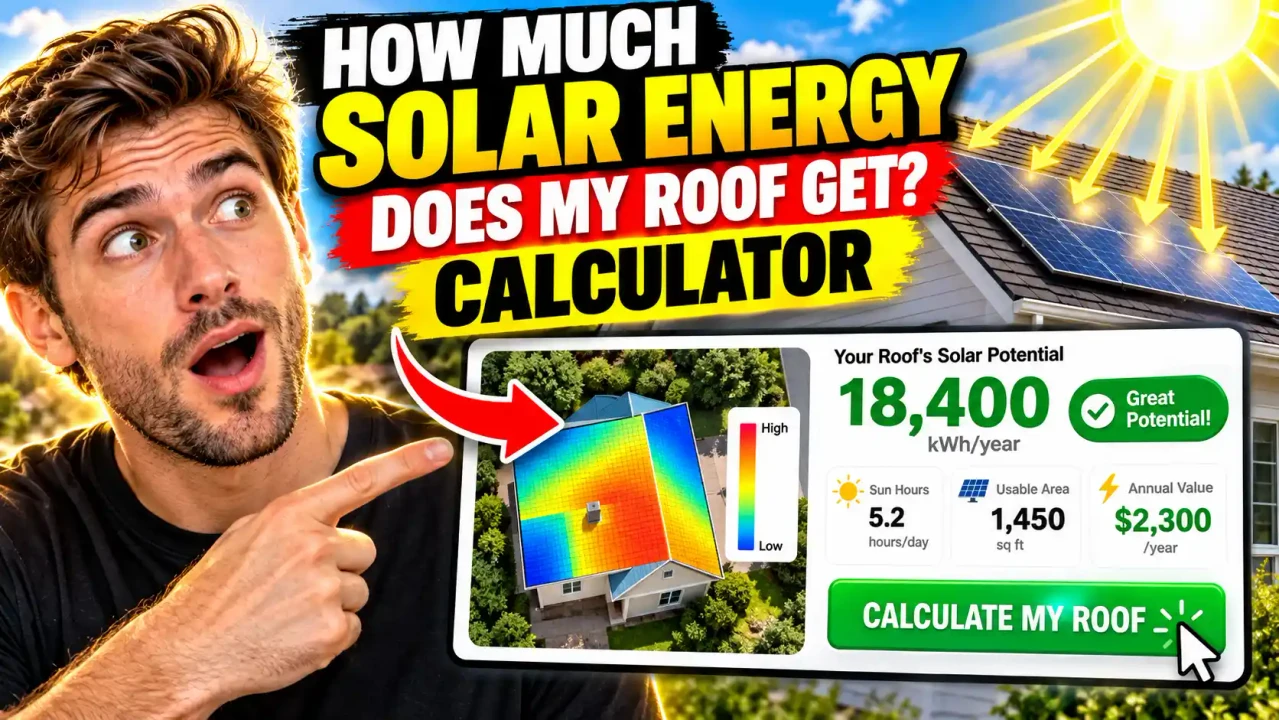
How Much Solar Energy Does My Roof Get Calculator
TL;DR Summary
The How Much Solar Energy Does My Roof Get Calculator estimates how much solar energy reaches a roof each day and over a year using roof area, average solar radiation, shading loss, and a roof exposure factor. It is a planning estimate rather than a site-specific engineering or PV system simulation, and the available tool information does not establish a specific data-storage or server-processing policy.
About This Tool
The How Much Solar Energy Does My Roof Get Calculator is designed to answer a simple early-stage solar planning question: how much sunlight energy is available across a roof over time? It converts a roof area into square meters, applies an average daily solar-radiation value, adjusts for shading, and then applies a roof exposure factor. The result is shown as estimated solar energy per day and per year.
This distinction matters. Solar energy reaching a roof is not the same thing as electricity that solar panels will produce. A roof may receive a large amount of sunlight, while the final electrical output of a photovoltaic system is lower because of panel efficiency, temperature, inverter behavior, wiring, system losses, shading, orientation, and other factors. NREL's PVWatts model uses a much more detailed set of location, system, and performance inputs for PV production estimates.
The calculator is useful for homeowners, property owners, students, solar-curious users, and anyone who wants a simple first estimate before doing a more detailed solar assessment. It can also help explain why roof size alone does not determine solar potential. The amount of available solar radiation and the way the roof receives sunlight are important parts of the calculation.
What You Enter
The calculator uses four inputs.
- Roof Area: Enter the usable roof area in square feet. The calculator converts this value to square meters before applying the solar-radiation input.
- Average Daily Solar Radiation: Enter the average solar radiation for the relevant location and surface basis in kWh/m²/day. Solar-radiation data are commonly expressed in kWh/m² for PV resource analysis.
- Shading Loss: Enter the percentage of solar energy expected to be lost because of shading. A value of 0% means no shading adjustment, while 20% means the calculation retains 80% of the available energy.
- Roof Exposure Factor: Enter a value from 0 to 1 to represent the roof's effective exposure. A value of 1.00 represents full exposure under this simplified model. A lower value can represent reduced exposure caused by roof tilt or orientation. Shading should be entered separately rather than counted twice.
The tool does not automatically determine your address, roof geometry, solar resource, tree shading, or roof orientation from satellite imagery. You therefore need to provide a suitable solar-radiation value and exposure assumption. NREL and the U.S. Department of Energy note that rooftop solar potential depends on factors including roof size, shading, direction, tilt, and location.
What You Get
The calculator returns three useful values:
- Roof Area: The entered roof area converted to square meters.
- Estimated Daily Solar Energy: The estimated solar energy reaching the roof in kWh/day after the shading and exposure adjustments.
- Estimated Annual Solar Energy: The daily estimate multiplied by 365, expressed in kWh/year.
These outputs describe solar energy available at the roof surface under the assumptions you enter. They do not represent guaranteed electricity generation, utility savings, system size, or financial return.
How to Use
- Step 1: Measure or estimate the roof area that you want to evaluate and enter it in square feet.
- Step 2: Enter an appropriate average daily solar-radiation value in kWh/m²/day for the location and surface being evaluated.
- Step 3: Enter the estimated percentage of solar energy lost to shading.
- Step 4: Enter a roof exposure factor from 0 to 1 to represent reduced exposure from roof orientation or tilt under this simplified model.
- Step 5: Review the estimated daily and annual solar energy values and use them as an early planning reference.
Technical Explanation and Formula
The calculator uses a standard simplified solar-energy-area relationship. Because the supplied tool context does not document a hidden production model, the formula below should be understood as the standard calculation used for the stated purpose rather than a claim about an undisclosed internal algorithm.
Step 1 — Convert roof area:
Roof Area (m²) = Roof Area (ft²) × 0.092903
The conversion uses the international foot. NIST defines one foot as exactly 0.3048 meter.
Step 2 — Apply shading and roof exposure:
Daily Solar Energy = Roof Area (m²) × Solar Radiation × (1 − Shading / 100) × Exposure Factor
Where:
- Roof Area: roof surface area in m².
- Solar Radiation: average daily solar energy in kWh/m²/day.
- Shading: estimated shading loss as a percentage.
- Exposure Factor: a dimensionless value from 0 to 1 representing effective roof exposure.
Step 3 — Estimate annual solar energy:
Annual Solar Energy = Daily Solar Energy × 365
The model does not apply a special leap-year adjustment. It uses 365 days for the annual estimate.
Worked Example
Consider an illustrative roof with 2,000 ft² of area. Assume an average daily solar-radiation value of 5.00 kWh/m²/day, 10% shading loss, and a roof exposure factor of 0.90. These values are only an example and are not a claim about any particular U.S. location.
First, the roof area is converted:
2,000 × 0.092903 = 185.806 m²
Then the estimated daily solar energy is:
185.806 × 5.00 × 0.90 × 0.90 = 752.51 kWh/day
The annual estimate is:
752.51 × 365 = 274,667.72 kWh/year
The example demonstrates the calculation only. Actual solar radiation varies by location, season, weather, roof orientation, tilt, shading, and other conditions. The U.S. Department of Energy explains that solar radiation changes with atmospheric conditions and that radiation measurements are commonly expressed as energy received per unit area.
Choosing a Solar-Radiation Value
The solar-radiation input is one of the most important inputs in this calculator. A value should represent the location and surface you are trying to evaluate. NREL's solar-resource tools use detailed meteorological and solar-radiation datasets, including global horizontal, direct normal, and diffuse horizontal irradiance data.
For a more detailed PV analysis, NREL's PVWatts Calculator accepts location information and PV system specifications such as system size, module type, array type, system losses, tilt, and azimuth. This Toolhox calculator should therefore be viewed as a simpler roof-energy estimate, not a replacement for a detailed PV performance model.
Preset Examples and Quick Reference
| Input | Unit | Meaning |
|---|---|---|
| Roof Area | ft² | Roof area being evaluated |
| Solar Radiation | kWh/m²/day | Average daily solar energy per square meter |
| Shading Loss | % | Estimated reduction caused by shading |
| Exposure Factor | 0–1 | Adjustment for effective roof exposure |
Why Use This How Much Solar Energy Does My Roof Get Calculator & How Our Calculator Beats the Competition
The main value of this calculator is that it puts the basic relationship between roof area and solar resource into one repeatable calculation. Different methods are useful at different stages of solar planning, so the table below describes practical trade-offs rather than claiming that one method is universally better.
| Method | Ease of Use | Calculation Speed | Best For | Limitations |
|---|---|---|---|---|
| Toolhox Calculator | Simple inputs | Immediate estimate | Early roof-energy planning | Requires user-provided solar resource and exposure assumptions |
| Manual Calculation | Requires more work | Depends on the user | Understanding the formula | More opportunity for conversion or arithmetic errors |
| Spreadsheet | Flexible | Fast after setup | Repeated scenarios | Requires spreadsheet setup and formula maintenance |
| Professional PV Software | More complex | Depends on the model | Detailed PV design and analysis | Requires more inputs and technical assumptions |
Assumptions and Limitations
This calculator is an estimate of solar energy reaching a roof. It does not calculate actual photovoltaic electricity production. It does not model individual solar-panel efficiency, inverter efficiency, module temperature, DC-to-AC sizing, wiring, soiling, degradation, battery storage, utility rates, incentives, electricity consumption, or project economics.
The result also depends strongly on the solar-radiation value supplied by the user. A poor or mismatched solar-resource value can produce a misleading result. The exposure factor is another simplified input. It should not be treated as a detailed solar-access model.
Roof shading can vary throughout the day and year. Trees, neighboring buildings, roof structures, chimneys, and other obstructions can change the available sunlight. The U.S. Department of Energy identifies shading, direction, location, roof size, tilt, and construction as factors in individual rooftop solar potential.
For a purchase decision, system design, permit application, financing decision, or detailed production forecast, use site-specific solar-resource information and have the proposed system reviewed by an appropriately qualified solar professional. NREL likewise cautions that PV performance predictions contain assumptions and uncertainties and that more sophisticated modeling tools are available for detailed analysis.
Use this calculator as an early planning and education tool. The result should not be treated as a guarantee of actual solar production or project performance.