Solar Panel Efficiency Degradation Calculator Now
Use the Solar Panel Efficiency Degradation Calculator to estimate future panel efficiency from annual degradation and years in service, with clear results.
Please complete this field to continue.
Please complete this field to continue.
Please complete this field to continue.
Results
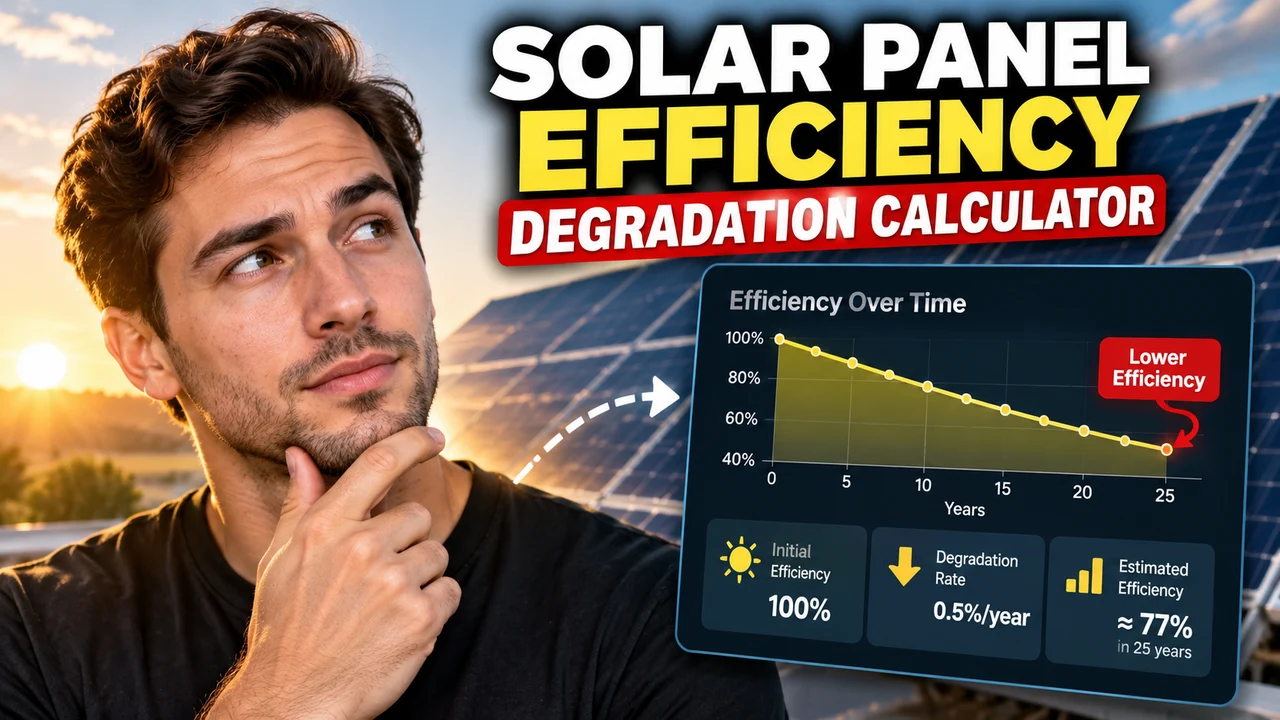
Solar Panel Efficiency Degradation Calculator
TL;DR Summary
The Solar Panel Efficiency Degradation Calculator estimates how a solar panel's efficiency may change over time using its starting efficiency, annual degradation rate, and years in service. It is an estimate based on a compounded degradation model, and privacy behavior beyond the information shown on the page is not assumed.
About This Tool
The Solar Panel Efficiency Degradation Calculator helps estimate the expected efficiency of a photovoltaic (PV) panel after it has operated for a selected number of years. Solar panels gradually lose performance as they age. The amount of degradation varies by panel technology, materials, operating conditions, climate, installation, and other factors.
This calculator gives you a simple way to model that change. You enter the panel's initial efficiency, the expected annual degradation rate, and the number of years in service. The calculator then estimates the remaining efficiency and shows how much efficiency has been lost.
The tool is useful for homeowners, solar shoppers, installers, energy researchers, students, property owners, and anyone reviewing the expected long-term performance of a photovoltaic system. It can also be useful when comparing different assumed degradation rates during early-stage planning.
What You Need to Enter
- Initial Panel Efficiency: Enter the panel's efficiency when new. For example, a panel rated at 20% converts about 20% of incoming solar energy into electricity under its rated test conditions.
- Annual Degradation Rate: Enter the expected percentage reduction in performance per year. You can use the rate stated in the panel's documentation when available. The calculator starts with 0.5% as a reference value.
- Years in Service: Enter the number of years that the panel has operated or is expected to operate.
The annual degradation rate is not a universal value for every solar panel. The U.S. Department of Energy notes that PV module efficiency degrades at about 0.5% per year, while National Renewable Energy Laboratory research has reported a 0.5% per-year median across a large body of degradation measurements. Individual products and systems can differ.
What the Calculator Produces
The main result is the estimated panel efficiency after the selected number of years. The calculator also reports the absolute efficiency loss in percentage points, the percentage of original performance retained, and the relative performance loss.
For example, if a panel starts at 20% efficiency and loses 0.5% of its remaining performance each year, the estimated efficiency after 25 years is about 17.64%. That represents an absolute efficiency reduction of about 2.36 percentage points. The model estimates that about 88.22% of the original performance remains.
These are different ways of describing the same modeled change. A percentage-point reduction compares the starting and ending efficiency directly. Relative performance loss describes the reduction compared with the original performance.
How to Use
- Step 1: Enter the panel's initial efficiency as a percentage, using the manufacturer's published rating when available.
- Step 2: Enter the expected annual degradation rate. Use the panel manufacturer's documented rate when you have it; otherwise, 0.5% can be used as a general reference assumption.
- Step 3: Enter the number of years in service or the future period you want to model.
- Step 4: Review the estimated efficiency, efficiency loss, retained performance, and relative performance loss.
- Step 5: Compare the result with the manufacturer's specifications or measured system performance when making a real-world investment or maintenance decision.
Technical Explanation and Formula
The calculator uses a standard compounded annual degradation model. It assumes that each year's degradation is applied to the performance remaining after the previous year.
Formula:
Estimated Efficiency = Initial Efficiency × (1 − Annual Degradation Rate)Years
When the annual degradation rate is entered as a percentage, the calculation first converts it to a decimal.
Variables:
- Initial Efficiency: The panel's starting efficiency, expressed as a percentage.
- Annual Degradation Rate: The annual relative reduction in performance, expressed as a percentage.
- Years: The number of years in service or the period being modeled.
- Estimated Efficiency: The modeled efficiency remaining after the selected period, expressed as a percentage.
For example, with a 20% starting efficiency, a 0.5% annual degradation rate, and 25 years of service:
Estimated Efficiency = 20 × (1 − 0.005)25
Estimated Efficiency ≈ 17.64%
The model therefore estimates an absolute efficiency loss of about 2.36 percentage points. The remaining performance is about 88.22% of the starting performance.
Why Compounding Matters
A compounded model is different from simply subtracting the annual degradation rate from the original efficiency every year. With compounding, the degradation applies to the performance that remains. This means the calculated loss is slightly different from a simple straight-line model over longer periods.
The calculator is designed around this compounded approach because it provides a straightforward way to represent annual relative degradation. If a particular manufacturer's warranty or engineering model specifies a different degradation pattern, that documented method should be used instead.
Preset Examples and Quick Reference
| Initial Efficiency | Annual Degradation | Years | Estimated Efficiency |
|---|---|---|---|
| 20% | 0.5% | 10 | About 19.02% |
| 20% | 0.5% | 25 | About 17.64% |
| 20% | 0.5% | 30 | About 17.21% |
| 20% | 1.0% | 10 | About 18.09% |
These examples are mathematical illustrations of the calculator formula, not predictions for a particular solar panel. A real panel's published degradation warranty or measured performance may produce a different result.
Why Use This Solar Panel Efficiency Degradation Calculator & How Our Calculator Beats the Competition
| Method | Ease of Use | Calculation Method | Best For | Limitations |
|---|---|---|---|---|
| Toolhox Calculator | Enter three values | Compounded annual degradation model | Quick efficiency estimates and scenario checks | Does not model every panel, climate, or system-specific factor |
| Manual Calculation | Requires formula work | Depends on the formula selected | Learning or checking calculations | More opportunity for input or arithmetic errors |
| Spreadsheet | Requires setup | Can use custom formulas | Multiple scenarios or detailed project models | Requires maintaining formulas and inputs |
| Professional Engineering Software | Usually more involved | Can model many system variables | Detailed project analysis | More inputs and greater modeling complexity may be required |
The practical advantage of a dedicated calculator is that the main inputs and the calculation relationship are presented together. It can help users understand the effect of changing the annual degradation assumption without building a spreadsheet from scratch. It is not intended to replace detailed photovoltaic system modeling or manufacturer-specific engineering analysis.
Assumptions and Limitations
The calculation assumes a constant annual relative degradation rate throughout the selected period. Real solar modules may not degrade at a perfectly constant rate. Early-life effects, environmental exposure, thermal conditions, moisture, ultraviolet exposure, mechanical stress, soiling, electrical components, and other system factors can affect observed performance.
The calculator also focuses on efficiency degradation. It does not independently calculate solar irradiance, weather, shading, panel orientation, tilt, temperature effects, inverter losses, wiring losses, downtime, soiling, or actual annual electricity production.
A panel's efficiency rating is normally measured under defined test conditions. Actual field performance can differ from the rated value. A reduction in measured system output does not necessarily mean that the panel itself has degraded by the same percentage because other parts of the system can affect production.
For a real installation, use the manufacturer's published degradation specification when available. For financial projections, system design, warranty decisions, or engineering work, the calculator should be treated as an estimate rather than a substitute for project-specific analysis.
The calculator also does not determine whether a particular panel meets a warranty threshold. Warranty terms vary by manufacturer and product, so those documents should be reviewed directly for contractual limits and measurement conditions.