Hvac Furnace Lifecycle Cost Comparison Tool Online
Compare upfront, fuel, maintenance, and lifecycle costs with the Hvac Furnace Lifecycle Cost Comparison Tool. Estimate long-term costs for two furnace options.
Please complete this field to continue.
Please complete this field to continue.
Please complete this field to continue.
Please complete this field to continue.
Please complete this field to continue.
Please complete this field to continue.
Please complete this field to continue.
Please complete this field to continue.
Please complete this field to continue.
Please complete this field to continue.
Please complete this field to continue.
Please complete this field to continue.
Results
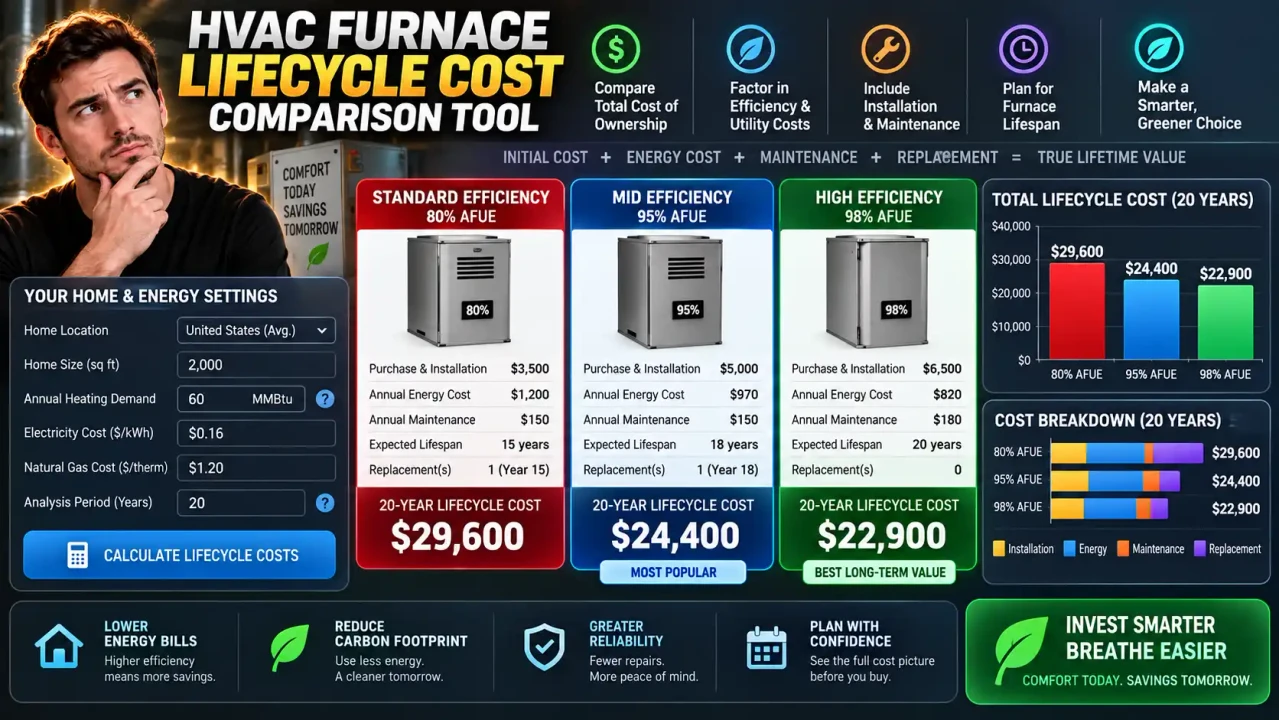
Hvac Furnace Lifecycle Cost Comparison Tool
TL;DR Summary
The Hvac Furnace Lifecycle Cost Comparison Tool compares two furnace options using initial cost, AFUE, fuel price, maintenance cost, service life, discount rate, and cost escalation to estimate life-cycle cost. Use the result for planning and comparison rather than as a substitute for a detailed HVAC design, contractor quote, or professional engineering review; privacy behavior for the calculator is not specified, so avoid entering sensitive information unless the page clearly explains how submitted data is handled.
About This Tool
The Hvac Furnace Lifecycle Cost Comparison Tool helps you look beyond the purchase price of a furnace. A furnace can cost more to buy but less to operate, or it can cost less up front but require more energy over its useful life. Comparing only the installation price can therefore miss an important part of the ownership cost.
This tool is designed to compare two furnace options using a common set of cost and efficiency assumptions. It is useful when you are reviewing replacement choices, comparing equipment proposals, checking the effect of higher AFUE, or building an early-stage heating budget. Homeowners, property managers, contractors, facility teams, and other people evaluating furnace options can use the results as a starting point for a longer-term cost discussion.
The main inputs are the annual useful heating load, current fuel price, discount rate, and annual energy and maintenance cost escalation rate. You then enter the initial cost, AFUE, annual maintenance cost, and service life for Furnace A and Furnace B. Costs are entered in U.S. dollars, fuel price is entered in dollars per therm, heating demand is entered in MMBtu per year, AFUE is entered as a percentage, and service life is entered in years.
AFUE is an important furnace efficiency measure. The U.S. Department of Energy describes AFUE as the ratio of useful energy delivered to the heated space to the energy input to the furnace. A higher AFUE generally means that less fuel input is required to deliver the same useful heating output, all else being equal. AFUE does not by itself capture every cost associated with a complete heating system, such as duct losses, building heat loss, electricity used by auxiliary equipment, or installation-specific issues.
What the Tool Calculates
The calculator estimates the annual fuel requirement for each furnace from the useful heating load and AFUE. It then estimates the first-year fuel cost from the entered fuel price. Annual fuel and maintenance costs can increase according to the escalation rate supplied by the user. Future operating costs are discounted to present value using the entered discount rate. The initial purchase and installation cost is then added to the discounted operating costs.
The main results are the estimated life-cycle cost for Furnace A, the estimated life-cycle cost for Furnace B, the dollar difference between the two estimates, and the option with the lower estimated life-cycle cost under the entered assumptions. The calculator also reports estimated annual fuel use for each furnace in therms.
How to Use
- Step 1: Enter the building's annual useful heating load in MMBtu per year. Use a value that represents the useful heat the building needs rather than the furnace's input rating.
- Step 2: Enter the current fuel price in dollars per therm, then enter the discount rate and expected annual escalation rate for energy and maintenance costs.
- Step 3: Enter Furnace A's initial cost, AFUE, annual maintenance cost, and expected service life.
- Step 4: Enter the same four categories of information for Furnace B so the two options can be compared.
- Step 5: Review the estimated life-cycle cost, annual fuel use, and cost difference shown in the results.
- Step 6: Test the comparison with reasonable alternative fuel prices, escalation rates, and service-life assumptions before making a purchasing decision.
Technical Explanation and Formula
The calculator uses a simplified present-value life-cycle cost approach. The method follows the basic structure used in life-cycle cost analysis: initial cost plus the present value of recurring operating costs. NIST Handbook 135 describes present-value calculations for one-time costs and annually recurring costs, including recurring costs that change over time. :contentReference[oaicite:2]{index=2}
Step 1: Estimate annual fuel use.
Annual Fuel Use = Annual Useful Heating Load ÷ AFUE × 10
Heating load is measured in MMBtu/year. AFUE is entered as a decimal, such as 0.95 for 95%. The factor of 10 converts MMBtu to therms because one therm is 100,000 Btu and one MMBtu is 1,000,000 Btu.
Step 2: Estimate first-year fuel cost.
Annual Fuel Cost = Annual Fuel Use × Fuel Price
Annual fuel use is in therms/year and fuel price is in dollars/therm, producing dollars per year.
Step 3: Escalate recurring costs.
For year t, the simplified model applies:
Cost in Year t = Year 1 Cost × (1 + Escalation Rate)t−1
This approach treats fuel and maintenance costs as recurring costs that change at the same user-supplied escalation rate. It is intentionally simpler than a full federal LCC analysis, which can use fuel-specific and region-specific energy escalation factors.
Step 4: Discount future costs.
Present Value of Year t Cost = Cost in Year t ÷ (1 + Discount Rate)t
The calculator sums the discounted annual fuel and maintenance costs over the entered service life.
Step 5: Calculate life-cycle cost.
Life-Cycle Cost = Initial Cost + Present Value of Operating Costs
The result is an estimate in current U.S. dollars. Intermediate calculations are not rounded to whole dollars. Displayed monetary results are rounded to two decimal places, while annual fuel use is displayed to one decimal place.
Worked Example
Consider a hypothetical comparison with an annual useful heating load of 60 MMBtu, a fuel price of $1.20 per therm, a 3% discount rate, and a 2% annual escalation rate. Suppose Furnace A costs $6,000, has 80% AFUE, requires $250 per year in maintenance, and has a 15-year life. Suppose Furnace B costs $7,500, has 95% AFUE, requires $250 per year in maintenance, and has the same 15-year life.
Furnace A's estimated annual fuel use would be:
60 ÷ 0.80 × 10 = 750 therms/year
Its first-year fuel cost would therefore be:
750 × $1.20 = $900/year
Furnace B's estimated annual fuel use would be:
60 ÷ 0.95 × 10 ≈ 631.6 therms/year
Its first-year fuel cost would be approximately:
631.6 × $1.20 ≈ $757.89/year
The calculator then escalates the annual fuel and maintenance costs and discounts each future year's cost back to present value. The example is only an illustration of the calculation method. It does not represent a typical home, furnace, fuel price, or purchasing recommendation.
What the Result Means
A lower estimated life-cycle cost means that the entered combination of initial cost, fuel use, maintenance, service life, discount rate, and escalation assumptions produces a lower calculated total for that option. It does not automatically mean that the furnace is the right choice for a particular building.
For example, a higher-efficiency furnace may reduce modeled fuel use but have a higher installation price. The life-cycle comparison helps show how those two effects interact. A change in fuel price can also change the result. If fuel becomes more expensive, the operating-cost difference between efficiency levels may become more important. If the expected ownership period is shorter, the higher initial cost may be recovered differently.
The tool is most useful when both options are evaluated with the same heating-load assumption and the same economic assumptions. Changing the heating load, fuel price, discount rate, or escalation rate between the two options would make the comparison inconsistent.
Why Use This Hvac Furnace Lifecycle Cost Comparison Tool & How Our Calculator Beats the Competition
The practical benefit of this calculator is that it puts purchase cost and future operating cost into one comparison. Different methods are useful for different levels of analysis.
| Method | Ease of Use | Calculation Approach | Best For | Limitations |
|---|---|---|---|---|
| Toolhox Calculator | Enter defined inputs and compare two options | Initial cost plus discounted fuel and maintenance costs | Early-stage furnace cost comparison | Uses user-supplied assumptions and a simplified LCC model |
| Manual Calculation | Requires more calculation work | Depends on the formulas and assumptions selected by the user | Custom calculations and learning | More opportunity for arithmetic or formula errors |
| Spreadsheet | Flexible after setup | Can model detailed annual cash flows | Scenario analysis and custom models | Requires spreadsheet setup and formula maintenance |
| Professional Engineering or LCC Software | Usually requires more inputs and expertise | Can support detailed building, equipment, and economic models | Detailed project evaluation | More complex than a simple two-option comparison |
The Toolhox calculator should therefore be viewed as a planning and comparison tool, not as a replacement for detailed engineering or a full NIST BLCC analysis. NIST describes BLCC as software for evaluating the relative cost effectiveness of alternative building systems and components, while DOE describes life-cycle cost as a way to account for total ownership costs rather than only the initial purchase price. :contentReference[oaicite:3]{index=3}
Assumptions and Limitations
- The annual useful heating load is supplied by the user. The calculator does not perform a building heat-load analysis.
- AFUE is used to estimate the fuel required to deliver the entered useful heating load.
- The model assumes that the entered annual heating load remains constant over the selected furnace life.
- Fuel and maintenance costs are assumed to escalate at the same user-entered rate.
- The calculator discounts future operating costs using one user-entered discount rate.
- The model does not automatically retrieve local fuel prices, climate data, utility tariffs, furnace quotes, rebates, tax incentives, or manufacturer data.
- The model does not include blower electricity, duct losses, comfort differences, repair events, replacement parts, financing costs, taxes, disposal costs, salvage value, or changes in heating load unless those effects are reflected in the user's inputs.
- Furnace A and Furnace B may have different service lives. The displayed comparison is based on each option's entered life rather than a common replacement-cycle analysis.
- The calculation does not determine whether a particular furnace is correctly sized for a building.
- Federal, state, and local efficiency requirements or incentive programs can change. Users should verify applicable requirements and incentives before purchasing equipment.
For a real replacement project, the result should be considered one part of the decision. A contractor or qualified HVAC professional may need to review building heat loss, furnace sizing, ductwork, combustion and venting requirements, installation conditions, local code requirements, equipment availability, and the actual equipment proposal.