Hvac Refrigerant Charge Calculator By Weight Now
Use Hvac Refrigerant Charge Calculator By Weight to estimate how much refrigerant to add from the target charge and current charge, with weight-based results.
Please complete this field to continue.
Please complete this field to continue.
Results
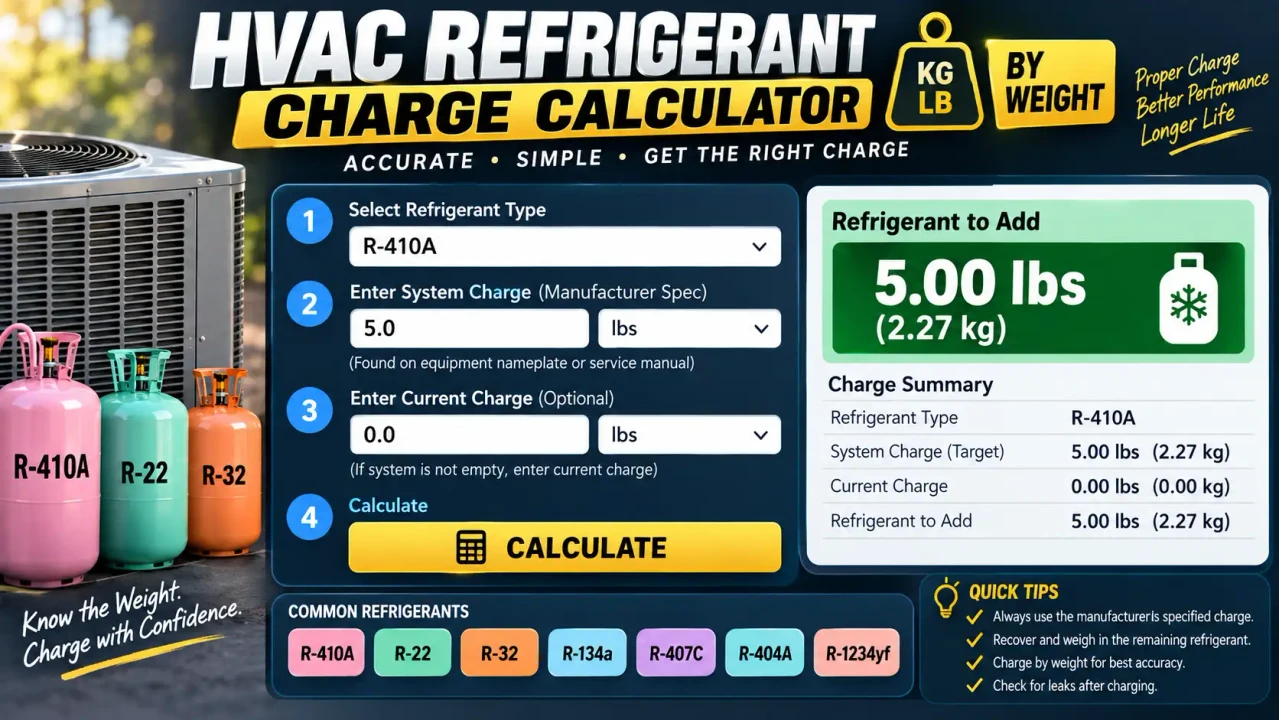
Hvac Refrigerant Charge Calculator By Weight
TL;DR Summary
Hvac Refrigerant Charge Calculator By Weight estimates how much refrigerant would need to be added to reach a specified target charge from a measured current charge. It is a weight-based estimate, not a substitute for the equipment manufacturer's charging instructions, and the supplied tool information does not establish a specific privacy or data-storage policy.
What This Tool Does
The Hvac Refrigerant Charge Calculator By Weight is designed for a simple HVAC service calculation: compare a target refrigerant charge with the amount currently in a system and determine the difference by weight. This can help organize a charging calculation when the correct system charge is already known from reliable equipment information.
The basic idea is straightforward. A technician or other user enters the target charge and the current charge. The calculator subtracts the current charge from the target charge. If the result is positive, that difference represents the estimated amount of refrigerant needed to reach the target. If the current charge is already equal to or greater than the target, the calculator does not recommend adding more refrigerant based on those two numbers.
The tool is intended for weight-based charge calculations. The supplied calculator specification uses pounds (lb) for both inputs and outputs. Both values should use the same unit. Do not enter a target in pounds and a current charge in kilograms.
Who Can Use It?
This type of calculation may be useful to HVAC technicians, refrigeration service personnel, maintenance staff, equipment owners working with qualified service personnel, students learning HVAC service concepts, and anyone who needs to check the arithmetic behind a refrigerant charge-by-weight calculation.
Professional HVAC work involves more than subtracting two weights. The correct refrigerant, equipment specifications, system condition, charging procedure, recovery requirements, and operating measurements can all matter. The calculator therefore works best as a calculation aid after the correct target charge has been established.
What You Need to Enter
The calculator uses two inputs:
- Target Refrigerant Charge: The required refrigerant charge in pounds. This should come from the equipment manufacturer's specifications or another verified source appropriate to the system.
- Current Refrigerant Charge: The measured amount of refrigerant currently in the system, also in pounds.
The target charge is not automatically selected from a refrigerant database. The calculator does not identify the correct charge for a particular air conditioner, heat pump, refrigerator, refrigerant type, model number, or line-set configuration. Those details must be established separately.
How to Use
- Step 1: Find the verified target refrigerant charge for the equipment. Use the manufacturer's nameplate, installation information, service documentation, or another appropriate source.
- Step 2: Measure or otherwise establish the current refrigerant charge in pounds using an appropriate method and equipment.
- Step 3: Enter the target charge in the Target Refrigerant Charge field.
- Step 4: Enter the measured current charge in the Current Refrigerant Charge field.
- Step 5: Review the Amount to Add result. A positive result is the weight difference between the target and current charges.
- Step 6: Check the Charge Difference and Excess Charge results before taking any service action. If the current charge is above the target, the calculator does not indicate that more refrigerant should be added.
- Step 7: Follow the equipment manufacturer's charging procedure and applicable refrigerant-handling requirements before adding, removing, or recovering refrigerant.
Technical Explanation and Formula
The standard weight-based calculation is:
Amount to Add = Target Charge − Current Charge
For the calculator's displayed “Amount to Add” result, a negative difference is treated as zero because a negative amount would mean the system is already above the entered target rather than indicating that refrigerant should be added.
The variables are:
- Target Charge: Required refrigerant charge, measured in pounds (lb).
- Current Charge: Existing refrigerant charge, measured in pounds (lb).
- Amount to Add: Positive refrigerant weight difference needed to reach the target, measured in pounds (lb).
- Charge Difference: Target Charge minus Current Charge, measured in pounds (lb).
For example, if a verified target charge is 8.50 lb and the measured current charge is 6.00 lb:
Amount to Add = 8.50 lb − 6.00 lb = 2.50 lb
The calculator therefore reports 2.50 lb as the amount to add. This example demonstrates only the arithmetic. It does not establish that 8.50 lb is the correct charge for any particular HVAC system.
Why the Target Charge Matters
A charge-by-weight calculation is only as useful as the target charge entered into it. The target should not be guessed from system size alone. Equipment documentation may specify a factory charge, and additional refrigerant requirements can depend on the equipment design and installation details.
The U.S. Environmental Protection Agency explains that full charge information can be established using methods that include manufacturer information, appropriate calculations, actual measurements, or an established range in applicable circumstances. EPA also regulates refrigerant handling under Section 608 of the Clean Air Act. :contentReference[oaicite:0]{index=0}
The U.S. Department of Energy's air-conditioning guidance likewise recommends determining the factory charge from the manufacturer's specifications, such as information on the equipment nameplate or manufacturer documentation. :contentReference[oaicite:1]{index=1}
Quick Reference Example
| Target Charge | Current Charge | Charge Difference | Amount to Add |
|---|---|---|---|
| 8.50 lb | 6.00 lb | 2.50 lb | 2.50 lb |
| 10.00 lb | 10.00 lb | 0.00 lb | 0.00 lb |
| 8.00 lb | 9.00 lb | -1.00 lb | 0.00 lb |
In the last example, the current charge is 1.00 lb above the target entered by the user. The calculator does not turn that result into a recommendation to recover a specific amount. Any refrigerant removal or adjustment should follow the equipment manufacturer's procedure and applicable service requirements.
Weight Units
This implementation uses pounds (lb) as the calculation unit. Both inputs must use pounds. If your source information is in kilograms, convert the value to pounds before entering it or use a separate verified unit conversion method.
The conversion between kilograms and pounds is approximately:
pounds = kilograms × 2.20462
kilograms = pounds ÷ 2.20462
Do not mix units within one calculation. A unit mismatch can produce a result that looks reasonable while being materially wrong.
Important Refrigerant-Service Context
This calculator does not select a refrigerant or determine whether a refrigerant is compatible with an HVAC system. It also does not determine whether a system has a leak, whether a system has been properly evacuated, or whether the final operating conditions are correct.
EPA Section 608 rules apply to stationary refrigeration and air-conditioning equipment. EPA states that the rules address refrigerant handling and prohibit intentional venting of covered refrigerants during service, maintenance, repair, or disposal. EPA also states that certification requirements apply to technicians who service covered appliances in circumstances where they could reasonably be expected to release refrigerant. :contentReference[oaicite:2]{index=2}
These regulatory requirements are separate from the arithmetic performed by this calculator. A numerical result does not by itself authorize a service procedure.
Assumptions and Limitations
- The target charge entered by the user is assumed to be the correct target for the specific equipment and installation.
- The current charge is assumed to have been measured or established using an appropriate method.
- Both inputs are expressed in pounds.
- The calculation does not identify the correct refrigerant.
- The calculation does not determine factory charge information from a model number.
- The calculation does not account for refrigerant type, pressure-temperature relationships, superheat, subcooling, ambient conditions, airflow, compressor condition, or other diagnostic measurements.
- The calculation does not diagnose or locate refrigerant leaks.
- The calculation does not determine the legally required service or recovery procedure.
- The result is a mathematical estimate based on the values entered and should not be treated as a complete HVAC charging procedure.
A professional HVAC technician should review the system and manufacturer requirements when the charge is uncertain, the system has been opened or repaired, a leak is suspected, operating measurements do not match expected conditions, or the calculated amount conflicts with equipment documentation.
Why Use This Hvac Refrigerant Charge Calculator By Weight & How Our Calculator Beats the Competition
The practical value of this tool is that it focuses on one specific calculation: the weight difference between a verified target charge and a measured current charge. Different methods still have different roles, so the table below compares the calculator with common ways of handling the same arithmetic.
| Method | Ease of Use | Calculation Speed | Best For | Limitations |
|---|---|---|---|---|
| Toolhox Calculator | Enter two weights | Immediate arithmetic result | Checking the target-to-current charge difference | Does not determine the correct system charge or replace service procedures |
| Manual Calculation | Simple subtraction | Depends on the user | Quick checks without a calculator | Requires the user to perform and check the arithmetic |
| Spreadsheet | Requires setup | Fast after setup | Repeated calculations or service records | Requires a spreadsheet structure and correct formulas |
| Professional Engineering or Service Software | Varies by software | Varies by workflow | Broader system analysis and engineering work | May involve more inputs and functions than this simple weight calculation |
The calculator is therefore best viewed as a focused arithmetic aid. It does not claim to replace manufacturer documentation, professional HVAC diagnostics, or applicable refrigerant-handling requirements.
When Not to Rely on the Result Alone
Do not rely on the calculator alone when the target charge is unknown, the equipment documentation is unavailable, the system has a suspected leak, the refrigerant type is uncertain, the system requires a specialized charging method, or operating conditions suggest that the system is not functioning normally.
For covered stationary equipment, follow applicable EPA Section 608 requirements and the equipment manufacturer's instructions. EPA's current Section 608 guidance continues to address certification, service practices, refrigerant recovery, reclamation, sales restrictions, and related requirements. :contentReference[oaicite:3]{index=3}