Mg To Gram Converter For Liquid Medication
Convert milligrams to grams for liquid medication measurements. Enter an mg amount and get the equivalent value in grams.
Please complete this field to continue.
Results
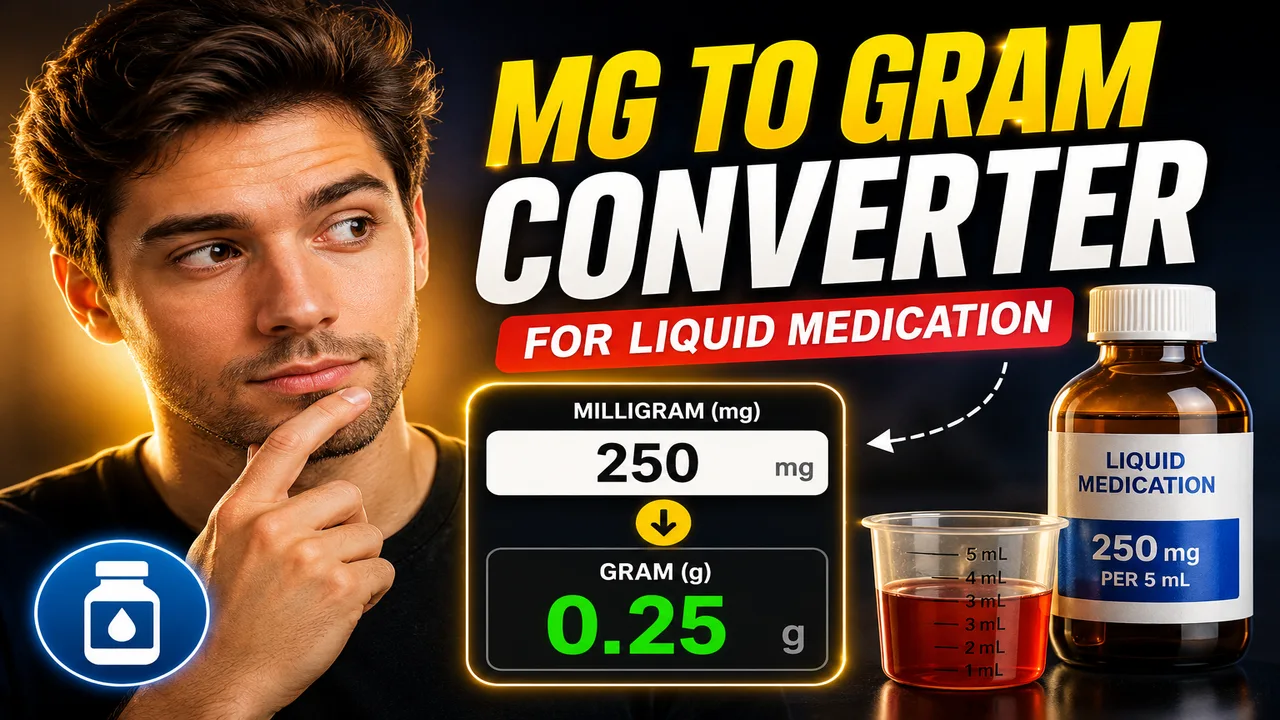
Mg To Gram Converter For Liquid Medication
TL;DR Summary
The Mg To Gram Converter For Liquid Medication converts an amount in milligrams (mg) into grams (g) using the standard metric conversion of 1,000 milligrams per gram. It is a simple unit conversion and does not determine a medication dose, concentration, or volume; privacy behavior for entered information is not specified by the supplied tool documentation.
About This Tool
The Mg To Gram Converter For Liquid Medication is a simple metric unit converter for changing a medication amount expressed in milligrams into grams. Milligrams and grams are both units of mass, and the conversion between them is fixed: one gram contains 1,000 milligrams.
This type of conversion can be useful when medication information is presented in different units. A medicine label, prescription record, dosing reference, or calculation may use milligrams, while another reference may use grams. Instead of doing the division manually, you can enter the milligram amount and use the converted gram value as a quick reference.
The calculator requires one input: the amount in milligrams. Enter a non-negative number such as 100, 250, 500, or 1,000. The tool then divides that number by 1,000 and displays the result in grams. The result is a mass conversion only. The tool does not, based on the supplied specification, calculate a liquid volume such as milliliters, determine medication concentration, identify a drug, or recommend a dose.
This distinction is important for liquid medication. Liquid medicines are often labeled with a concentration such as a certain number of milligrams per milliliter. Converting milligrams to grams does not tell you how many milliliters of liquid are needed. To determine a volume from a medication concentration, you would need the medication's labeled concentration and a separate dose-to-volume calculation. Those details are not inputs to this converter.
Who Can Use It?
The tool can be useful for anyone who needs a straightforward mg-to-g unit conversion while reviewing medication information. It may also help students, caregivers, health-information readers, and people working with measurement references. However, the calculator should not be used to decide how much medicine to take or give to another person.
For medication use, always distinguish between the amount of active ingredient and the volume of liquid. For example, a label might express an amount as milligrams while also giving a concentration per milliliter. The gram result from this tool only changes the mass unit. It does not replace the medication label or prescribing instructions.
Inputs and Outputs
| Item | Details |
|---|---|
| Input | Amount in milligrams (mg) |
| Input type | Non-negative number |
| Output | Equivalent amount in grams (g) |
| Conversion factor | 1,000 mg = 1 g |
How to Use
- Step 1: Read the medication amount or other mass value that you want to convert and make sure it is expressed in milligrams (mg).
- Step 2: Enter the milligram amount into the Amount in Milligrams (mg) field.
- Step 3: Review the displayed gram value. The converter divides the entered milligram amount by 1,000.
- Step 4: Compare the result with the original medication information before using it for any further calculation.
Technical Explanation and Formula
The standard metric conversion used by this tool is:
grams = milligrams ÷ 1,000
The variables are:
- Milligrams (mg): the amount entered by the user.
- Grams (g): the converted mass.
- 1,000: the number of milligrams in one gram.
For example, if the input is 250 mg:
250 mg ÷ 1,000 = 0.25 g
Another example is 1,500 mg:
1,500 mg ÷ 1,000 = 1.5 g
The calculation does not require a medication-specific conversion factor because milligrams and grams are standard metric mass units. The calculator does not need the medicine name or liquid volume to perform this particular conversion.
Precision and Display
The calculation itself is a direct division by 1,000. The displayed result is formatted to six decimal places by the calculator logic. Trailing zeros may therefore appear in the displayed value. For example, 250 mg corresponds to 0.250000 g in the displayed format, while the underlying mathematical value is 0.25 g.
Do not confuse display precision with medication precision. A larger number of decimal places does not mean that a medication should be measured or administered to that level of precision. The appropriate measurement precision depends on the medicine, its packaging, the measuring device, and the instructions provided by a qualified healthcare professional.
Preset Examples and Quick Reference
| Milligrams | Equivalent Grams |
|---|---|
| 100 mg | 0.1 g |
| 250 mg | 0.25 g |
| 500 mg | 0.5 g |
| 750 mg | 0.75 g |
| 1,000 mg | 1 g |
| 2,000 mg | 2 g |
Understanding Liquid Medication Measurements
Liquid medication can involve more than one measurement. A medicine may have a mass of active ingredient expressed in milligrams and a liquid volume expressed in milliliters. A concentration connects those measurements. For example, a product label may state a concentration in mg per mL. That concentration is separate from the basic mg-to-g conversion performed here.
If you already know a mass in milligrams and only need the equivalent mass in grams, this converter is appropriate for that narrow task. If you are trying to work out how many milliliters to measure, this converter alone does not provide enough information. You would need the concentration printed on the product label and the intended dose. Follow the product label and professional medical instructions for medication dosing.
Why Use This Mg To Gram Converter For Liquid Medication & How Our Converter Beats the Competition
The practical value of this converter is that it focuses on one clearly defined unit conversion. Different methods can be useful in different situations, depending on whether you need a quick conversion, a repeatable calculation, or a larger medication-management workflow.
| Method | Ease of Use | Calculation Speed | Best For | Limitations |
|---|---|---|---|---|
| Toolhox Converter | Enter one mg value | Immediate calculation | Simple mg-to-g conversion | Does not calculate dose, concentration, or liquid volume |
| Manual Calculation | Requires division | Depends on the user | Occasional conversions | Manual entry and calculation are required |
| Spreadsheet | Requires setup | Useful for repeated calculations | Multiple conversion records | More setup than a single conversion needs |
| Professional Medication Software | Depends on the system | Depends on the system | Broader clinical workflows | May include functions beyond a simple unit conversion |
Assumptions and Limitations
This calculator assumes that the entered value is a mass expressed in milligrams and that the desired output is the equivalent mass in grams. The conversion is based on the standard relationship that 1 gram equals 1,000 milligrams.
The tool does not identify medications or verify medication labels. It does not determine whether an amount is an appropriate dose. It does not convert a milligram amount into milliliters, teaspoons, drops, or another liquid measurement. It also does not account for a medicine's concentration, patient age, weight, medical condition, prescribed dose, or dosing schedule.
For medication decisions, do not rely on the converted number alone. Check the exact product label and prescription instructions. If the numbers on the label or prescription are unclear, contact a pharmacist, prescriber, or other appropriate healthcare professional before measuring or administering the medicine.
The privacy behavior of this specific calculator was not established by the supplied tool documentation. Avoid entering sensitive personal or medical information unless the page clearly explains how that information is handled.