Grams To Ml Olive Oil Converter
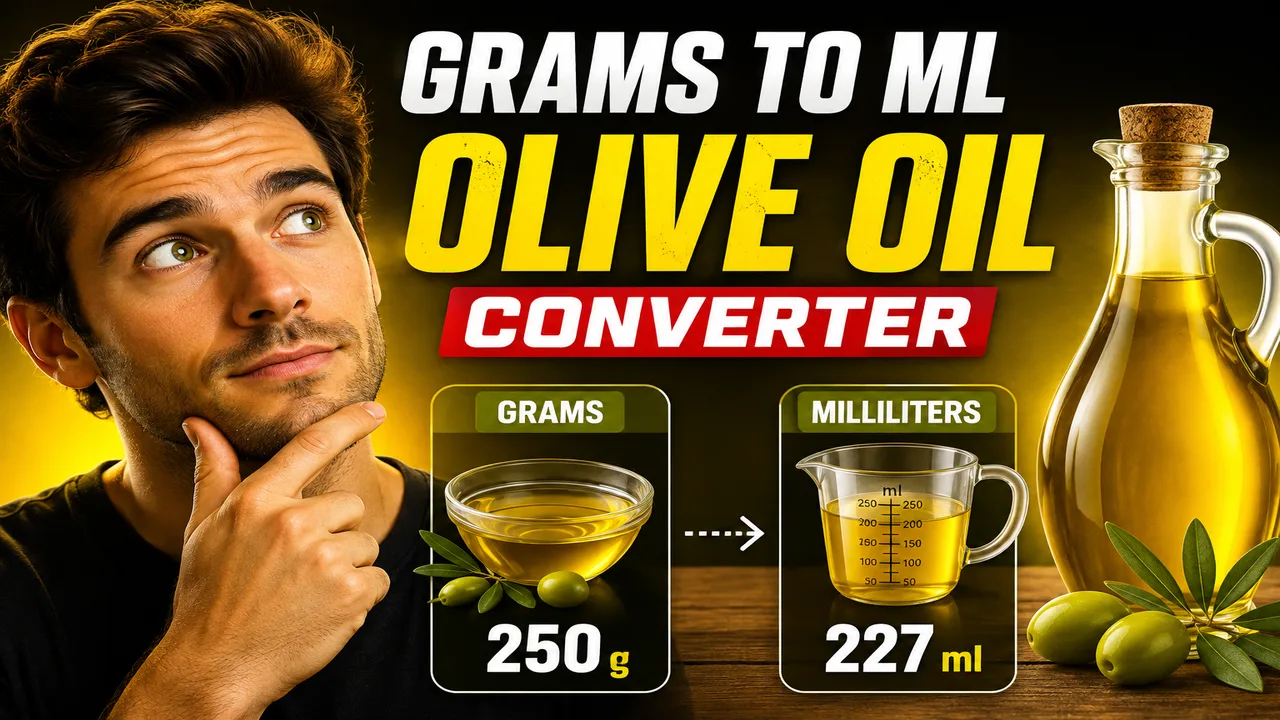
Convert olive oil from grams to milliliters using a 0.91 g/mL density reference. Get quick volume estimates for recipes and cooking.
Please complete this field to continue.
Results
Grams To Ml Olive Oil Converter
TL;DR Summary
The Grams To Ml Olive Oil Converter converts a weight of olive oil in grams into an estimated volume in milliliters using a reference density of 0.91 g/mL. It is intended for practical cooking and recipe conversions, and the result can vary slightly with olive oil type, temperature, and measurement conditions. The page does not provide a specific privacy guarantee, so avoid entering sensitive information unless the site's privacy policy explains how submitted data is handled.
About the Grams To Ml Olive Oil Converter
The Grams To Ml Olive Oil Converter helps when a recipe gives olive oil by weight but you need to measure it by volume. This is common when moving between a kitchen scale and measuring cups, spoons, or a graduated container. Because grams measure mass and milliliters measure volume, the two units cannot be converted directly without using the density of the ingredient.
Olive oil is less dense than water, so 100 grams of olive oil occupies more than 100 milliliters. This converter uses a practical reference density of 0.91 grams per milliliter. With that reference, 100 grams of olive oil is about 109.89 milliliters. The conversion is therefore useful for recipe preparation, cooking, food portioning, and other everyday situations where an olive oil weight needs to be expressed as a volume.
The tool is designed for anyone who needs a simple grams-to-milliliters olive oil conversion. Home cooks can use it when adapting recipes. Bakers can use it when a recipe lists oil by weight but their measuring equipment uses milliliters. Food preparation teams can also use the conversion as a quick reference when working with measured quantities.
The required input is straightforward: enter the amount of olive oil in grams. The converter then returns the corresponding estimated volume in milliliters (mL). No additional ingredient selection is required because the tool is specifically designed for olive oil.
How to Use
- Step 1: Enter the weight of your olive oil in the grams field. For example, enter 100 for 100 grams.
- Step 2: Check that the amount represents the olive oil itself and is entered as a non-negative number.
- Step 3: Review the calculated volume shown in milliliters.
- Step 4: Use the milliliter result to measure the olive oil with suitable volume-measuring equipment.
Technical Explanation and Formula
The standard density relationship is:
Density = Mass ÷ Volume
Rearranging the formula for the required volume gives:
Volume = Mass ÷ Density
For this converter:
Milliliters = Grams ÷ 0.91
The variables are:
- Mass: the amount of olive oil entered by the user, measured in grams (g).
- Density: the reference olive oil density, set to 0.91 grams per milliliter (g/mL).
- Volume: the calculated olive oil volume, expressed in milliliters (mL).
For example, if you enter 100 grams:
100 g ÷ 0.91 g/mL = 109.89 mL
The calculator displays the final volume to two decimal places. The underlying conversion uses the full calculated value before this final display rounding.
Why Olive Oil Needs a Density-Based Conversion
A gram and a milliliter describe different physical properties. A gram measures mass, while a milliliter measures volume. Water is often used as a familiar reference because its density is close to 1 g/mL under common reference conditions, but olive oil is lighter by volume. That is why 100 grams of olive oil does not equal 100 milliliters.
Published food and measurement references commonly place olive oil near 0.91 g/mL for practical conversion purposes. The USDA's olive oil inspection guidance also describes determining oil density by weighing a known volume and expressing the result in grams per milliliter. :contentReference[oaicite:3]{index=3}
Preset Examples and Quick Reference
| Olive Oil Weight | Estimated Volume |
|---|---|
| 10 g | 10.99 mL |
| 25 g | 27.47 mL |
| 50 g | 54.95 mL |
| 100 g | 109.89 mL |
| 150 g | 164.84 mL |
| 200 g | 219.78 mL |
| 250 g | 274.73 mL |
| 500 g | 549.45 mL |
These examples are calculated from the same 0.91 g/mL reference density. For instance, 250 grams divided by 0.91 g/mL gives approximately 274.73 mL. Similar reference conversions using 0.91 g/mL produce about 109.89 mL for 100 grams and 274.73 mL for 250 grams. :contentReference[oaicite:4]{index=4}
Grams, Milliliters, and Kitchen Measurements
Recipes can use different measurement systems. A kitchen scale normally measures mass in grams, while liquid measuring tools measure volume in milliliters. The converter bridges those two measurement methods for olive oil.
For cooking, the calculated result is usually sufficient as a practical estimate. If a recipe requires a precise volume, use a suitable graduated measuring container. If a recipe requires a precise mass, a kitchen scale remains the direct way to measure grams.
It is also important to distinguish milliliters from fluid ounces. A milliliter is a metric unit of volume, while a U.S. fluid ounce is a U.S. customary volume unit. This tool specifically returns milliliters and does not automatically convert the result into U.S. fluid ounces.
Why Use This Grams To Ml Olive Oil Converter & How Our Grams To Ml Olive Oil Converter Beats the Competition
The practical advantage of this tool is that it focuses on one specific conversion: olive oil weight to volume. Instead of requiring you to remember the density value or perform the division manually, you enter the grams and receive the corresponding milliliter estimate.
| Method | Ease of Use | Calculation Speed | Best For | Limitations |
|---|---|---|---|---|
| Toolhox Grams To Ml Olive Oil Converter | Simple | Immediate calculation after input | Quick olive oil weight-to-volume conversions | Uses a fixed reference density and provides an estimate |
| Manual Calculation | Requires arithmetic | Depends on the user | Users who already know the density formula | Requires remembering the density and performing the division |
| Spreadsheet | Requires setup | Fast after setup | Repeated calculations or custom worksheets | Requires creating or maintaining the formula |
| Professional Measurement Software | Varies | Depends on the software | Specialized measurement workflows | May include features that are unnecessary for a simple kitchen conversion |
Assumptions and Limitations
The main assumption is that olive oil has a reference density of 0.91 g/mL. Actual density can vary with temperature, composition, and the particular product. The USDA explains that olive oil density can be determined by measuring a known volume and its weight, which highlights why density is a physical property rather than a universal mass-to-volume constant. :contentReference[oaicite:5]{index=5}
For everyday recipes, small differences from the reference density may have little practical impact. For laboratory work, manufacturing, commercial formulation, or any process where an exact physical measurement is required, use the measured or certified density for the specific olive oil rather than relying only on this general-purpose conversion.
The converter does not identify the brand, grade, temperature, or batch of olive oil. It also does not measure the oil directly. It performs a mathematical conversion using the stated reference density. The result should therefore be treated as an estimate rather than a laboratory measurement.
Users should also avoid assuming that the result represents a U.S. tablespoon, cup, or fluid ounce without a separate volume conversion. Those units have their own defined relationships with milliliters. If your recipe specifies a particular household measure, convert the calculated milliliters using the appropriate unit definition.
When to Use a Kitchen Scale Instead
If your recipe specifies grams, weighing the olive oil directly is generally the most direct way to reproduce the stated mass. If you only have a volume measuring tool, this converter provides a practical estimate of the volume corresponding to the specified weight.
For example, a recipe calling for 100 grams of olive oil can be approached in two ways. You can weigh 100 grams directly on a kitchen scale, or you can use this converter to estimate the equivalent volume of about 109.89 mL. The second method is useful when your available measuring equipment is marked in milliliters.
Overall, the Grams To Ml Olive Oil Converter is intended to make a common cooking conversion easier to perform and easier to check. Enter the olive oil weight in grams, review the estimated milliliters, and use the result according to the precision your recipe or application requires.