Protein Grams To Calories Calculator
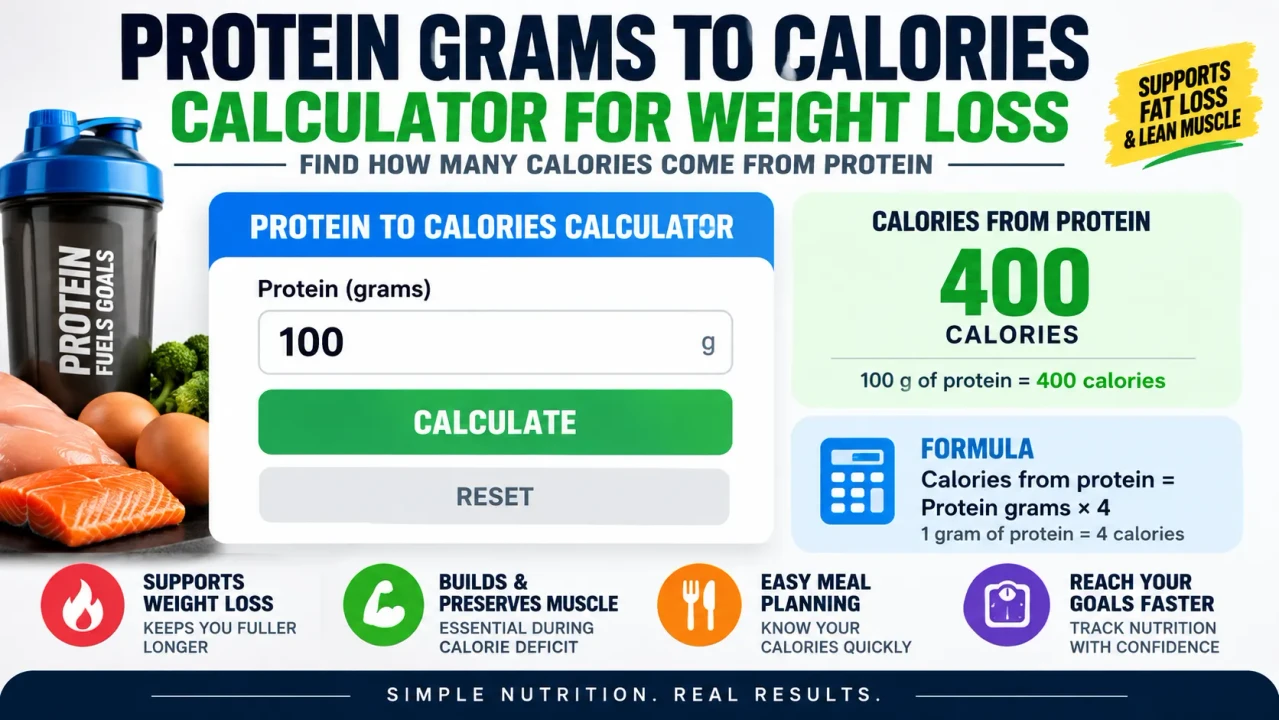
Calculate calories from protein grams using the standard 4 calories per gram protein factor. Useful for nutrition and weight-loss planning.
Please complete this field to continue.
Results
Protein Grams To Calories Calculator For Weight Loss
TL;DR Summary
This Protein Grams To Calories Calculator For Weight Loss converts a stated amount of protein in grams into its estimated calorie contribution using the standard 4-calories-per-gram protein factor. It is a simple nutrition estimate, not a complete weight-loss calorie calculator, and the supplied tool information does not establish how entered data is stored or processed.
What Is the Protein Grams To Calories Calculator For Weight Loss?
The Protein Grams To Calories Calculator For Weight Loss is a simple calculator for people who want to understand how many calories come from a given amount of protein. You enter the amount of protein in grams, and the calculator converts that amount into kilocalories, commonly written as kcal or simply calories in everyday nutrition language.
This can be useful when reviewing a meal, checking a nutrition label, planning a diet, or comparing protein amounts during a weight-loss plan. Protein is one of the three major macronutrients that provide energy. The other two main macronutrients are carbohydrates and fat. For the standard Atwater general factors, protein provides about 4 calories per gram. USDA and FDA nutrition resources use this general factor when explaining the energy contribution of protein. :contentReference[oaicite:3]{index=3}
The calculator focuses only on the relationship between protein grams and calories from protein. It does not determine how much protein you personally need, how many total calories you should eat, how quickly you will lose weight, or whether a specific diet is appropriate for you. Those questions depend on additional factors and require information that this simple conversion does not use.
Who Can Use This Calculator?
This tool may be useful for anyone who wants a quick protein-to-calorie conversion. People tracking macronutrients can use it to estimate the energy contribution of protein in a food or meal. Someone reading a nutrition label can also use it to check the approximate calorie contribution represented by the listed protein amount.
It may also help people who are organizing a weight-loss eating plan. However, the phrase “for weight loss” describes the intended use context rather than a claim that the calculator can determine an individual weight-loss plan. Weight management involves total energy intake, energy use, food choices, activity, health status, and other factors. FDA guidance notes that calorie needs can vary based on factors such as age, sex, height, weight, and physical activity. :contentReference[oaicite:4]{index=4}
What Input Does the Calculator Need?
The calculator requires one input: Protein (grams). Enter the amount of protein you want to convert. The value can represent protein in a serving, meal, or other quantity as long as the number you enter is expressed in grams.
For example, if a nutrition label lists 25 grams of protein per serving, enter 25. If your meal contains an estimated 40 grams of protein, enter 40. The calculator then applies the standard protein energy factor.
The supported input is a non-negative protein amount. The tool configuration allows values from 0 through 1,000 grams. Protein amounts should not be entered as ounces, pounds, milligrams, or calories. Convert the quantity to grams before entering it if your source uses another unit.
What Does the Calculator Output?
The main result is Calories from Protein, shown in kilocalories (kcal). The calculator also displays the protein amount used in the calculation so you can confirm the input.
For ordinary nutrition use, “kilocalories” and “Calories” are often used interchangeably. Nutrition Facts labels in the United States display calories as the energy value of a serving. FDA explains that calories represent energy obtained from carbohydrate, fat, protein, and other calorie-producing components. :contentReference[oaicite:5]{index=5}
How to Use the Protein Grams To Calories Calculator For Weight Loss
- Step 1: Find the amount of protein you want to evaluate, such as the protein listed on a Nutrition Facts label or the protein amount in your meal plan.
- Step 2: Enter that amount in the Protein (grams) field. Make sure the value is expressed in grams.
- Step 3: Run the calculation to see the estimated calories supplied by that amount of protein.
- Step 4: Use the result as part of your broader nutrition review. Do not treat protein calories as the total calories in the food or meal.
Technical Explanation and Formula
The standard calculation is straightforward:
Calories from Protein = Protein Grams × 4 kcal/g
There are two variables in this formula:
| Variable | Meaning | Unit |
|---|---|---|
| Protein Grams | The amount of protein entered by the user. | grams (g) |
| 4 kcal/g | The standard general Atwater energy factor for protein. | kilocalories per gram |
| Calories from Protein | The estimated energy contribution from the entered protein. | kilocalories (kcal) |
USDA FoodData Central explains that most energy values are calculated using the Atwater general factors of 4 calories per gram for protein, 9 for fat, and 4 for carbohydrates. USDA also notes that some foods can use specific Atwater factors instead of the general factors. :contentReference[oaicite:6]{index=6}
For this calculator, the general protein factor is used because the tool's purpose is a direct protein-gram-to-calorie conversion. The calculation does not attempt to identify the specific food, protein source, digestibility, or food-specific energy factor.
Worked Examples
Example 1: 25 grams of protein
25 g × 4 kcal/g = 100 kcal
Example 2: 50 grams of protein
50 g × 4 kcal/g = 200 kcal
Example 3: 100 grams of protein
100 g × 4 kcal/g = 400 kcal
| Protein | Estimated Calories From Protein |
|---|---|
| 10 g | 40 kcal |
| 20 g | 80 kcal |
| 25 g | 100 kcal |
| 30 g | 120 kcal |
| 40 g | 160 kcal |
| 50 g | 200 kcal |
| 75 g | 300 kcal |
| 100 g | 400 kcal |
Protein Calories Are Not Total Food Calories
One important point is that the result represents calories from protein only. It does not represent the total calorie content of a food or meal unless protein is the only calorie-producing nutrient being considered.
For example, a food can contain protein, carbohydrates, and fat at the same time. The protein portion contributes about 4 kcal per gram under the general Atwater factor, while carbohydrates generally contribute 4 kcal per gram and fat generally contributes 9 kcal per gram. USDA and FDA nutrition resources use these general factors when explaining calorie values. :contentReference[oaicite:7]{index=7}
If you want to estimate the total calories in a food from its macronutrients, you would need the grams of protein, carbohydrate, and fat and would need to account for applicable labeling and calculation rules. This tool does not provide that broader calculation.
How This Relates to Weight Loss
Protein can be an important part of a weight-management eating pattern, but converting protein grams to calories is only one small part of understanding a diet. The calculator does not recommend a calorie deficit or establish a personal protein target.
A person may use the result to understand how much of a meal's energy comes from protein. For example, if a meal contains 30 grams of protein, the standard conversion estimates 120 kcal from that protein. The remaining calories, if any, can come from other nutrients or calorie-producing components.
FDA notes that maintaining or achieving a healthy body weight involves balancing calories consumed with calories used by the body, and that individual calorie needs vary. :contentReference[oaicite:8]{index=8}
Why Use This Protein Grams To Calories Calculator For Weight Loss & How Our Calculator Beats the Competition
| Method | Ease of Use | Calculation Speed | Best For | Limitations |
|---|---|---|---|---|
| Toolhox Calculator | Enter protein grams | Immediate calculation | Quick protein-to-calorie conversions | Does not calculate total dietary calories or personal protein needs |
| Manual Calculation | Requires multiplication | Depends on the user | Checking a single conversion | More opportunity for arithmetic or unit-entry mistakes |
| Spreadsheet Calculation | Requires setup | Fast after setup | Repeated calculations and tracking | Requires a spreadsheet and an appropriate formula |
| Professional Nutrition Software | Depends on the software | Depends on the system | Broader dietary analysis | May include features and data beyond a simple protein conversion |
The practical benefit of this calculator is its narrow scope. Instead of building a spreadsheet or doing the multiplication manually, a user can enter protein grams and review the corresponding calorie estimate. That makes it useful when the specific question is simply, “How many calories come from this amount of protein?”
It should not be viewed as a replacement for a full food-tracking system, nutrition database, or individualized dietary assessment. Those tools may use additional food, nutrient, serving-size, and personal information that is outside the scope of this calculator.
Assumptions and Limitations
- The calculator uses the standard general factor of 4 kcal per gram of protein.
- The result is an estimate of protein's calorie contribution, not necessarily the exact energy value of a specific food.
- USDA notes that some foods can have specific Atwater factors, so food-specific energy calculations can differ from a simple general-factor calculation. :contentReference[oaicite:9]{index=9}
- The calculator does not determine an individual's recommended protein intake.
- The calculator does not determine an individual's daily calorie requirement or calorie deficit.
- The calculator does not calculate total calories from protein, carbohydrates, fat, and other calorie-producing components together.
- The calculator does not account for a person's age, sex, height, weight, activity level, medical conditions, medications, or other personal factors.
- The supplied tool specifications do not establish a particular data-storage or server-processing policy. Avoid entering sensitive information unless the page provides separate privacy information.
When Should You Get Professional Guidance?
A simple protein-to-calorie conversion is generally different from individualized nutrition advice. If you have a medical condition, are pregnant or breastfeeding, have a history of an eating disorder, are managing a medically supervised diet, or have been given specific dietary instructions by a healthcare professional, use those instructions rather than relying on a basic calorie conversion alone.
For everyday food tracking, the calculator can serve as a reference for understanding the calorie contribution of a known protein amount. For broader weight-management decisions, consider the complete nutrition information for the food or meal and the factors that affect your individual needs.
Quick Reference
| Protein Amount | Formula | Protein Calories |
|---|---|---|
| 15 g | 15 × 4 | 60 kcal |
| 35 g | 35 × 4 | 140 kcal |
| 60 g | 60 × 4 | 240 kcal |
| 80 g | 80 × 4 | 320 kcal |
In short, the Protein Grams To Calories Calculator For Weight Loss provides a focused conversion: enter protein in grams and multiply it by 4 to estimate the calories contributed by that protein. It is most useful as one small part of a larger nutrition or weight-management review.
Q: How many calories are in 1 gram of protein? A: Using the standard general Atwater factor, 1 gram of protein provides about 4 calories. Q: How do I convert protein grams to calories? A: Multiply the protein amount in grams by 4. For example, 50 grams of protein × 4 equals 200 calories from protein. Q: How many calories are in 25 grams of protein? A: Using the standard 4-calorie-per-gram factor, 25 grams of protein provides about 100 calories. Q: Does this calculator show the total calories in a food? A: No. It estimates calories from protein only. Total food calories can also come from carbohydrates, fat, and other calorie-producing components. Q: Can I use this calculator for weight loss? A: Yes, you can use it to understand the calorie contribution of protein within a weight-loss eating plan. It does not calculate a personal calorie target, calorie deficit, or recommended protein intake. Q: Can the actual calorie value differ from the calculator result? A: Yes. The calculator uses the standard 4 kcal-per-gram protein factor. USDA notes that food-specific Atwater factors can differ from general factors for some foods. Q: What protein unit should I enter? A: Enter protein in grams. If your protein amount is listed in another unit, convert it to grams before using the calculator.