Gram Atomic Mass Calculator With Steps
Calculate gram atomic mass from an element symbol or name. Get standard atomic weight in g/mol with clear step-by-step chemistry results.
Please complete this field to continue.
Results
Gram Atomic Mass Calculator With Steps
TL;DR Summary
The Gram Atomic Mass Calculator With Steps finds the standard atomic weight of a chemical element and expresses that value as gram atomic mass, commonly written in g/mol. It is intended for chemistry study and routine calculations; privacy behavior beyond the information shown on the page is not specified, so avoid entering sensitive information.
What Is a Gram Atomic Mass?
Gram atomic mass is an older chemistry term for the mass of one mole of atoms of an element, expressed in grams. In modern chemistry, molar mass is the more common term. For an element, the numerical value used for gram atomic mass is the same numerical value normally listed as its standard atomic weight, with the unit expressed as grams per mole.
For example, sodium has a standard atomic weight of about 22.990 u. Its molar mass is commonly written as 22.990 g/mol. This relationship is useful because atomic-scale data and laboratory-scale measurements use different units. The periodic table gives relative atomic mass or standard atomic weight, while laboratory calculations often need molar mass in g/mol.
This calculator makes that conversion-style lookup simple. Enter an element symbol such as Na, Fe, or Au, or enter the element's English name such as Sodium, Iron, or Gold. The tool identifies the element and returns its standard atomic weight and corresponding gram atomic mass.
Who Can Use This Calculator?
The tool is useful for students, teachers, tutors, laboratory learners, and anyone reviewing basic chemistry calculations. It can help when a problem gives an element and asks for its gram atomic mass or molar mass. It is also useful when studying the relationship between atomic mass, moles, and measurable mass.
Students can use the step-by-step output to understand why the numerical value stays the same while the unit changes. Teachers can use the calculator as a quick reference when preparing examples or checking classroom work. Anyone working through introductory stoichiometry can use the result as the elemental molar-mass value needed for later calculations.
What Inputs Are Required?
The calculator requires one input: an element symbol or element name. The input can be written in normal upper- or lowercase form. For example, na is interpreted as sodium, while Fe identifies iron. Full names are also supported.
No sample mass, number of moles, chemical formula, isotope abundance, or solution volume is required for this particular calculation. Those values belong to other chemistry calculations. Keeping the input focused makes the tool suitable for the specific task of finding gram atomic mass.
What Does the Calculator Return?
The result includes the selected element, its standard atomic weight in atomic mass units, its gram atomic mass in g/mol, and a short sequence of calculation steps. The main result is the value in g/mol, which is the unit normally used for molar mass in chemistry.
For example, entering Na produces sodium and a gram atomic mass of approximately 22.990 g/mol. Entering Fe produces approximately 55.845 g/mol. Entering Au produces approximately 196.96657 g/mol.
How to Use the Gram Atomic Mass Calculator With Steps
- Step 1: Enter the chemical element symbol or the full English element name, such as Na, Sodium, Fe, or Iron.
- Step 2: Submit the calculation so the tool can identify the element and retrieve its atomic-weight value.
- Step 3: Review the standard atomic weight shown in atomic mass units (u).
- Step 4: Read the gram atomic mass shown in grams per mole (g/mol).
- Step 5: Review the displayed steps to see how the atomic-weight value is expressed as the molar mass used in ordinary chemistry calculations.
Technical Explanation and Formula
The standard chemistry relationship used by this tool is:
Gram atomic mass ≈ standard atomic weight × 1 g/mol per u
In practical classroom calculations, this means the numerical value is carried from the periodic-table atomic-weight value into g/mol.
| Variable | Meaning | Unit |
|---|---|---|
| Standard atomic weight | The recommended relative atomic mass value for the element | u for this calculator's presentation |
| Gram atomic mass | The mass of one mole of atoms, using the conventional numerical relationship | g/mol |
For sodium:
Standard atomic weight = 22.990 u
Gram atomic mass ≈ 22.990 g/mol
The same approach applies to other elements. For iron, the standard atomic weight is about 55.845, so the corresponding gram atomic mass used in routine chemistry calculations is about 55.845 g/mol.
Why Atomic Mass Values Are Not Always Whole Numbers
Many periodic-table values contain decimal places. This is because standard atomic weights represent the recommended relative atomic masses associated with the normal terrestrial isotopic composition of an element. An element can occur as a mixture of isotopes, and the weighted contribution of those isotopes can produce a decimal value.
This is different from mass number. Mass number refers to the total number of protons and neutrons in one particular isotope and is normally a whole number. Standard atomic weight is a different quantity and is the value normally used for many general chemistry and molar-mass calculations.
Preset Examples and Quick Reference
| Input | Element | Gram Atomic Mass |
|---|---|---|
| H | Hydrogen | 1.008 g/mol |
| C | Carbon | 12.011 g/mol |
| O | Oxygen | 15.999 g/mol |
| Na | Sodium | 22.990 g/mol |
| Cl | Chlorine | 35.45 g/mol |
| Fe | Iron | 55.845 g/mol |
| Cu | Copper | 63.546 g/mol |
| Au | Gold | 196.96657 g/mol |
Gram Atomic Mass vs. Atomic Mass
Atomic mass and gram atomic mass describe related ideas at different scales. Atomic mass is used for an individual atom and is commonly expressed in unified atomic mass units, written as u. Gram atomic mass refers to the mass associated with one mole of atoms and is expressed in g/mol.
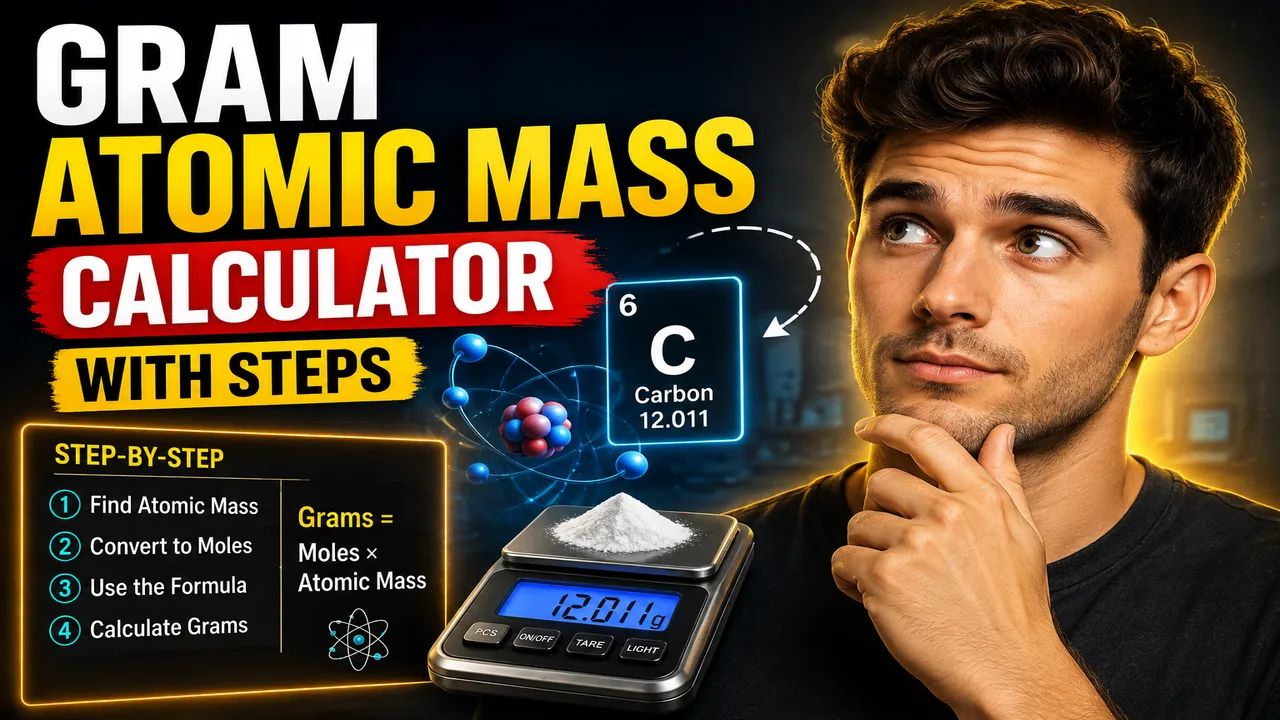
For example, carbon has a standard atomic weight of about 12.011. In a periodic-table context, this value is associated with the atomic-weight quantity. In a laboratory calculation, carbon's molar mass is commonly used as approximately 12.011 g/mol.
Why Use This Gram Atomic Mass Calculator With Steps & How Our Calculator Beats the Competition
The calculator is designed for a focused task: identify an element and show the corresponding gram atomic mass with the calculation steps. Different methods can still be useful depending on the problem.
| Method | Ease of Use | Calculation Speed | Best For | Limitations |
|---|---|---|---|---|
| Toolhox Calculator | Enter one element | Immediate result from the tool | Quick element-to-gram-atomic-mass lookups with steps | Focused on gram atomic mass rather than full stoichiometry |
| Manual Calculation | Requires a periodic table | Depends on the user | Learning the process by hand | Requires finding and interpreting the atomic-weight value |
| Spreadsheet | Requires setup | Fast after setup | Repeated calculations and custom datasets | More setup than a single lookup needs |
| Professional Chemistry Software | Depends on the software | Depends on the software | Broader chemistry workflows | May provide many functions that are unnecessary for a simple gram atomic mass lookup |
Assumptions and Limitations
This calculator treats gram atomic mass as the conventional molar-mass expression of an element's standard atomic weight. It is intended for ordinary chemistry calculations and educational use. It is not an isotope-mass calculator and does not determine the mass of a specific isotope from a mass number.
For elements that do not have a standard atomic weight because they lack a characteristic natural isotopic composition, the periodic-table convention uses a bracketed mass number for a selected nuclide. Those values should not be interpreted as a natural standard atomic weight in the same way as elements with characteristic terrestrial isotope abundances.
The result should also not be confused with the mass of one individual atom in grams. A single atom has a vastly smaller mass. Gram atomic mass is associated with one mole of atoms and is normally expressed in g/mol.
The calculator does not calculate molecular mass, formula mass, grams-to-moles conversions for a sample, isotope-abundance averages, stoichiometric ratios, or chemical-reaction yields. If your problem involves a compound such as H2O or NaCl, you generally need a molar-mass or formula-mass calculation rather than a single-element gram atomic mass lookup.
For schoolwork, laboratory planning, or research, always follow the atomic-weight values and rounding rules required by your course, laboratory, textbook, or governing method. The displayed result is a chemistry reference value and should not be treated as a substitute for a specialized scientific method when one is required.