Gram To Micron Calculator For Plastic Film
Convert plastic film GSM to estimated micron thickness using film density. Enter GSM and density to calculate thickness in µm and mm.
Please complete this field to continue.
Please complete this field to continue.
Results
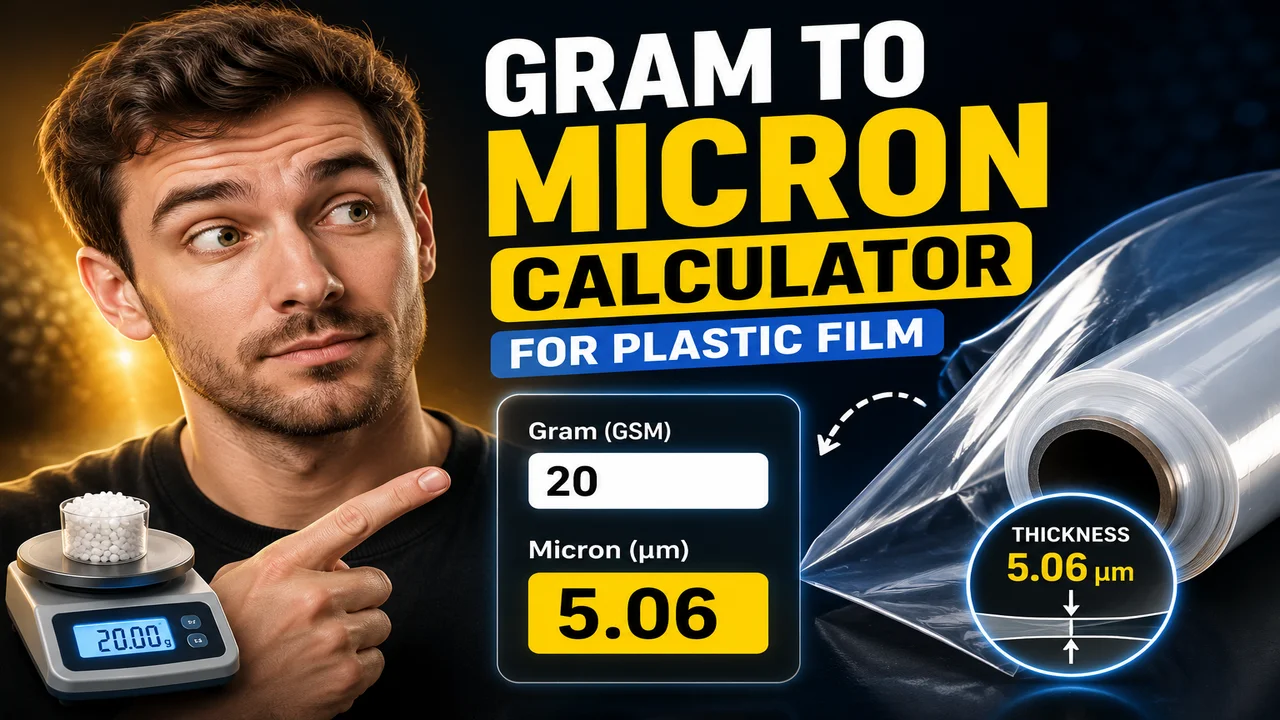
Gram To Micron Calculator For Plastic Film
TL;DR Summary
The Gram To Micron Calculator For Plastic Film converts film weight expressed as GSM (grams per square meter) into an estimated film thickness in microns by using the film density. It is a calculation aid based on a standard weight-to-thickness relationship; the page does not specify how entered values are handled, so users should avoid entering sensitive information.
About This Tool
The Gram To Micron Calculator For Plastic Film is designed for people who need to estimate plastic film thickness from its weight per unit area. In flexible packaging and film work, two common ways to describe a material are GSM and micron. GSM means grams per square meter and describes how much one square meter of film weighs. Micron, written as µm, describes the physical thickness of the film.
These measurements are related, but they are not interchangeable without knowing the material density. A lower-density plastic and a higher-density plastic can have the same GSM while having different thickness values. That is why the density input is an important part of this calculation.
This calculator requires two values: the film GSM and the film density. Enter GSM in g/m². Enter density in g/cm³. The calculator then estimates the corresponding film thickness in microns (µm). It also shows the same thickness in millimeters for users who work with both units.
The tool is useful for packaging professionals, plastic film buyers, production teams, converters, quality-control staff, students, and anyone who needs a quick GSM-to-thickness calculation. It can also help when checking whether a stated film weight and stated thickness are broadly consistent with a known material density.
What You Need to Enter
- Film Weight (GSM): Enter the mass of one square meter of film in grams. For example, 100 means 100 g/m².
- Film Density: Enter the material density in grams per cubic centimeter, written as g/cm³. Use the density that applies to the actual film material or formulation.
The calculator does not require the film width or roll length because the calculation uses GSM rather than the total weight of a complete roll. GSM already represents weight per unit area, so the area is built into the measurement.
How to Use
- Step 1: Enter the film weight in GSM, using grams per square meter (g/m²).
- Step 2: Enter the applicable film density in grams per cubic centimeter (g/cm³).
- Step 3: Run the calculation to obtain the estimated film thickness in microns.
- Step 4: Review the micron result and the equivalent thickness in millimeters.
- Step 5: Check that the density value represents the actual film material before using the result for production, purchasing, or quality decisions.
Technical Explanation and Formula
The standard relationship for a homogeneous material is:
GSM = Micron × Density
Rearranging the formula gives the calculation used for GSM to micron conversion:
Micron = GSM ÷ Density
The variables are:
- GSM: Film weight in grams per square meter (g/m²).
- Density: Material density in grams per cubic centimeter (g/cm³).
- Micron: Estimated film thickness in micrometers (µm).
The unit relationship works because one square meter with a one-micron thickness has a volume of one cubic centimeter. Therefore, for a homogeneous film, the density in g/cm³ directly links GSM to micron thickness.
For example, suppose a plastic film has a GSM of 100 g/m² and a density of 0.92 g/cm³. The calculation is:
Micron = 100 ÷ 0.92 = 108.6957 µm
Rounded to two decimal places, the estimated thickness is 108.70 µm. Since 1,000 microns equal 1 millimeter, this is 0.1087 mm.
Why Density Matters
Density is essential because GSM measures mass while micron measures thickness. Two films with the same GSM can have different thicknesses when their densities are different. Conversely, two films with the same thickness can have different GSM values when their densities differ.
For example, using a hypothetical 100 g/m² film weight, a density of 0.90 g/cm³ gives about 111.11 µm, while a density of 1.20 g/cm³ gives about 83.33 µm. The GSM is identical in both cases, but the calculated thickness changes because the density changes.
Quick Reference Example
| GSM | Density (g/cm³) | Estimated Thickness |
|---|---|---|
| 50 g/m² | 0.92 | 54.35 µm |
| 100 g/m² | 0.92 | 108.70 µm |
| 150 g/m² | 0.92 | 163.04 µm |
These examples demonstrate the formula only. They do not represent a guaranteed specification for a particular commercial plastic film. The correct density should come from the material being measured or specified.
Important Assumptions
The calculation assumes that the supplied GSM represents the film's mass per square meter and that the supplied density is appropriate for the material being evaluated. It also treats the film as a homogeneous material for the purpose of the basic calculation.
Real plastic films may contain additives, coatings, inks, fillers, adhesives, metallization, moisture, or multiple layers. A multilayer structure may not be accurately represented by using the density of only one layer. In those situations, the result should be treated as an estimate unless the effective density or individual layer information is known.
When the Result Should Not Be Used Alone
The calculator is intended for estimation and conversion, not as a replacement for physical thickness measurement or a formal product specification. If a film is being purchased, manufactured, inspected, or released against a contractual thickness requirement, compare the calculation with the supplier specification and an appropriate measurement method.
Density can vary by material grade and formulation. Using an incorrect density can produce a corresponding error in the estimated micron value. Measurement conditions and film construction can also affect how closely calculated thickness matches a measured value.
Gram, GSM, and Total Film Weight
The term “gram” by itself does not define the same quantity as GSM. A gram is a unit of mass, while GSM is mass per square meter. This calculator therefore uses GSM (g/m²) as the weight input. If you only know the total mass of a film roll or sample, you need the corresponding film area before you can calculate GSM.
For example, total film weight can be divided by total film area to obtain an average mass per square meter. That GSM value can then be used with the appropriate density in this calculator. This distinction is important because total grams alone cannot determine thickness without an area measurement.
Why Use This Gram To Micron Calculator For Plastic Film & How Our Calculator Beats the Competition
The practical value of this tool is that it puts the standard GSM-to-thickness relationship into a simple two-input calculation. It does not require users to build a spreadsheet or manually rearrange the formula each time. At the same time, the calculation remains transparent because the required variables and formula can be checked directly.
| Method | Ease of Use | Calculation Process | Best For | Limitations |
|---|---|---|---|---|
| Toolhox Calculator | Enter GSM and density | Uses GSM ÷ density | Quick film thickness estimates | Depends on the density supplied by the user |
| Manual Calculation | Requires formula entry | User performs the division | Checking a single calculation | More opportunity for unit or arithmetic errors |
| Spreadsheet | Requires a prepared sheet | Formula must be entered or stored | Repeated calculations and records | Requires spreadsheet setup and maintenance |
| Professional Engineering Software | May require more setup | Can support broader engineering workflows | Detailed engineering analysis | May be more functionality than needed for a basic GSM-to-micron conversion |
Key Limitations
- The result depends directly on the GSM and density entered.
- The calculator does not determine the material density for you.
- Total grams alone are not sufficient; the weight input is GSM in g/m².
- The basic formula assumes a homogeneous material relationship.
- Multilayer, coated, filled, metallized, or otherwise complex structures may need a more detailed mass and thickness calculation.
- The calculated result is an estimate and should not replace a suitable physical measurement or product specification where one is required.
- The page does not specify how entered information is handled. Avoid entering sensitive information unless the site's data-handling policy clearly permits it.
For routine GSM-to-micron conversion, the key requirement is using the correct density with the correct GSM value. If those inputs are reliable, the standard formula provides a straightforward way to estimate film thickness in microns.