Kg To Pound-Force Calculator With Steps
Convert kilograms to pound-force using standard gravity. See the lbf result, newtons, conversion factor, and calculation steps.
Please complete this field to continue.
Results
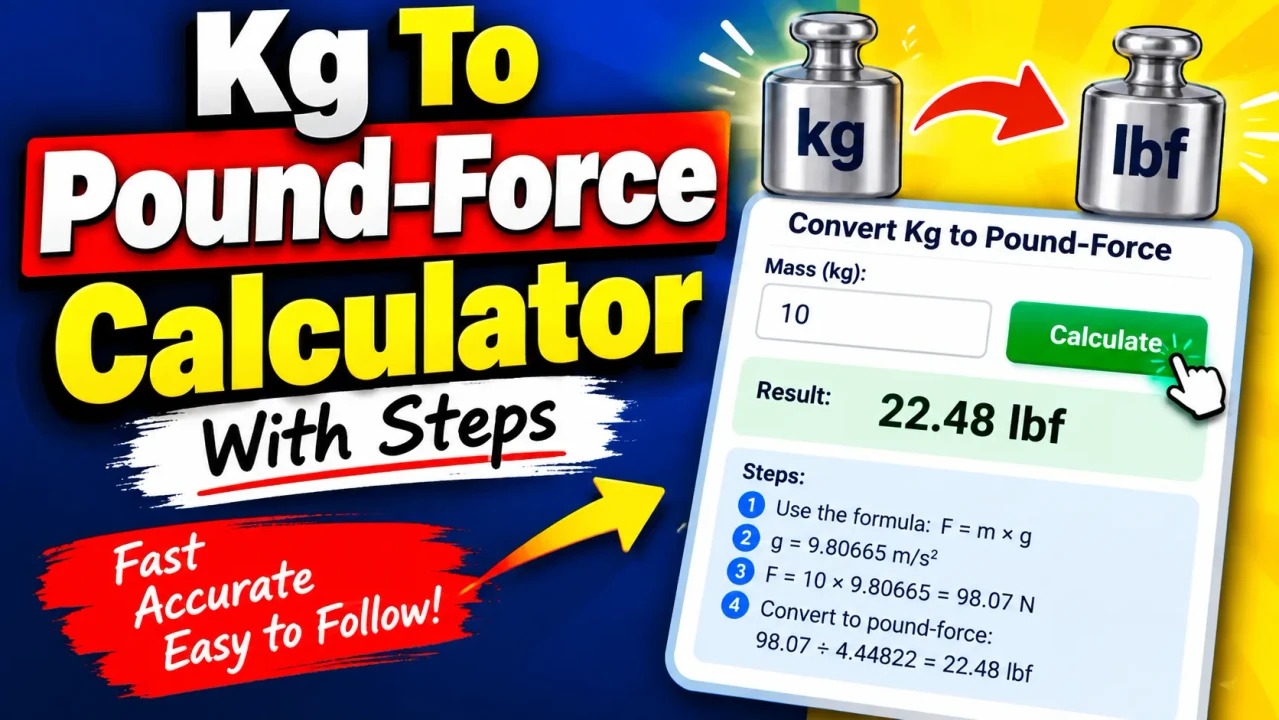
Kg To Pound-Force Calculator With Steps
TL;DR Summary
The Kg To Pound-Force Calculator With Steps converts a kilogram value to pound-force (lbf) using standard gravity and shows the resulting force in pound-force and newtons. It is intended for quick conversion and estimation, so results should not be treated as a substitute for professional engineering analysis when exact application-specific conditions matter; the supplied tool information does not establish a specific data-storage or server-processing policy.
About This Tool
The Kg To Pound-Force Calculator With Steps helps convert a value expressed in kilograms into an equivalent force expressed in pound-force, or lbf, using standard gravity. This is useful when a value given as a mass needs to be expressed as force under the standard-gravity convention.
A kilogram (kg) is a unit of mass, while pound-force (lbf) is a unit of force. They are not directly interchangeable without specifying an acceleration. This calculator uses standard gravity, which is defined as 9.80665 meters per second squared. Under that convention, one kilogram of mass corresponds to approximately 2.204623 pound-force.
The calculator is useful for students, technicians, engineers, educators, machinists, and anyone working with measurements that move between metric mass values and force values. It can also help when checking calculations, preparing notes, reviewing specifications, or converting a familiar kilogram value into an equivalent force value.
What You Enter
The calculator uses one main input: kilograms (kg). Enter a value of zero or greater. Decimal values are supported, so you can enter values such as 2.5, 10, 25.75, or 100. The calculator does not require additional inputs such as length, area, time, or acceleration because it uses standard gravity as the fixed conversion basis.
The kilogram input represents mass. Because pound-force measures force, the conversion assumes standard gravity rather than treating kilograms and pound-force as identical types of measurement.
What the Calculator Produces
The calculator returns the converted force in pound-force (lbf). It also provides the corresponding force in newtons (N) and displays the conversion factor used at standard gravity. The result is displayed to six decimal places for the calculated force values.
For example, entering 10 kg produces approximately 22.046226 lbf at standard gravity. The corresponding force is approximately 98.066500 N.
How to Use
- Step 1: Enter the mass you want to convert in the Kilograms (kg) field.
- Step 2: Check that the kilogram value is zero or greater and represents the mass you intend to convert.
- Step 3: Run the calculation to obtain the equivalent force in pound-force (lbf).
- Step 4: Review the newton value and conversion factor shown with the result.
Technical Explanation and Formula
The calculator uses standard gravity to turn mass into force. The basic physics relationship is:
Force = Mass × Acceleration
For this calculator:
Force in newtons = kilograms × 9.80665 m/s²
The result in newtons is then converted to pound-force:
Force in lbf = Force in newtons ÷ 4.4482216152605
Combining these relationships gives:
Force in lbf = kilograms × 9.80665 ÷ 4.4482216152605
This produces the commonly used standard-gravity conversion:
1 kg ≈ 2.204623 lbf
| Variable | Meaning | Unit |
|---|---|---|
| kg | Input mass | kilograms |
| 9.80665 | Standard gravity | m/s² |
| N | Calculated force | newtons |
| 4.4482216152605 | Newtons per pound-force | N/lbf |
| lbf | Calculated force | pound-force |
Worked Example
Suppose you enter 10 kg.
First, calculate the force in newtons:
10 × 9.80665 = 98.0665 N
Then convert newtons to pound-force:
98.0665 ÷ 4.4482216152605 ≈ 22.046226 lbf
So, under standard gravity, 10 kg corresponds to approximately 22.046226 lbf.
Quick Reference
| Mass | Approximate Force at Standard Gravity |
|---|---|
| 1 kg | 2.204623 lbf |
| 5 kg | 11.023113 lbf |
| 10 kg | 22.046226 lbf |
| 25 kg | 55.115566 lbf |
| 50 kg | 110.231131 lbf |
| 100 kg | 220.462262 lbf |
Why Standard Gravity Matters
Mass and force describe different physical quantities. A kilogram describes how much mass an object has. Pound-force describes the force acting on an object. The force produced by a given mass depends on acceleration. This calculator uses standard gravity so that the conversion has a defined and repeatable basis.
Standard gravity is 9.80665 m/s². This is a conventional reference value. It does not mean that gravitational acceleration is identical at every location on Earth. Local gravity can vary slightly with latitude, elevation, and other factors. For most ordinary conversion work, the standard-gravity convention is the appropriate basis when no application-specific acceleration is supplied.
When to Use the Result
This calculator is appropriate when you need a standard-gravity conversion between a kilogram mass and an equivalent pound-force value. It can be useful for quick checks, educational work, documentation, unit conversion, and preliminary calculations.
For an application involving actual forces, loads, acceleration, structural design, lifting equipment, machinery, safety limits, or regulated engineering work, do not assume that standard-gravity conversion alone represents the complete physical situation. The actual acceleration and other forces may need to be considered separately.
Why Use This Kg To Pound-Force Calculator With Steps & How Our Calculator Beats the Competition
This calculator provides a direct way to perform a standard-gravity kg-to-lbf conversion without manually setting up the conversion equations. The practical difference between this tool and other calculation methods is mainly the amount of manual work required and the level of specialized analysis available.
| Method | Ease of Use | Calculation Speed | Best For | Limitations |
|---|---|---|---|---|
| Toolhox Calculator | Enter one kilogram value | Direct calculation | Quick standard-gravity kg-to-lbf conversions | Uses standard gravity rather than application-specific acceleration |
| Manual Calculation | Requires the formula and constants | Depends on the user | Learning or checking the calculation | More opportunity for arithmetic or unit errors |
| Spreadsheet | Requires a prepared formula | Fast after setup | Repeated conversions and custom worksheets | Requires spreadsheet setup and maintenance |
| Professional Engineering Software | Usually more complex | Depends on the software and model | Detailed engineering analysis | More tools and inputs than a simple unit conversion requires |
Assumptions and Limitations
- The conversion uses standard gravity of 9.80665 m/s².
- The input is treated as mass in kilograms.
- The output is force in pound-force.
- The conversion uses 4.4482216152605 newtons per pound-force.
- The result is a standard-gravity conversion, not a measurement of the actual force in a specific physical system.
- Local gravitational acceleration and application-specific acceleration are not entered into the calculator.
- Rounding is applied to the displayed final result; the underlying conversion uses the stated constants.
- A result should not be used by itself for safety-critical engineering, structural, lifting, machinery, or regulated design decisions.
If your application depends on a specific acceleration rather than standard gravity, use the appropriate force equation with that acceleration. Professional review may be needed when the result affects equipment ratings, structural loads, safety limits, or other high-consequence decisions.