Kg To Newtons Calculator With Earth Gravity Online
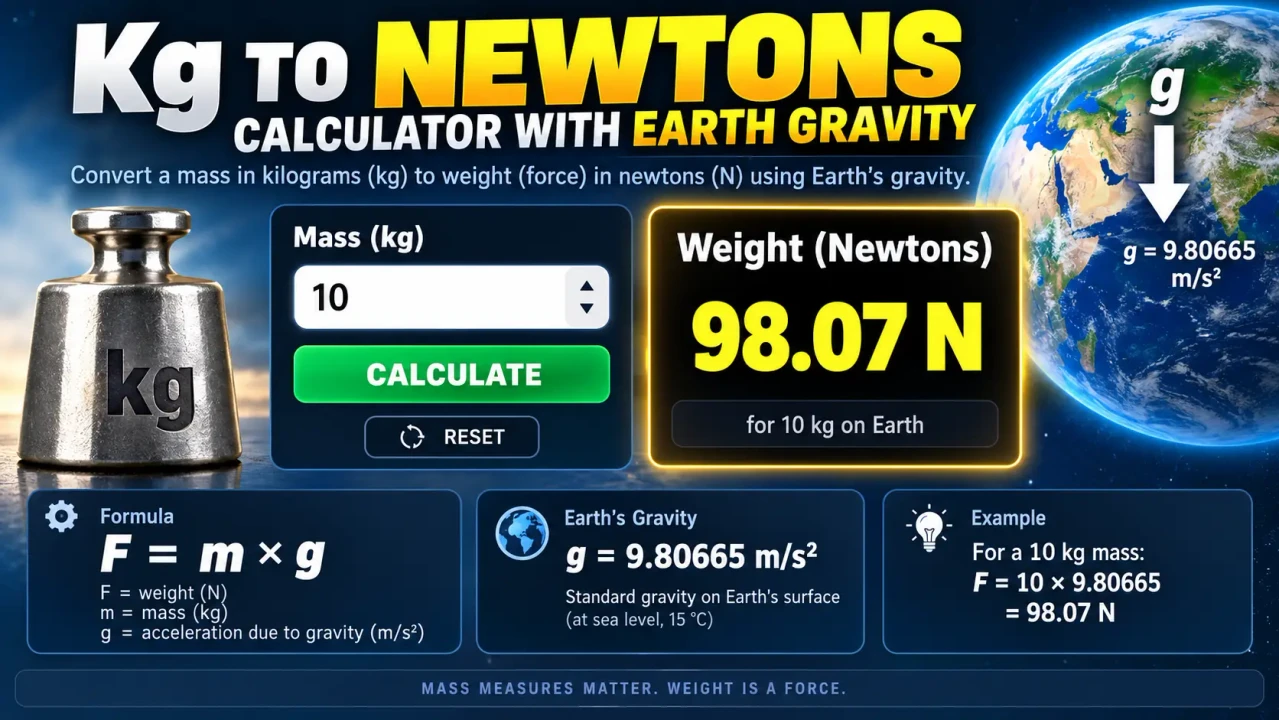
Kg To Newtons Calculator With Earth Gravity converts kilograms to newtons using standard Earth gravity of 9.80665 m/s². Calculate weight force from mass quickly.
Please complete this field to continue.
Results
Kg To Newtons Calculator With Earth Gravity
TL;DR Summary
The Kg To Newtons Calculator With Earth Gravity converts a mass in kilograms into its corresponding weight force in newtons using standard Earth gravity of 9.80665 m/s². It is intended for quick physics, science, engineering, and unit-conversion calculations; privacy behavior is not specified by the supplied tool information, so avoid entering sensitive information.
What Is the Kg To Newtons Calculator With Earth Gravity?
The Kg To Newtons Calculator With Earth Gravity is a simple physics calculator for converting mass from kilograms (kg) to force in newtons (N). It uses the relationship between mass, acceleration, and force to estimate the weight force of an object under standard Earth gravity.
This distinction matters because kilograms and newtons measure different physical quantities. A kilogram is a unit of mass. A newton is a unit of force. A mass does not become a force simply because it is written in kilograms. To calculate the force associated with that mass under gravity, the mass must be multiplied by an acceleration value.
For this calculator, the acceleration is standard gravity: 9.80665 meters per second squared (m/s²). This is a conventional reference value used for standard gravity. The result is expressed in newtons.
The calculator is useful for students, teachers, hobbyists, technicians, engineers, and anyone who needs a quick kg-to-newton conversion for a physics or mechanics calculation. It can also help when checking a hand calculation or understanding why an object's mass in kilograms and its weight force in newtons are not numerically the same.
What Do You Enter?
The calculator requires one main input: mass in kilograms. Enter a non-negative mass such as 1 kg, 10 kg, 50 kg, or 70 kg. The calculation then applies standard Earth gravity to that mass.
The tool does not require you to enter the gravity constant separately because the calculator's stated purpose is specifically to calculate force using standard Earth gravity. This keeps the calculation focused on the kg-to-newton conversion.
The input is a numerical mass value. For example, if the mass is 70 kg, the calculation uses 70 as the mass value and multiplies it by 9.80665 m/s².
What Does the Calculator Return?
The main result is force in newtons (N). The result represents the weight force associated with the entered mass when standard Earth gravity is used.
The calculator also shows the entered mass in kilograms and identifies the standard gravity value used in the calculation. This gives you a quick way to check the inputs and understand the basis of the result.
How to Use the Kg To Newtons Calculator With Earth Gravity
- Step 1: Enter the object's mass in kilograms in the Mass field.
- Step 2: Check that the mass is a valid non-negative number.
- Step 3: Review the calculated force shown in newtons.
- Step 4: Use the result as the gravitational force for calculations where standard Earth gravity is the intended reference.
Technical Explanation and Formula
The standard calculation is based on Newton's second law:
Force = Mass × Acceleration
For this tool, the formula is:
F = m × g
- F = force or weight force, measured in newtons (N)
- m = mass, measured in kilograms (kg)
- g = standard acceleration due to gravity, 9.80665 m/s²
Because one newton is equivalent to one kilogram meter per second squared (kg·m/s²), multiplying kilograms by meters per second squared produces newtons.
For example, for a mass of 10 kg:
F = 10 kg × 9.80665 m/s² = 98.0665 N
For a mass of 70 kg:
F = 70 kg × 9.80665 m/s² = 686.4655 N
The displayed result is rounded to four decimal places. The underlying multiplication is performed before the final display rounding.
Why Standard Earth Gravity Is Used
Gravity is not exactly the same at every location on Earth. It can vary because of factors such as latitude and elevation. A calculator that uses actual local gravitational acceleration would therefore require additional location information or a specific gravity value.
This tool instead uses standard gravity, 9.80665 m/s². That value provides a defined reference for calculations and makes the conversion reproducible. It should not be interpreted as a measurement of the exact local gravitational acceleration at every location on Earth.
Kg to Newtons Quick Reference
| Mass | Calculation | Force |
|---|---|---|
| 1 kg | 1 × 9.80665 | 9.80665 N |
| 5 kg | 5 × 9.80665 | 49.03325 N |
| 10 kg | 10 × 9.80665 | 98.0665 N |
| 20 kg | 20 × 9.80665 | 196.133 N |
| 50 kg | 50 × 9.80665 | 490.3325 N |
| 70 kg | 70 × 9.80665 | 686.4655 N |
| 100 kg | 100 × 9.80665 | 980.665 N |
Mass vs. Weight: Why the Units Matter
Mass and weight are related but are not the same thing. Mass describes how much matter an object contains and is measured in kilograms. Weight is a force caused by gravity and is measured in newtons.
For example, an object with a mass of 70 kg has the same mass regardless of where it is located. Its weight force can change if the local gravitational acceleration changes. The result from this calculator is therefore a standard-gravity weight force rather than a measurement of the object's mass.
Why Use This Kg To Newtons Calculator With Earth Gravity & How Our Calculator Beats the Competition
The practical advantage of this calculator is that it focuses on one clearly defined conversion: kilograms to newtons using standard Earth gravity. Different calculation methods can still be useful depending on the task.
| Method | Ease of Use | Calculation Speed | Best For | Limitations |
|---|---|---|---|---|
| Toolhox Calculator | Enter one mass value | Immediate result | Quick kg-to-newton conversions | Uses standard gravity rather than location-specific gravity |
| Manual Calculation | Requires multiplication | Depends on the user | Learning and checking the formula | More opportunity for arithmetic or unit errors |
| Spreadsheet | Requires setup | Useful for repeated calculations | Lists of many mass values | Requires a spreadsheet and a correctly configured formula |
| Professional Engineering Software | Usually requires more setup | Depends on the software and model | Broader engineering calculations | More functionality than needed for a simple kg-to-newton conversion |
Common Uses
A kg-to-newton calculation can appear in many basic mechanics problems. Examples include calculating the gravitational force on an object, checking a physics exercise, estimating a load for a simple calculation, or converting a known mass into force before using it in another equation.
It can also be useful when reading technical material that expresses mass in kilograms but requires force in newtons. Converting the units before continuing the calculation helps keep equations dimensionally consistent.
Assumptions and Limitations
This calculator assumes standard Earth gravity of 9.80665 m/s². It does not calculate local gravitational acceleration from latitude, elevation, geographic coordinates, or a measured gravity value.
The result should therefore be treated as a standard-gravity calculation. If a project requires the actual gravitational acceleration at a particular location, use an appropriate location-specific gravity value instead of relying only on this standard conversion.
The calculator also does not account for other forces acting on an object. Air resistance, buoyancy, acceleration from motion, support forces, tension, friction, and other mechanical effects are outside the scope of this simple calculation.
For routine educational or preliminary calculations, the standard-gravity result may be suitable. For safety-critical engineering, structural design, laboratory work, equipment specifications, or other applications where a specific physical measurement is required, the result should be checked against the applicable technical requirements and reviewed by an appropriately qualified professional.
Summary
The Kg To Newtons Calculator With Earth Gravity provides a straightforward conversion from mass in kilograms to gravitational force in newtons. Its core calculation is F = m × 9.80665, using standard Earth gravity. Because kilograms measure mass and newtons measure force, the gravity value is essential to the conversion.
Use the calculator when standard gravity is the intended reference. If the calculation depends on actual local gravity or additional physical forces, more detailed inputs and a different calculation method may be required.