Ppm To Grams Per Liter Calculator
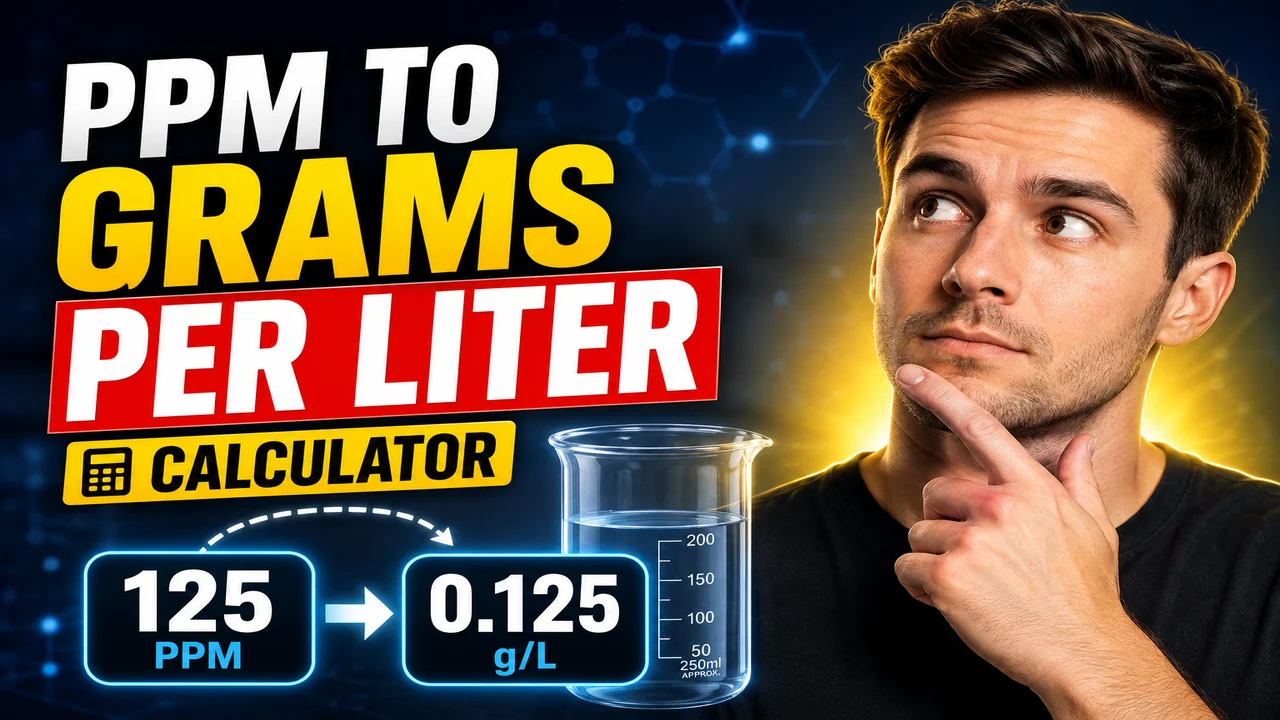
Convert PPM to grams per liter with this simple calculator. Enter a concentration in ppm and get the approximate g/L value for dilute water solutions.
Please complete this field to continue.
Results
Ppm To Grams Per Liter Calculator
TL;DR Summary
The Ppm To Grams Per Liter Calculator converts a concentration given in parts per million (PPM) into grams per liter (g/L), using the standard water or dilute aqueous-solution relationship. The result is a practical conversion estimate; privacy behavior is not specified by the supplied tool information, so avoid entering sensitive information unless the page clearly explains how entered data is handled.
About This Tool
The Ppm To Grams Per Liter Calculator helps you convert a concentration from parts per million, written as PPM or ppm, into grams per liter, written as g/L. This is useful when a concentration is provided in one unit but a recipe, laboratory calculation, water-treatment instruction, chemical preparation, or other measurement requires the other.
For water and dilute aqueous solutions, PPM and milligrams per liter are commonly treated as numerically equivalent. Since 1 milligram is equal to 0.001 gram, the conversion from PPM to grams per liter is straightforward: divide the PPM value by 1,000. For example, 500 ppm corresponds to approximately 500 mg/L, which is 0.5 g/L under the standard water-based approximation. This relationship is widely used for routine concentration work involving dilute water solutions. :contentReference[oaicite:3]{index=3}
The calculator is designed for users who already know the concentration in PPM and want the equivalent value in grams per liter. It can be useful for students, laboratory users, water-quality work, aquarium and hydroponic users, chemical preparation, and anyone working with concentration values where g/L is the preferred unit.
What You Enter
The calculator requires one main input: the concentration in parts per million (PPM). Enter a value of zero or greater. The calculator then applies the standard conversion and displays the corresponding concentration in grams per liter (g/L).
No separate volume, mass, molar mass, or chemical name is required for this basic conversion. Those values would only be needed for a different type of concentration calculation. Keeping the input focused on PPM makes the tool suitable when the PPM value is already known.
What You Get
The primary result is the concentration in grams per liter (g/L). The calculation does not change the substance or concentration itself; it changes the way the concentration is expressed.
For example:
- 1 ppm → 0.001 g/L
- 10 ppm → 0.010 g/L
- 100 ppm → 0.100 g/L
- 500 ppm → 0.500 g/L
- 1,000 ppm → 1.000 g/L
These examples use the standard dilute-water relationship. In this context, 1 ppm is approximately 1 mg/L, and 1,000 mg equals 1 gram. :contentReference[oaicite:4]{index=4}
How to Use
- Step 1: Enter the known concentration in the Concentration (PPM) field.
- Step 2: Check that the PPM value is zero or greater and represents the concentration you want to convert.
- Step 3: Read the calculated result shown in grams per liter (g/L).
- Step 4: Use the converted value in your next calculation, record, recipe, or concentration comparison as appropriate for your application.
Technical Explanation and Formula
The standard calculation for water or dilute aqueous solutions is based on two unit relationships. First, 1 ppm is approximately equal to 1 mg/L when the solution has a density close to water. Second, 1 mg equals 0.001 g. Combining these relationships gives the conversion used by this tool. :contentReference[oaicite:5]{index=5}
Formula:
grams per liter = PPM ÷ 1,000
Where:
- PPM = concentration in parts per million.
- grams per liter = converted concentration in g/L.
- 1,000 = the number of milligrams in one gram.
For example, if the concentration is 250 ppm:
250 ÷ 1,000 = 0.25 g/L
So, 250 ppm is approximately 0.25 grams per liter for a dilute water-based solution.
Why PPM and Grams per Liter Are Related
PPM is a ratio that expresses one part of a substance per one million parts of a mixture. Grams per liter expresses the mass of a substance contained in one liter of solution. These are different types of concentration units, so they are not universally interchangeable without considering solution density.
For dilute aqueous solutions, however, the density is close enough to 1 kilogram per liter that 1 ppm is commonly treated as approximately 1 mg/L. That makes the PPM-to-g/L conversion a simple division by 1,000. :contentReference[oaicite:6]{index=6}
Preset Examples and Quick Reference
| PPM | Approximate mg/L | Approximate g/L |
|---|---|---|
| 1 ppm | 1 mg/L | 0.001 g/L |
| 5 ppm | 5 mg/L | 0.005 g/L |
| 10 ppm | 10 mg/L | 0.010 g/L |
| 50 ppm | 50 mg/L | 0.050 g/L |
| 100 ppm | 100 mg/L | 0.100 g/L |
| 250 ppm | 250 mg/L | 0.250 g/L |
| 500 ppm | 500 mg/L | 0.500 g/L |
| 1,000 ppm | 1,000 mg/L | 1.000 g/L |
The table uses the common dilute-water approximation rather than a density correction. If your solution has a substantially different density, the simple 1 ppm ≈ 1 mg/L relationship may not be appropriate.
When This Conversion Works Well
The simple conversion is useful when working with water or dilute aqueous solutions where the solution density is close to 1 kg/L. Common examples include routine water-quality measurements and other applications where PPM is being used as a mass-based concentration and the solution is mostly water. :contentReference[oaicite:7]{index=7}
It is also useful for checking manual calculations. If you have a known PPM value and need a quick g/L equivalent, dividing by 1,000 provides the standard result under the water-based assumption.
Important Assumptions and Limitations
The main limitation is that the simple conversion assumes a water-like or dilute aqueous solution. PPM is fundamentally a ratio, while g/L is a mass-per-volume unit. When solution density differs significantly from water, the numerical relationship between PPM and mg/L changes. A density-corrected conversion may then be required. :contentReference[oaicite:8]{index=8}
For example, concentrated brines, concentrated chemical solutions, organic solvents, and other non-water liquids may have densities that are meaningfully different from 1 kg/L. In those cases, using the simple water approximation can produce a different result from a density-based calculation.
This calculator also does not determine what a particular PPM measurement means chemically. It does not identify a substance, determine whether a concentration is safe, calculate molarity, or decide whether a solution meets a regulatory or treatment limit. Those questions require additional information about the substance, solution, measurement method, temperature, density, and applicable standards.
For laboratory work where high precision matters, use the density and measurement conditions appropriate to the specific solution. For regulated, safety-critical, medical, environmental, or industrial decisions, verify the converted value against the applicable technical documentation or a qualified professional rather than relying on a basic unit conversion alone.
Why Use This Ppm To Grams Per Liter Calculator & How Our Calculator Beats the Competition
The practical value of this calculator is that it focuses on one specific conversion: PPM to grams per liter. It avoids requiring unrelated inputs when the PPM concentration is already known. The comparison below describes the trade-offs between common ways of performing the same conversion without making unsupported claims about competing products.
| Method | Ease of Use | Calculation Speed | Best For | Limitations |
|---|---|---|---|---|
| Toolhox Ppm To Grams Per Liter Calculator | Enter one PPM value | Immediate calculator result | Quick standard PPM-to-g/L conversions | Uses the standard water/dilute-solution relationship and does not provide a density correction |
| Manual Calculation | Requires the formula and arithmetic | Depends on the user | Learning or checking the conversion | Manual entry and arithmetic can take more effort |
| Spreadsheet Calculation | Requires a prepared formula | Fast after setup | Repeated calculations or custom worksheets | Requires spreadsheet setup and formula maintenance |
| Professional Chemistry Software | May require more setup | Depends on the software and calculation | Advanced calculations and detailed chemical analysis | May include capabilities that are unnecessary for a simple unit conversion |
The key point is scope. A basic PPM-to-g/L conversion needs only the PPM value when the standard water-based approximation applies. More advanced work may require additional variables, such as solution density, temperature, or chemical composition. A tool designed for a more detailed chemistry calculation may therefore be more appropriate when those factors materially affect the result.
Assumptions and Limitations
- The standard conversion assumes water or a dilute aqueous solution.
- For this use case, 1 ppm is treated as approximately 1 mg/L.
- One gram equals 1,000 milligrams.
- The result is therefore PPM divided by 1,000.
- Solutions with substantially different densities may require a density-corrected conversion.
- The calculator does not assess whether a concentration is safe, legal, suitable, or recommended for a particular application.
- The calculator does not replace laboratory measurement, chemical analysis, regulatory guidance, or professional review where those are required.
- Privacy behavior is not specified by the supplied tool information, so sensitive information should not be entered unless the page clearly explains how it is handled.
For routine water-based conversions, the calculation is simple and transparent. For higher-precision applications, confirm the meaning of PPM and the density of the actual solution before using the result.