Speech Length Calculator: Words To Minutes Converter
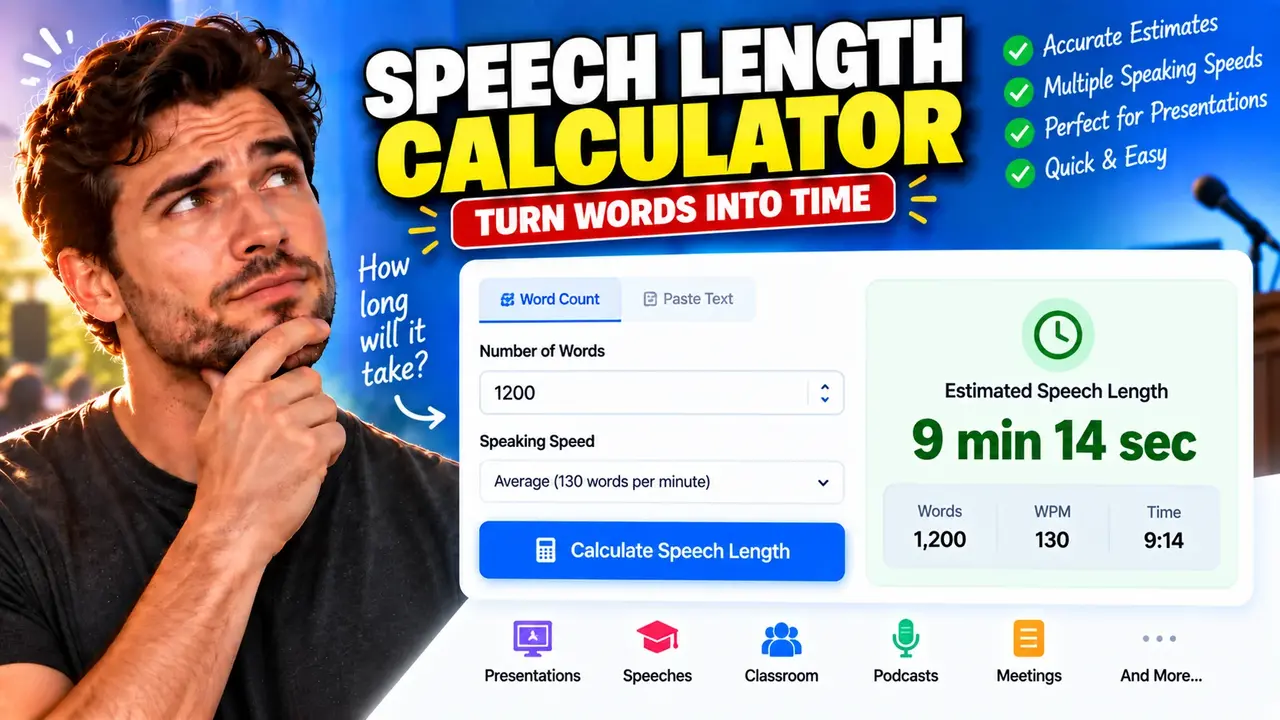
Calculate exact speech duration based on your word count and speaking speed. Free tool to convert words to minutes for presentations, speeches, and essays.
Speech Length Calculator
TL;DR Summary
Speech Length Calculator helps estimate how long a speech may take to deliver based on the amount of spoken content and a speaking rate. It is intended as a planning estimate rather than a guarantee of actual delivery time, and the supplied tool information does not specify how entered data is stored or processed.
What Is a Speech Length Calculator?
Speech Length Calculator is a practical planning tool for estimating the delivery time of a speech. When you write a speech, presentation, script, toast, lesson, introduction, or other spoken material, the number of words gives you a useful starting point for estimating how long it will take to say out loud. A speech length calculator turns that word count and speaking pace into an estimated duration.
This can help when you need to fit a speech into a scheduled time slot. For example, a speaker preparing a five-minute presentation may want to know whether a draft is short enough. A student preparing a classroom speech may need to stay within an assigned time limit. A presenter preparing notes for a meeting may want a quick estimate before practicing. Writers can also use the calculation while drafting to decide whether a script needs to be shortened or expanded.
What Does the Calculator Measure?
The main purpose of a speech length calculator is to connect speech length with speaking speed. Speech length is commonly measured by the number of words. Speaking speed is commonly expressed in words per minute, or WPM. The result is an estimated speaking time in minutes.
The basic relationship is simple: more words generally require more time to speak, while a faster speaking rate generally reduces the required time. A slower speaking rate increases the estimated duration.
The supplied tool information identifies Speech Length Calculator as the tool name and provides instructions for creating content around its stated purpose, but it does not provide a confirmed interface specification or hidden implementation details. Therefore, the calculation described here is the standard calculation appropriate for a speech-length tool, rather than a claim about an unseen internal implementation.
Who Can Use It?
A speech length calculator can be useful for students, teachers, presenters, public speakers, content writers, event speakers, video script writers, and anyone preparing spoken material. It is especially useful during the planning stage, when you want to compare a draft against a target speaking time.
Students can use an estimate before practicing a class presentation. Speakers can use it to check whether a draft is likely to fit a scheduled slot. Writers can use it when creating scripts for spoken delivery. Presenters can compare different drafts and identify when a script may need editing.
What Inputs Are Needed?
The standard calculation requires two pieces of information:
- Word count: The number of words in the speech or spoken script.
- Speaking rate: The estimated number of words spoken per minute, expressed as WPM.
If the Toolhox interface provides a text field, the word count may be obtained from the speech text. If it instead asks for a word count directly, you can enter the number of words in the draft. The exact interface controls are not specified in the supplied material, so users should follow the labels displayed by the live calculator.
What Output Should You Expect?
The standard output is an estimated speech duration, normally expressed in minutes and potentially seconds. For example, a 600-word speech delivered at 120 words per minute has an estimated duration of 5 minutes.
This estimate is useful because it gives you a simple target for practice. If your calculated time is longer than the available speaking slot, you may need to remove words. If it is much shorter, you may have room to add supporting points, examples, transitions, or other material.
How to Use the Speech Length Calculator
Step 1: Determine the number of words in your speech or spoken script. Use the word count from your draft or the count requested by the calculator.
Step 2: Enter or select the speaking rate in words per minute if the calculator provides a speaking-rate option.
Step 3: Submit the values or use the calculator control shown on the page to calculate the estimated speech length.
Step 4: Review the estimated duration and compare it with your target speaking time.
Step 5: Practice the speech aloud and adjust the draft if your real delivery time differs from the estimate.
Technical Explanation and Formula
The standard formula for estimating speech duration is:
Speech Duration (minutes) = Word Count ÷ Speaking Rate (words per minute)
The variables are:
- Word Count: The total number of words in the speech, measured in words.
- Speaking Rate: The expected delivery pace, measured in words per minute (WPM).
- Speech Duration: The estimated time needed to deliver the speech, measured in minutes.
To convert decimal minutes into seconds, multiply the decimal portion by 60. For example, 4.5 minutes equals 4 minutes and 30 seconds because 0.5 × 60 = 30 seconds.
Worked example: Suppose a speech contains 750 words and the expected speaking rate is 150 WPM.
750 ÷ 150 = 5 minutes
The estimated speech length is therefore 5 minutes.
For another example, a 900-word speech at 120 WPM gives:
900 ÷ 120 = 7.5 minutes
0.5 minute × 60 = 30 seconds
The estimate is 7 minutes and 30 seconds.
These examples show why both word count and speaking rate matter. The same script can have different delivery times when read at different speeds.
Quick Reference
| Word Count | At 100 WPM | At 120 WPM | At 150 WPM |
|---|---|---|---|
| 300 words | 3 minutes | 2 minutes 30 seconds | 2 minutes |
| 600 words | 6 minutes | 5 minutes | 4 minutes |
| 750 words | 7 minutes 30 seconds | 6 minutes 15 seconds | 5 minutes |
| 900 words | 9 minutes | 7 minutes 30 seconds | 6 minutes |
| 1,200 words | 12 minutes | 10 minutes | 8 minutes |
The table is a mathematical reference based on the standard words-per-minute formula. It is not a claim that every speaker will deliver these word counts at exactly those times.
Why Speaking Rate Matters
Word count alone cannot determine the exact time needed to deliver a speech. Two people can read the same script at different speeds. A speaker may also change pace during the presentation. Pauses, emphasis, audience interaction, pronunciation, transitions, and moments of silence can all affect the actual duration.
For this reason, a calculated speech length should be treated as an estimate. If timing is important, use the calculator during drafting and then rehearse the complete speech aloud. Your practice result gives you a more useful check of the time needed for your particular delivery.
When to Use the Calculator
Use Speech Length Calculator when you have a known or estimated word count and want to plan around a speaking time. It can be useful before a classroom presentation, meeting, speech, event, recorded narration, or other spoken assignment. It can also help when editing several versions of the same script.
For example, if your event gives you a fixed time limit, you can calculate the approximate word count that fits that limit by rearranging the standard formula:
Maximum Word Count = Target Duration (minutes) × Speaking Rate (WPM)
A five-minute target at 120 WPM corresponds to approximately 600 words:
5 × 120 = 600 words
This provides a useful drafting target. You should still leave room for natural pauses and other parts of your delivery when the schedule is strict.
Assumptions and Limitations
The standard calculation assumes a reasonably consistent speaking rate. It also assumes that the word count represents the material that will actually be spoken. If your script contains stage directions, headings, notes, or other text that will not be read aloud, those words can affect the estimate if they are included in the count.
The result does not by itself measure your actual speaking speed. It also does not automatically account for pauses, audience questions, demonstrations, slides, laughter, interruptions, deliberate dramatic pauses, or changes in delivery pace unless those factors are separately reflected in the calculation.
A speech with technical terms or difficult names may also take longer to deliver than a simple script with the same number of words. Reading from notes can produce a different pace from memorized delivery. Practice conditions can also differ from the actual event.
Because the supplied tool context does not document a specific privacy or data-processing policy, do not assume that entered speech text is stored, deleted, processed locally, or sent to a server. Avoid entering sensitive information unless the page clearly explains how that information is handled.
Why Use This Speech Length Calculator & How Our Speech Length Calculator Beats the Competition
The practical value of a Speech Length Calculator is that it turns a simple word count and speaking-rate assumption into an estimated duration. Different methods can serve different needs, so the right choice depends on how much control and detail you need.
| Method | Ease of Use | Calculation Speed | Best For | Limitations |
|---|---|---|---|---|
| Toolhox Speech Length Calculator | Designed for a direct speech-length estimate | Provides a calculation without requiring manual arithmetic | Quick speech-time planning | Estimate depends on the inputs and does not replace live rehearsal |
| Manual Calculation | Requires basic arithmetic | Depends on the user performing the calculation | Simple one-off calculations | More work and easier to calculate incorrectly |
| Spreadsheet Calculation | Requires setting up cells or formulas | Useful for repeated calculations | Managing multiple drafts or scenarios | Requires a spreadsheet and setup |
| Professional Presentation or Speech Software | May involve more features and setup | Depends on the software and workflow | Broader presentation-production tasks | May provide more functionality than needed for a simple duration estimate |
The comparison is about general methods rather than named competing products. Toolhox should be viewed as a practical calculation option, while manual arithmetic, spreadsheets, and broader software may be appropriate for users with different workflows.
Use the Result as a Planning Estimate
A speech length estimate is most useful when it is combined with practice. Start with the calculator to understand the expected duration of your draft. Then read the complete speech aloud at the pace you expect to use. If the actual time is different, adjust your script or your target pace as needed.
For strict time limits, do not rely only on the calculated number. Leave enough flexibility for natural pauses and delivery changes. If your speech includes audience participation, questions, demonstrations, or other activities, include those activities in your overall event schedule rather than treating the word-count calculation as the complete presentation time.
In short, Speech Length Calculator provides a straightforward way to connect words with estimated speaking time. It is useful for drafting, editing, scheduling, and rehearsal planning, while the final timing should be confirmed through actual practice.