Grams To Ml Honey Converter
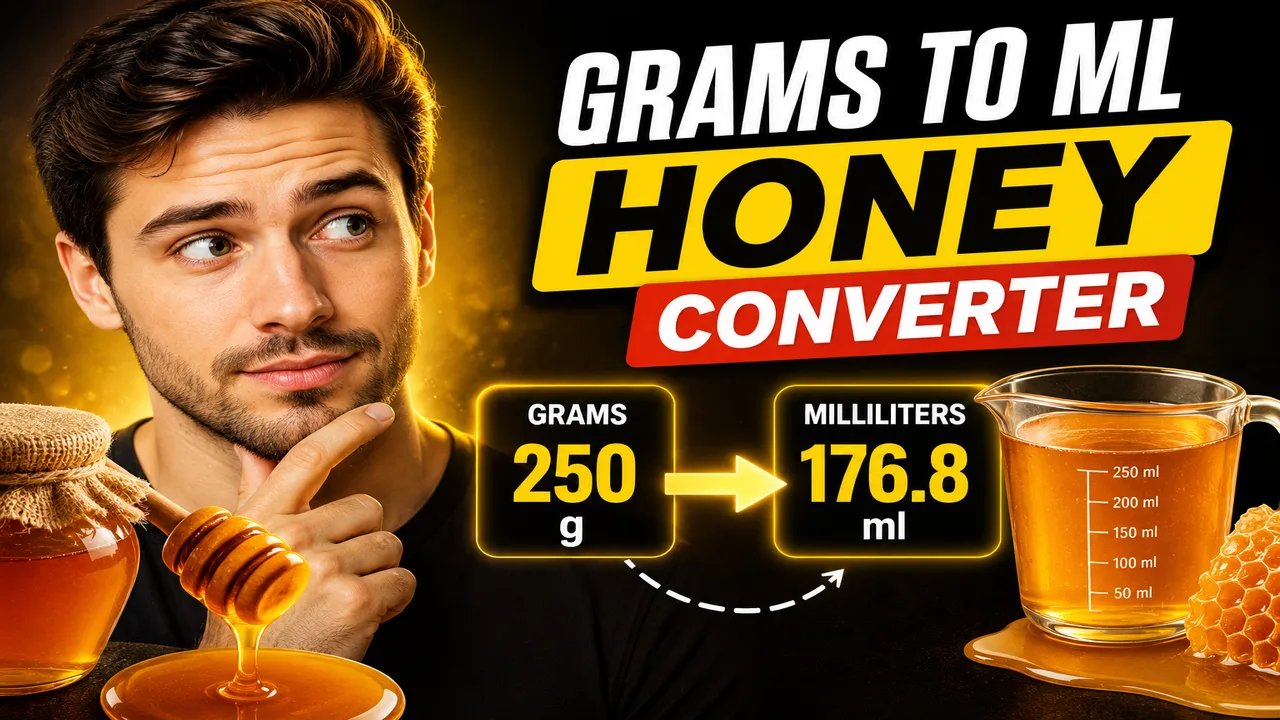
Convert honey grams to milliliters using a 1.42 g/mL reference density. Get a practical volume estimate for recipes and baking.
Please complete this field to continue.
Results
Grams To Ml Honey Converter
TL;DR Summary
Grams To Ml Honey Converter converts a honey weight in grams into an estimated volume in milliliters using a reference density of 1.42 g/mL. Honey density can vary with moisture content, temperature, and the specific honey, so the result is a practical kitchen conversion rather than a laboratory measurement; no specific data-handling or privacy behavior is provided by the supplied tool information.
What Is the Grams To Ml Honey Converter?
The Grams To Ml Honey Converter is a simple kitchen and baking conversion tool for changing a measured weight of honey from grams (g) into an estimated volume in milliliters (mL). This is useful when a recipe gives honey by weight but your measuring tools are marked in milliliters, or when you want to understand how much space a particular amount of honey will occupy.
Grams and milliliters do not measure the same thing. Grams measure mass, while milliliters measure volume. Because honey is denser than water, 100 grams of honey does not occupy 100 mL. A density value is needed to connect the two measurements. A commonly used reference value for honey is approximately 1.42 grams per milliliter. Using that reference, 100 grams of honey corresponds to about 70.42 mL.
The converter is designed around this basic density relationship. You enter the honey weight in grams, and the tool divides that value by the reference density to estimate the corresponding volume. The calculation is useful for cooking, baking, recipe preparation, ingredient planning, and quick measurement conversions.
Who Can Use This Honey Conversion Tool?
This converter can be useful for home cooks, bakers, recipe developers, food bloggers, students, and anyone working with honey measurements. It is especially helpful when a recipe uses grams but the available measuring cup, jug, or spoon uses milliliters.
For example, if a recipe calls for 250 g of honey, you can enter 250 into the converter. Using a density of 1.42 g/mL, the estimated volume is about 176.06 mL. This can make it easier to portion honey without manually performing the calculation.
The tool can also help when comparing recipe measurements. If one recipe lists honey in grams and another lists honey in milliliters, the converter provides a consistent reference point for translating between the two forms.
What Input Does the Tool Need?
The converter requires one main input: honey weight in grams. Enter a non-negative number such as 50, 100, 150, or 250. Decimal values can also be used when a recipe calls for a more precise weight.
The tool does not need a separate density input for the standard conversion because the calculation uses a reference honey density of 1.42 g/mL. This keeps the conversion simple and avoids requiring users to look up a density value before using the tool.
What Output Does It Produce?
The main output is the estimated honey volume in milliliters (mL). The result is calculated from the entered grams and the reference density. The displayed value is rounded to two decimal places for practical readability.
For example, entering 100 grams produces approximately 70.42 mL. Entering 500 grams produces approximately 352.11 mL. These values are estimates based on the same reference density.
How to Use the Grams To Ml Honey Converter
- Step 1: Enter the weight of your honey in the Honey Weight field, using grams as the unit.
- Step 2: Check that the entered value is a valid non-negative number.
- Step 3: Calculate the conversion to see the estimated honey volume in milliliters.
- Step 4: Use the resulting milliliter value as a practical volume reference for your recipe or measurement.
Technical Explanation and Formula
The standard mass-to-volume relationship is based on density. For honey, the calculation used here is:
Volume (mL) = Mass (g) ÷ Density (g/mL)
For this converter:
- Mass: the amount of honey entered by the user, measured in grams.
- Density: the reference honey density, set to 1.42 g/mL.
- Volume: the estimated amount of honey in milliliters.
For a 100 g conversion:
100 g ÷ 1.42 g/mL = 70.42 mL
The grams and grams in the density unit cancel during the calculation, leaving milliliters as the result. The converter does not need a separate grams-to-milliliters universal factor because the density of the ingredient determines the relationship.
Why Honey Does Not Have a Universal Exact Grams-to-Milliliters Ratio
It is important to understand that honey is a natural food, not a pure mathematical constant. Its density can vary. Moisture content is one factor that can affect honey density, and temperature can also change the volume of a liquid. Different honey products may therefore produce slightly different real-world measurements.
The reference value of 1.42 g/mL is useful for everyday conversion, but it should not be treated as the exact measured density of every jar of honey. USDA materials recognize honey as a food product with defined quality characteristics, while food-density references explain that density is the relationship between mass and volume. :contentReference[oaicite:0]{index=0}
For ordinary cooking and baking, a standard reference density provides a practical estimate. For laboratory work, commercial formulation, scientific testing, or other situations where exact volume matters, use a measured density for the specific honey sample or follow the measurement requirements of the relevant procedure.
Preset Examples and Quick Reference
| Honey Weight | Reference Density | Estimated Volume |
|---|---|---|
| 1 g | 1.42 g/mL | 0.70 mL |
| 10 g | 1.42 g/mL | 7.04 mL |
| 50 g | 1.42 g/mL | 35.21 mL |
| 100 g | 1.42 g/mL | 70.42 mL |
| 150 g | 1.42 g/mL | 105.63 mL |
| 250 g | 1.42 g/mL | 176.06 mL |
| 500 g | 1.42 g/mL | 352.11 mL |
| 1,000 g | 1.42 g/mL | 704.23 mL |
These examples are calculated from the same reference density. For instance, 250 g divided by 1.42 g/mL gives approximately 176.06 mL. The underlying conversion method is the same regardless of the amount entered.
Grams, Milliliters, Cups, and Spoons
Grams and milliliters are useful for different reasons. A kitchen scale measures mass, while a measuring cup, jug, tablespoon, or teaspoon measures volume. Because honey is relatively dense, using a water-based 1 g = 1 mL assumption would give a different result from the density-based honey conversion.
If you need to turn the calculated milliliters into cups or spoons, an additional volume-unit conversion is required. Those conversions are separate from the grams-to-milliliters calculation. The result from this tool should therefore be treated as the honey volume in mL, not as a direct statement of the number of cups or tablespoons unless another conversion is applied.
Why Use This Grams To Ml Honey Converter & How Our Grams To Ml Honey Converter Compares With Other Methods
| Method | Ease of Use | Calculation Process | Best For | Limitations |
|---|---|---|---|---|
| Toolhox Grams To Ml Honey Converter | Simple input and result | Uses grams divided by the reference honey density | Quick honey conversions | Uses a reference density rather than measuring the specific honey |
| Manual Calculation | Requires arithmetic | Mass divided by density | Users who want to calculate independently | Requires the correct density and manual calculation |
| Spreadsheet | Requires setup | Can store a density and apply a formula | Repeated conversions or custom worksheets | More setup than a single conversion requires |
| Measured Density | Requires measurement equipment | Uses the density of the actual honey sample | Applications where sample-specific density matters | More work and equipment are required |
The main practical advantage of the Toolhox converter is that it puts the standard calculation into a dedicated honey conversion workflow. Manual calculation and spreadsheets can also produce the same mathematical result when they use the same density. Measuring the density of the actual honey can be more appropriate when sample-specific physical properties matter.
Assumptions and Limitations
- The conversion uses a reference honey density of 1.42 g/mL.
- The result assumes the entered value represents honey mass in grams.
- The calculated value is an estimate of volume, not a direct measurement of the honey.
- Actual honey density can vary with composition, moisture content, temperature, and other physical conditions.
- The displayed result is rounded to two decimal places.
- The converter does not determine the measured density of a particular honey sample.
- The tool does not establish food quality, purity, grade, or nutritional characteristics.
- For laboratory, manufacturing, scientific, or other high-precision uses, use a verified density for the specific material and the appropriate measurement method.
USDA honey resources describe standards and quality characteristics for honey, while density research and reference material show why mass-to-volume conversion depends on density rather than a universal 1:1 relationship. :contentReference[oaicite:1]{index=1}
For everyday recipes, the conversion can provide a useful estimate when a recipe gives honey in grams but your measuring equipment uses milliliters. When precision matters, weighing honey directly is generally the more direct way to reproduce a recipe's stated mass.