Solar Irrigation System Sizing Calculator Online
Calculate pump and panel needs with the Solar Irrigation System Sizing Calculator Online. Estimate hydraulic power, daily energy, and required PV array size.
Please complete this field to continue.
Please complete this field to continue.
Please complete this field to continue.
Please complete this field to continue.
Please complete this field to continue.
Please complete this field to continue.
Please complete this field to continue.
Results
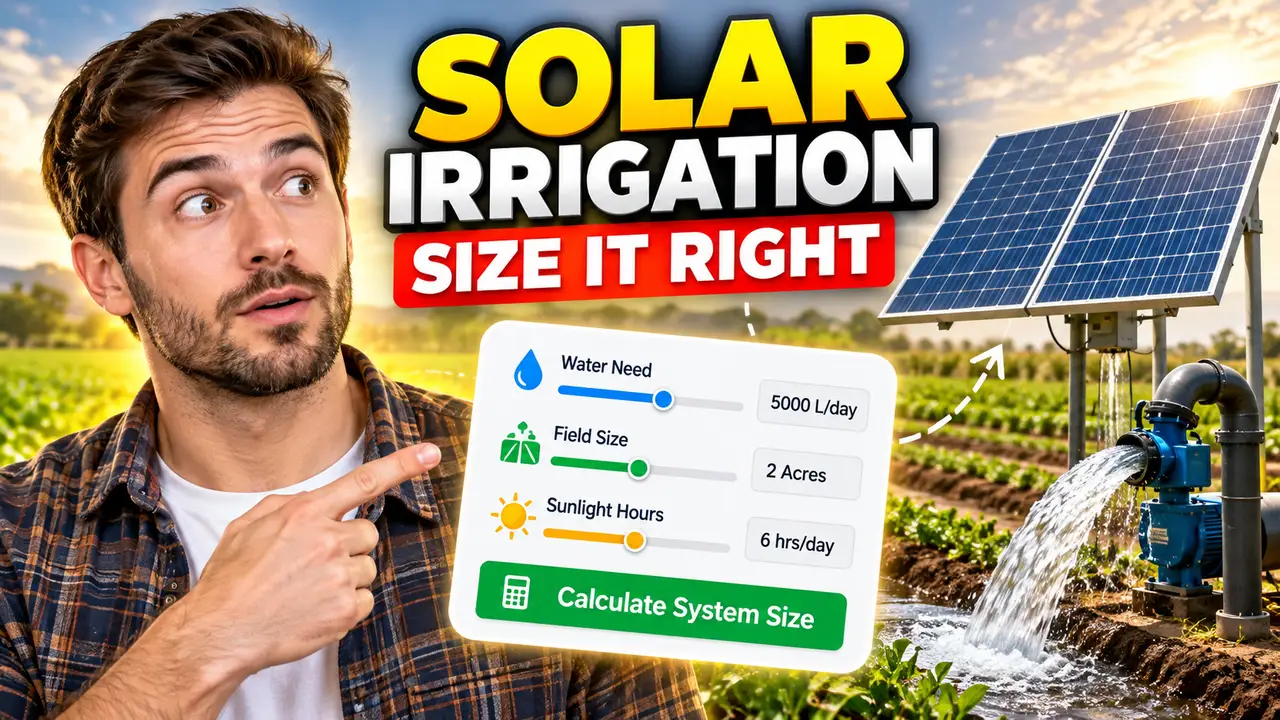
Solar Irrigation System Sizing Calculator Online
TL;DR Summary
The Solar Irrigation System Sizing Calculator Online estimates the water volume, hydraulic pump power, daily energy requirement, and solar PV array size needed for an irrigation pumping system. It is a planning estimate based on the values entered, not a substitute for site-specific pump selection, hydraulic design, solar-resource analysis, or professional engineering review; the supplied tool information does not specify how user data is stored or transmitted.
About This Tool
The Solar Irrigation System Sizing Calculator Online helps estimate the basic size of a solar-powered irrigation pumping system. It is intended for an early planning or pre-sizing check when you know the water flow your irrigation system needs, the total dynamic head, the expected daily pumping time, the system efficiency, the available peak sun hours, and the expected PV derating factor.
The calculator is useful for farmers, landowners, irrigation planners, renewable-energy users, installers, and anyone comparing the basic electrical and hydraulic requirements of a solar water pumping system. It can also help you understand how changes in flow, pumping head, operating time, efficiency, or solar availability affect the required PV capacity.
The main inputs are expressed in U.S. customary units. Required water flow is entered in gallons per minute (GPM). Total dynamic head is entered in feet. Pumping time is entered in hours per day. System efficiency and PV derating are entered as percentages. Peak sun hours are entered as hours per day. An optional solar-panel rating in watts can be entered when you also want an estimated panel count.
What the Calculator Estimates
The calculator first estimates the amount of water delivered each day. It then determines the hydraulic power associated with moving that water against the entered total dynamic head. From that hydraulic requirement, it estimates daily hydraulic energy and the electrical energy needed after applying the entered overall electrical-to-water efficiency.
The final PV sizing step uses the daily electrical energy requirement, the entered peak sun hours, and the PV derating factor. If a panel wattage is entered, the calculator divides the required PV capacity by the individual panel capacity and rounds the result up to a whole number of panels.
The result is therefore a first-pass sizing estimate. Actual solar pumping systems can behave differently because pump performance, controller behavior, motor efficiency, pipe friction, water-level changes, solar radiation, temperature, shading, array orientation, wiring losses, and operating conditions all affect system performance.
How to Use
- Step 1: Enter the required irrigation flow in gallons per minute. Use the flow rate that the irrigation system must receive during operation.
- Step 2: Enter the total dynamic head in feet. Include the vertical lift and the pressure and friction requirements that must be overcome by the pumping system.
- Step 3: Enter the number of hours per day that the pump is expected to operate.
- Step 4: Enter the overall electrical-to-water system efficiency as a percentage. Use an appropriate value for the actual pump, motor, controller, and related equipment when known.
- Step 5: Enter the design peak sun hours per day for the location and period being considered.
- Step 6: Enter the PV system derating factor as a percentage to account for expected usable-output losses.
- Step 7: Optionally enter the rated wattage of the solar panels you are considering. The calculator will then estimate the number of panels and the resulting installed PV capacity.
- Step 8: Review the estimated water volume, hydraulic power, daily energy demand, required PV array, and optional panel count before using the results for further system design.
Technical Explanation and Formula
The core hydraulic calculation follows the standard water-horsepower relationship used for irrigation pumping. For water, the specific gravity is treated as 1:
Water horsepower = (Q × H) ÷ 3,960
Q is the pump flow in gallons per minute (GPM). H is the total dynamic head in feet. The result is hydraulic or water horsepower.
The calculator converts hydraulic horsepower to kilowatts using:
Hydraulic power (kW) = Water horsepower × 0.746
Daily hydraulic energy is then:
Daily hydraulic energy (kWh/day) = Hydraulic power (kW) × Pumping hours per day
The electrical energy requirement accounts for the entered overall electrical-to-water system efficiency:
Daily electrical energy = Daily hydraulic energy ÷ System efficiency
For example, if the system efficiency is entered as 50%, the efficiency used in the calculation is 0.50. This means the electrical energy requirement is twice the useful hydraulic energy.
The PV array estimate uses:
Required PV array (kW) = Daily electrical energy ÷ (Peak sun hours × PV derating factor)
Peak sun hours represent equivalent hours of solar production at the reference peak irradiance level. The PV derating factor represents the usable portion of the nominal solar resource after the losses represented by the user's chosen design factor.
When panel wattage is supplied, the estimated panel count is:
Panel count = Ceiling(Required PV array in kW ÷ Panel rating in kW)
For example, a 400-watt panel has a nominal capacity of 0.40 kW. If the calculated PV requirement is 1.13 kW, 1.13 ÷ 0.40 equals 2.825, so the calculator rounds up to 3 panels. The installed nominal array would then be 1.20 kW.
Worked Example
Consider an irrigation system requiring 20 GPM, a total dynamic head of 100 feet, six pumping hours per day, 50% electrical-to-water efficiency, five peak sun hours per day, and an 80% PV derating factor.
The hydraulic requirement is approximately 0.51 horsepower, or about 0.38 kW of hydraulic power. At six operating hours per day, the system needs about 2.26 kWh/day of useful hydraulic energy. At 50% efficiency, the electrical requirement is about 4.52 kWh/day.
Using five peak sun hours and an 80% PV factor gives an estimated PV requirement of about 1.13 kW. With 400-watt panels, the calculator rounds this up to 3 panels, giving a nominal installed capacity of 1.20 kW.
Important Meaning of Total Dynamic Head
Total dynamic head is one of the most important inputs in a pumping calculation. It is not simply the depth of the well. It represents the total head the pump must overcome while delivering the required flow. Depending on the installation, this can include elevation differences, required discharge pressure, pipe friction, fittings, valves, and other hydraulic losses.
A system with a deeper water source is not automatically described correctly by entering only the well depth. Likewise, a shallow water source can still require substantial pumping power if the discharge pressure or pipe losses are high. Use an appropriate total dynamic head value for the complete pumping duty.
Preset Examples and Quick Reference
| Input or Output | Unit | What It Represents |
|---|---|---|
| Required Water Flow | GPM | Water delivered by the pump while operating |
| Total Dynamic Head | ft | Total pumping head the system must overcome |
| Pumping Time | hours/day | Expected daily pump operating time |
| System Efficiency | % | Electrical input converted into useful hydraulic output |
| Peak Sun Hours | hours/day | Design solar-energy availability |
| PV Derating | % | Usable portion of nominal PV production |
| Required PV Array | kW | Estimated nominal solar-array capacity |
Why Total Dynamic Head and Solar Availability Matter
Increasing flow or head increases the hydraulic power requirement. Increasing the number of pumping hours increases daily water delivery and daily energy demand. Lower system efficiency increases the electrical energy that must be supplied. Fewer peak sun hours or a lower usable PV factor increases the required nominal PV capacity.
Solar pumping is also a seasonal design problem. Solar availability changes with location, season, weather, array orientation, and other conditions. Water demand can change at the same time. A single annual average may therefore not represent the most demanding design period. A proper project assessment should use appropriate solar-resource and irrigation-demand data for the site and design period.
Why Use This Solar Irrigation System Sizing Calculator Online & How Our Calculator Beats the Competition
| Method | Ease of Use | Calculation Speed | Best For | Limitations |
|---|---|---|---|---|
| Toolhox Calculator | Enter the main sizing variables directly | Immediate estimate | Initial solar irrigation pre-sizing | Does not replace site-specific engineering or detailed pump selection |
| Manual Calculation | Requires working through each formula | Depends on the user | Checking individual calculations | More opportunity for unit or arithmetic mistakes |
| Spreadsheet Calculation | Requires a prepared spreadsheet | Fast after setup | Repeated scenarios and custom models | Quality depends on spreadsheet design and inputs |
| Professional Engineering Software | Usually requires more detailed setup | Depends on the model | Detailed project design and engineering analysis | More information and technical modeling may be required |
Assumptions and Limitations
This calculator is a pre-sizing tool. It does not select a specific pump from a manufacturer pump curve, model a complete pipe network, determine crop evapotranspiration, calculate site-specific irrigation scheduling, or perform a detailed solar-resource simulation.
The calculator assumes the entered flow rate and total dynamic head describe the required pumping duty. It also assumes that the entered system efficiency is an appropriate overall electrical-to-water efficiency and that the peak sun hours and PV derating factor are suitable for the design period.
Real pump performance depends on the actual pump curve and operating point. Motor, controller, inverter, wiring, temperature, shading, dust, array orientation, and other losses can affect PV system output. Water levels can also change during pumping, especially in wells. These effects may make actual performance different from this estimate.
The calculator should not be the only basis for purchasing equipment or constructing a permanent irrigation system. For larger, complex, or safety-critical installations, have the hydraulic requirements, pump curve, electrical system, solar resource, water availability, and local requirements reviewed by an appropriately qualified professional.
The tool's supplied information does not establish a specific privacy or data-storage policy. Avoid entering sensitive information unless the page's own privacy information explains how submitted data are handled.