Solar Water Heater Sizing Calculator Tool Online
Calculate solar collector area and storage needs with Solar Water Heater Sizing Calculator Tool. Enter household size and U.S. region for planning purposes.
Please complete this field to continue.
Please complete this field to continue.
Results
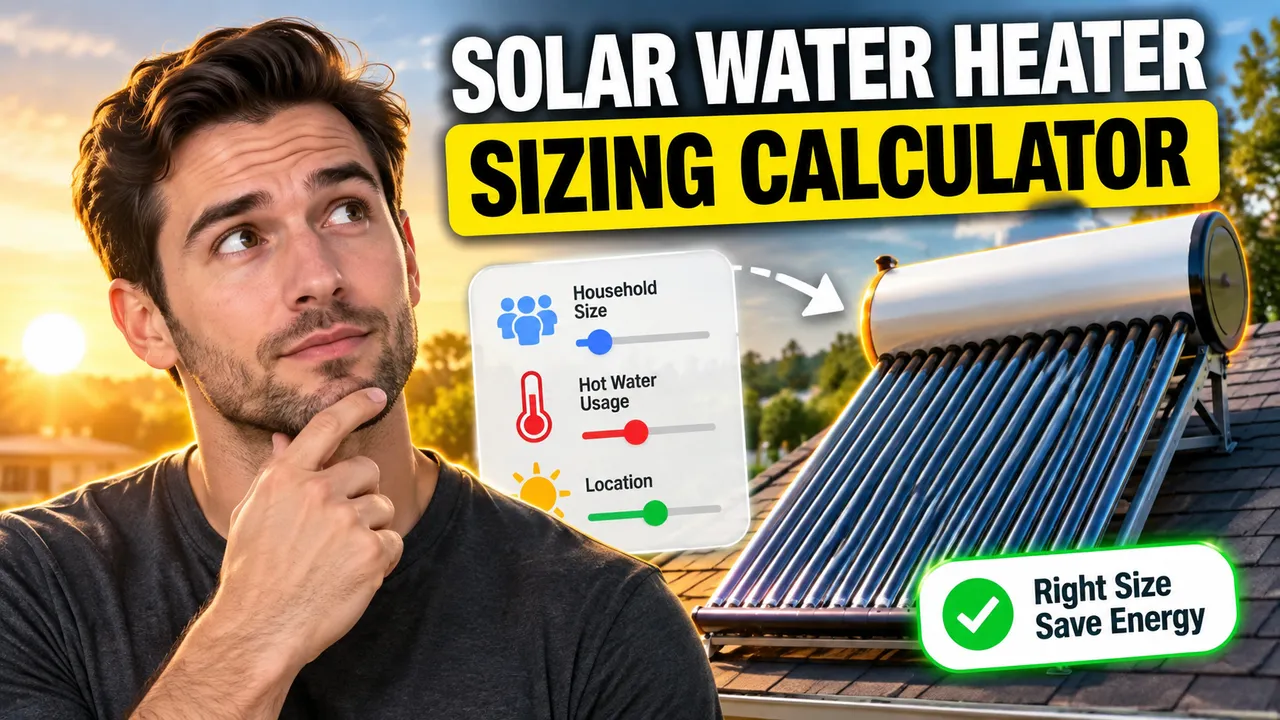
Solar Water Heater Sizing Calculator Tool
TL;DR Summary
The Solar Water Heater Sizing Calculator Tool estimates a residential solar thermal collector area and typical solar storage volume from household size and U.S. climate region. It is a planning estimate based on U.S. Department of Energy sizing guidance, not a final engineering design, and the supplied tool information does not establish a specific data-storage or server-processing policy.
What This Solar Water Heater Sizing Calculator Does
The Solar Water Heater Sizing Calculator Tool helps homeowners, planners, contractors, and other users make an early estimate of the size of a residential solar hot water system. The calculator focuses on two basic sizing questions: how much solar collector area may be appropriate and how much solar storage may be associated with that collector area.
Solar water heating systems use solar thermal collectors to capture heat from sunlight and transfer that heat to domestic hot water. A storage tank holds heated water until it is needed. Modern solar water heating systems can use different collector types and system arrangements, including active systems with pumps and passive systems that use natural circulation. Because system performance depends on the site, equipment, climate, orientation, storage, and hot water demand, a simple sizing estimate cannot replace a detailed system design.
This calculator uses a published U.S. Department of Energy residential rule of thumb for collector sizing. The guidance calls for about 20 square feet of collector area for the first two household members. For each additional person, the guidance gives about 8 square feet in the Sun Belt or about 12 to 14 square feet in the northern United States. For active systems, the same DOE guidance describes typical solar storage of about 1.5 gallons per square foot of collector area.
The calculator therefore asks for only two inputs: the number of household members and the U.S. climate region. Household size is important because hot water demand generally increases as more people use showers, sinks, appliances, and other fixtures. Climate region matters because solar resource and system requirements differ across the United States.
Who Can Use It?
This tool is intended for early-stage residential planning. A homeowner can use it to understand the approximate scale of a solar hot water installation before speaking with an installer. A contractor or building professional can use it as a quick rule-of-thumb reference during preliminary discussions. It can also help someone compare the general system size associated with a smaller or larger household.
The calculator is not intended to produce a stamped engineering design, equipment specification, plumbing plan, structural plan, or permit package. It also does not select a specific collector model, storage tank model, pump, heat exchanger, controller, backup heater, piping layout, or mounting system.
Inputs Used by the Calculator
- Number of household members: Enter the number of people who regularly use hot water in the home.
- U.S. climate region: Select either Sun Belt or Northern U.S. to apply the corresponding DOE collector-area rule of thumb.
The calculator intentionally keeps the input list small. It does not ask for information that is not needed for the selected rule-of-thumb calculation. For example, it does not require a solar radiation value, collector efficiency, roof pitch, collector brand, water temperature, or utility rate.
What the Calculator Produces
The primary result is a recommended solar collector area in square feet. For a Sun Belt location, the calculator produces a single collector-area estimate because the cited DOE guideline uses 8 square feet for each person beyond the first two. For a northern U.S. location, the calculator produces a range because the DOE guideline gives 12 to 14 square feet for each additional person.
The calculator also estimates typical solar storage in gallons by applying the cited active-system relationship of approximately 1.5 gallons of storage per square foot of collector area. When the collector result is a range, the storage result is also presented as a range.
How to Use
- Step 1: Enter the number of people who regularly use hot water in the home.
- Step 2: Select Sun Belt or Northern U.S. based on the home's location.
- Step 3: Review the estimated collector area shown in square feet.
- Step 4: Review the typical solar storage estimate shown in gallons.
- Step 5: Use the result as an early planning reference and have the final system evaluated for the actual site and equipment.
Technical Explanation and Formula
The calculator follows a simple rule-of-thumb approach rather than a detailed solar performance simulation.
For the first two household members:
Collector Area = 20 sq ft
For a Sun Belt location with more than two people:
Collector Area = 20 + (Additional People × 8) sq ft
For a northern U.S. location with more than two people:
Collector Area = 20 + (Additional People × 12 to 14) sq ft
Where:
- 20 sq ft is the DOE guideline for the first two household members.
- Additional People is the household size minus two, with zero used when the household has one or two members.
- 8 sq ft is the cited additional collector-area guideline for each additional person in the Sun Belt.
- 12 to 14 sq ft is the cited additional collector-area range for each additional person in the northern United States.
For active systems, the storage estimate uses:
Storage Volume = Collector Area × 1.5 gallons/sq ft
This means a calculated 40-square-foot collector area corresponds to about 60 gallons of storage under the cited storage relationship. The storage calculation is a sizing reference, not a recommendation for a particular commercially available tank.
Worked Example
Suppose a four-person household is located in the Sun Belt. The first two people account for 20 square feet. The two additional people add 8 square feet each.
Collector Area = 20 + (2 × 8) = 36 sq ft
Using the active-system storage relationship:
Storage = 36 × 1.5 = 54 gallons
The calculator would therefore show approximately 36 square feet of collector area and 54 gallons of typical solar storage. Actual equipment selection may use a different commercially available tank size and may require a different collector area after site-specific design.
Quick Reference
| Household Size | Sun Belt Collector Guideline | Northern U.S. Collector Guideline |
|---|---|---|
| 1–2 people | 20 sq ft | 20 sq ft |
| 3 people | 28 sq ft | 32–34 sq ft |
| 4 people | 36 sq ft | 44–48 sq ft |
| 5 people | 44 sq ft | 56–62 sq ft |
| 6 people | 52 sq ft | 68–76 sq ft |
The table is a direct application of the cited DOE rule of thumb. It should not be interpreted as a guaranteed system performance table.
Why Use This Solar Water Heater Sizing Calculator Tool & How Our Calculator Beats the Competition
The practical value of this tool is that it turns a published sizing guideline into a small set of household-specific estimates. It is useful when a detailed engineering model would be premature but a homeowner or planner still needs an initial idea of system scale.
| Method | Ease of Use | Calculation Speed | Best For | Limitations |
|---|---|---|---|---|
| Toolhox Calculator | Enter household size and region | Immediate estimate | Early residential planning | Uses a rule of thumb rather than site-specific engineering |
| Manual Calculation | Requires applying the sizing rule yourself | Depends on the user | Checking or learning the formula | More opportunity for arithmetic or application errors |
| Spreadsheet Calculation | Requires setting up or maintaining a worksheet | Fast after setup | Custom planning models | Results depend on the spreadsheet's formulas and assumptions |
| Professional Engineering Software | More inputs and technical knowledge required | Depends on the model | Detailed system and site analysis | More complex than a basic rule-of-thumb estimate |
Assumptions and Limitations
This calculator is intentionally a preliminary sizing tool. It does not perform a full solar thermal simulation. It does not calculate annual solar yield, monthly solar fraction, collector efficiency, freeze protection, stagnation temperature, piping losses, tank heat loss, backup-heater operation, roof shading, roof structure, orientation, tilt, local weather data, or detailed hot-water draw profiles.
The DOE guidance itself notes that professional worksheets and computer programs are used for detailed system requirements and collector sizing. Solar water heating performance also varies with solar resource, equipment type, system configuration, and installation conditions.
The calculator's Sun Belt and Northern U.S. categories are broad planning categories rather than a precise local solar-resource model. A location near a regional boundary may need a more detailed assessment. Household behavior can also vary significantly. A household with unusually high hot-water use may need a different system size from a household with the same number of occupants but lower demand.
For an actual installation, the result should be reviewed with a qualified solar water heating contractor or engineer. The final design should account for the site's solar resource, roof orientation and shading, local plumbing and building requirements, freeze and overheating protection, collector and tank specifications, backup heating, and the household's actual hot-water demand.