Solar Panel Weight Calculator For Roof
Use Solar Panel Weight Calculator For Roof to estimate total solar panel weight and roof load per square foot from panel count, panel weight, and dimensions.
Please complete this field to continue.
Please complete this field to continue.
Please complete this field to continue.
Please complete this field to continue.
Results
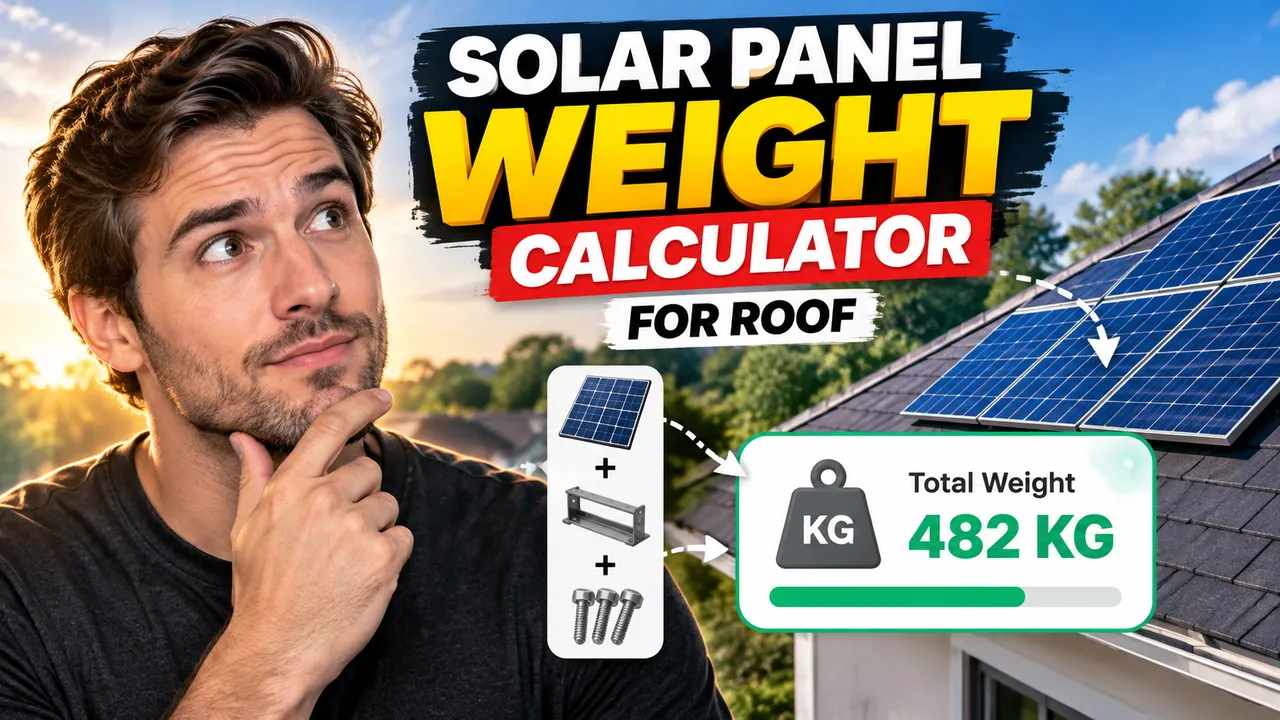
Solar Panel Weight Calculator For Roof
TL;DR Summary
The Solar Panel Weight Calculator For Roof estimates the combined weight of a group of solar panels and the panel-only weight spread across their covered roof area. Use it for early planning and load estimation; it does not replace a structural roof evaluation, and the supplied tool information does not establish how entered data is stored or transmitted.
About This Tool
The Solar Panel Weight Calculator For Roof is designed to answer a practical question before a rooftop solar installation: how much will the solar panels weigh, and how much panel weight is applied over the area occupied by the panels?
This is useful for homeowners, solar shoppers, installers, builders, and anyone doing an early review of a roof-mounted photovoltaic system. A solar array adds dead load to a roof. Dead load means the permanent weight of equipment that remains on the structure. Knowing the approximate panel weight helps with an initial review before a more complete structural assessment.
The calculator uses four inputs: the number of solar panels, the weight of each panel in pounds, the length of each panel in feet, and the width of each panel in feet. From those values, it calculates total panel weight, total panel-covered area, and the average panel weight per square foot of panel area.
The calculator does not require the user to enter total roof area because the calculation only needs the area occupied by the solar panels. It also does not require the user to enter a roof pitch, rafter size, roof age, snow load, wind speed, or building location. Those factors can matter for a complete structural design, but they are outside the basic panel-weight calculation.
What the Calculator Measures
Total Panel Weight: This is the combined weight of all panels entered. If 20 panels weigh 45 pounds each, the combined panel weight is 900 pounds.
Total Panel Area: This is the combined face area of the panels. It is calculated by multiplying the length and width of one panel and then multiplying that area by the number of panels.
Panel Weight per Roof Area: This is the average panel-only weight divided by the panel-covered area. The result is expressed in pounds per square foot, or lb/ft².
This last value is useful for understanding the average weight density of the panels themselves. It should not be treated as the complete structural load of a rooftop solar system.
How to Use
- Step 1: Enter the number of solar panels you expect to install.
- Step 2: Enter the weight of one panel in pounds. Use the manufacturer's published module weight when available.
- Step 3: Enter the length of one panel in feet.
- Step 4: Enter the width of one panel in feet.
- Step 5: Review the total panel weight, total panel area, and calculated panel weight per square foot.
- Step 6: Compare the estimate with the information provided by the solar installer, panel manufacturer, and the person responsible for evaluating the roof structure.
Technical Explanation and Formula
The calculator uses standard arithmetic based on the physical dimensions and weight of the panels. The calculation is intentionally focused on the panels rather than attempting to model an entire rooftop solar structural system.
Formula 1: Total Panel Weight
Total Panel Weight = Number of Panels × Weight per Panel
Number of Panels is the quantity of modules. Weight per Panel is measured in pounds. The result is measured in pounds.
Formula 2: Area of One Panel
Panel Area = Panel Length × Panel Width
Panel Length and Panel Width are measured in feet. The result is measured in square feet.
Formula 3: Total Panel Area
Total Panel Area = Number of Panels × Panel Area
The result represents the combined face area of all panels and is measured in square feet.
Formula 4: Average Panel Weight per Area
Panel Weight per Roof Area = Total Panel Weight ÷ Total Panel Area
The result is measured in pounds per square foot, or lb/ft².
No intermediate calculation is rounded. The displayed results are rounded to two decimal places.
Worked Example
Suppose a proposed array has 20 panels. Each panel weighs 45 lb and measures 6.5 ft by 3.3 ft.
| Input or Result | Value |
|---|---|
| Number of panels | 20 |
| Weight per panel | 45 lb |
| Panel dimensions | 6.5 ft × 3.3 ft |
| Total panel weight | 900 lb |
| Total panel area | 429 ft² |
| Average panel weight per area | 2.10 lb/ft² |
This example describes the weight of the panels over their combined panel area. It does not mean the roof receives exactly 2.10 lb/ft² at every location. Mounting points can concentrate loads on particular rafters, trusses, joists, or other structural members.
Why Racking and Mounting Weight Matters
A complete rooftop PV system normally includes more than the modules. Depending on the installation, there may be rails, clamps, flashing, fasteners, attachments, ballast, and other mounting components. These components add weight that is not included in this panel-only calculation.
Federal solar guidance illustrates why this distinction matters. The U.S. Department of Energy says a conventional PV system that includes racking materials may add approximately 6 lb/ft² of dead load, while noting that actual weights vary by system. NREL materials have also published lower typical estimates for certain rooftop PV configurations. These figures are reference ranges for planning and are not a substitute for the actual equipment specifications or structural design for a particular building.
What This Calculator Does Not Determine
The Solar Panel Weight Calculator For Roof does not determine whether a particular roof can safely support a solar installation. It does not calculate the capacity of rafters, trusses, joists, roof decking, connections, or foundations. It also does not calculate wind uplift, snow load, seismic load, rain load, or concentrated attachment forces.
Roof structure and site conditions can change the required engineering. The type of roof covering, roof slope, mounting method, building location, wind exposure, snow conditions, and the location of mounting attachments can all affect the structural evaluation.
Assumptions and Limitations
- The entered panel weight is assumed to be the weight of one solar module.
- The entered dimensions are assumed to be in feet.
- The calculation assumes every panel has the same weight and dimensions.
- The result covers panel weight only unless the user separately accounts for other system components.
- The calculator does not determine whether the existing roof has enough structural capacity.
- The calculated lb/ft² value is an average over panel area and does not represent concentrated attachment loads.
- Manufacturer specifications should be used when available instead of generic panel assumptions.
For an existing building, a structural professional or qualified solar design professional may need to review the roof structure before installation. This is particularly important where the roof is older, damaged, heavily loaded, unusually constructed, or subject to significant wind or snow conditions.
Why Use This Solar Panel Weight Calculator For Roof & How Our Calculator Beats the Competition
The practical advantage of this calculator is that it puts the basic panel-weight calculation into a repeatable input-and-result format. It is useful when you have the panel specifications and want a quick estimate without building the arithmetic manually. It is not intended to replace engineering software or a project-specific structural review.
| Method | Ease of Use | Calculation Speed | Best For | Limitations |
|---|---|---|---|---|
| Toolhox Calculator | Enter four panel values | Immediate calculation | Early panel-weight and area estimates | Does not perform structural engineering or full system-load analysis |
| Manual Calculation | Requires arithmetic | Depends on the user | Simple one-off calculations | More opportunity for arithmetic or unit-entry mistakes |
| Spreadsheet | Requires spreadsheet setup | Fast after setup | Repeated calculations and custom records | Requires formulas and workbook maintenance |
| Professional Engineering Software | More specialized | Depends on the model | Detailed structural design and load evaluation | More inputs and technical knowledge are required |
When to Use the Result
Use the result as an early planning number. It can help you understand the scale of the panel weight and provide a starting point for discussions with a solar installer or structural professional.
Do not use the result by itself to approve a solar installation. A roof's ability to support an array depends on its existing structure and the complete set of loads acting on it. The solar mounting system can also transfer forces to specific structural members rather than spreading the load evenly across the entire roof.
Panel Weight Versus Complete Solar-System Weight
One of the most important distinctions is the difference between module weight and system weight. A panel-only estimate can be useful, but it does not include every component installed on the roof. Racking, attachments, ballast, wiring, and other equipment may add additional dead load.
For this reason, use the manufacturer's documentation and the proposed mounting-system specifications when a project moves beyond early planning. The calculator is most useful as a transparent estimate based on known panel specifications, not as a final structural determination.
For a project-specific roof decision, the final evaluation should account for the applicable building requirements and site loads. Federal Building America guidance notes that rooftop PV design needs to consider dead load as well as wind and snow conditions, and that mounting can concentrate loads on individual roof members.