Free Speech Topic Generator | Unlimited Ideas
Generate persuasive, informative, and engaging speech topics in seconds using our free AI speech topic generator tool for students and speakers.
Choose Your Randomness
Full topics, ice-breaker questions, single words, or a mix.
If this field is highlighted, pick an option to continue.
How many fresh picks per click.
If this field is highlighted, pick an option to continue.
📌 Using this tool's default topics, questions & words. The category dropdown is disabled.
Your Topics
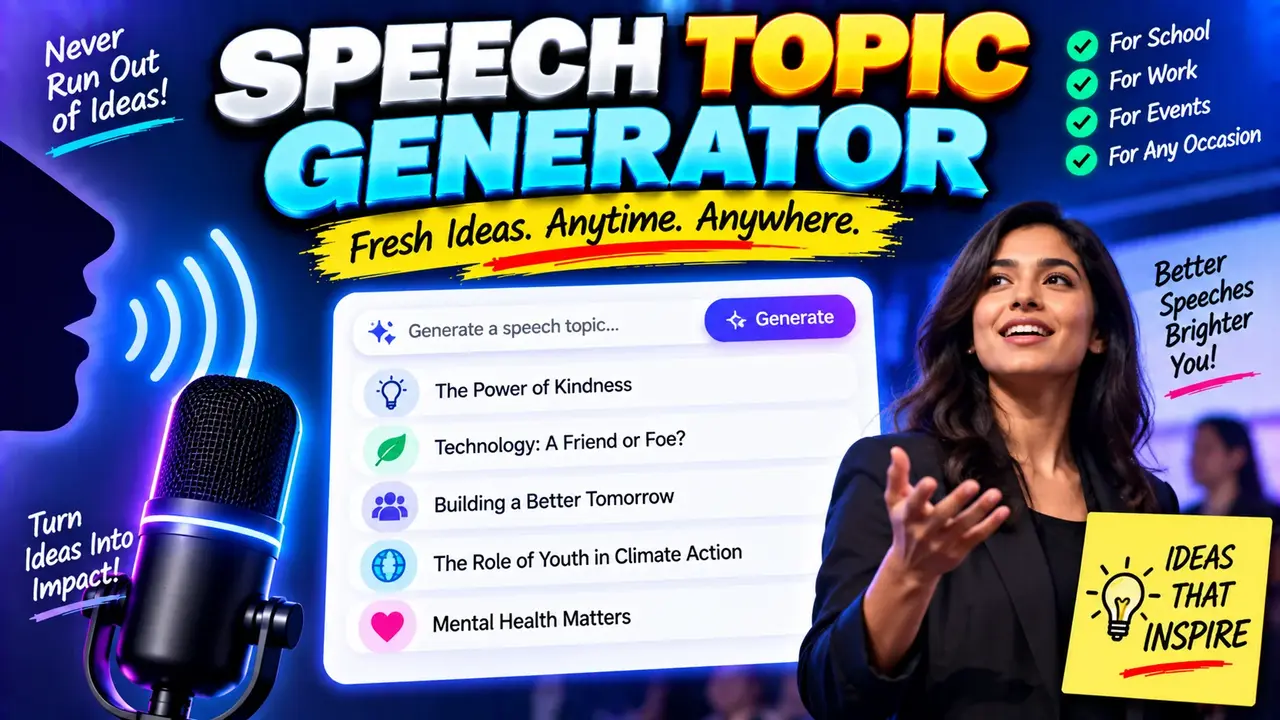
Online Speech Topic Generator
TL;DR Summary
Speech Topic Generator helps users come up with ideas for speeches when they need a starting point for a class, presentation, event, or other speaking task. The available tool specifications do not confirm its exact input fields, generation method, or data-handling behavior, so users should treat generated topics as starting ideas and avoid entering sensitive information unless the page clearly explains how submitted information is handled.
About Speech Topic Generator
Speech Topic Generator is a topic-idea tool designed to help users find possible subjects for a speech. Choosing a speech topic can be difficult when you know you need to speak about something but do not yet have a clear idea. A topic generator can help turn a blank page into a useful list of directions to consider.
The tool is relevant to students, teachers, presenters, public speakers, club members, event participants, and anyone preparing a speech. It can be useful when you need several ideas before choosing one. It can also help when your first few ideas feel too broad, too familiar, or difficult to develop into a full speech.
The exact fields and controls available in the live tool are not specified in the supplied tool information. Because of that, this page does not assume that the generator requires a particular topic, audience, speech length, category, tone, or difficulty level. If the interface provides those options, users can use them to narrow the type of ideas they want. If the interface does not provide them, the generated results should simply be treated as general speech-topic suggestions.
What the Tool Generates
The primary purpose of Speech Topic Generator is to produce possible speech topics. A generated topic is an idea that can be evaluated and developed into a speech. The tool does not replace the work of researching a subject, checking facts, understanding an audience, or creating a clear speech structure.
For example, a useful topic should give you enough room to explain an idea, make a case, tell a story, teach something, or engage an audience. A topic that is extremely broad may be difficult to cover in a short speech. A topic that is too narrow may not provide enough material. After receiving suggestions, consider whether each idea fits your assignment, audience, available time, and personal interests.
Who Can Use It?
Speech Topic Generator can be useful for people at different stages of speech preparation. A student who has been given a general speaking assignment may use it to explore possible subjects. A presenter may use it when preparing a new talk. A teacher or group leader may use topic ideas as prompts for speaking activities. Someone preparing an informal presentation can also use generated suggestions as a starting point for brainstorming.
The tool is especially useful when the main problem is topic selection rather than final speech writing. Once you choose an idea, you may still need to research the subject, identify reliable information, define your main message, organize your points, and prepare an introduction and conclusion.
How to Use
- Step 1: Open Speech Topic Generator and review the available input fields or topic options shown by the tool.
- Step 2: Enter the information requested by the interface, if any, using a speech subject, theme, category, or other available preference.
- Step 3: Start the generator using the control provided on the page.
- Step 4: Review the speech topic suggestions that are returned and identify ideas that fit your assignment or speaking goal.
- Step 5: Choose a topic that you can explain or develop within your available speaking time and that is appropriate for your intended audience.
- Step 6: Research and verify the selected topic before using it in a finished speech, especially when the speech depends on facts, statistics, quotations, or other claims.
Technical Explanation and Generation Logic
Speech Topic Generator is a generator rather than a mathematical calculator, so there is no confirmed numerical formula to document. The supplied specifications do not reveal the internal generation method, prompt structure, topic database, randomization process, or any hidden rules used by the live tool. It would therefore be misleading to claim a specific algorithm.
At a functional level, the generator takes the information available through its interface and produces speech-topic suggestions. The exact relationship between user inputs and generated results depends on the implementation of the tool. If optional controls are presented, they may help shape the requested type of topic, but users should rely on the actual controls and labels displayed on the page rather than assumed features.
There are also no confirmed units, conversion formulas, numerical precision rules, or calculation assumptions for this generator. The relevant output is a set of topic ideas rather than a calculated measurement.
Choosing a Useful Generated Topic
A generated idea is only a starting point. Before selecting it, check whether you can turn it into a focused speech. Consider the audience first. A topic that works for a classroom presentation may not work for a formal business presentation or a short event speech.
Next, consider scope. A broad subject such as technology, education, health, or the environment may contain many possible speech directions. Narrowing the subject to one clear question or issue can make the speech easier to organize.
Also consider your available evidence. If a topic depends on facts or current information, make sure you can find reliable sources to support the speech. If the topic is persuasive, consider whether you can explain the issue fairly and support your position with evidence. If it is informative, make sure there is enough accurate information to teach the audience something useful.
Preset Examples and Quick Reference
| Speech Goal | What to Look For | Next Step |
|---|---|---|
| Informative | A subject that can be clearly explained | Research the main facts and organize them into key points |
| Persuasive | An issue that allows a clear position and supporting evidence | Define the main claim and check reliable sources |
| Class presentation | A topic that fits the assignment and time limit | Check the teacher's requirements before developing the idea |
| General brainstorming | An idea that sparks further questions | Expand the idea into possible points, questions, or examples |
These examples describe ways to evaluate a generated topic. They are not claims about preset categories built into the tool. The supplied tool information does not confirm a fixed list of categories or generation modes.
Why Use This Speech Topic Generator & How Our Speech Topic Generator Beats the Competition
The practical value of a speech topic generator is that it gives you a structured starting point for brainstorming. The supplied information confirms the tool's purpose but does not provide verified performance data or feature-by-feature information about other named generators. The comparison below therefore focuses on general methods rather than unsupported competitor claims.
| Method | Ease of Use | Generation Approach | Best For | Limitations |
|---|---|---|---|---|
| Toolhox Speech Topic Generator | Designed for topic generation | Produces speech-topic ideas based on the available tool inputs | Starting a speech-topic brainstorming process | Generated ideas still need user review and development |
| Manual Brainstorming | Depends on the user | User creates ideas without a generator | People who already have several ideas | Can be difficult when starting with a blank page |
| Spreadsheet List | Requires setup or an existing list | Uses previously collected topic ideas | Organizing a personal topic bank | Does not automatically create new ideas unless additional logic is added |
| General Search | Requires reviewing search results | Finds existing pages, lists, and discussions | Researching possible subjects and background information | Results may be broad and still require topic selection |
Assumptions and Limitations
The most important limitation is that the supplied specifications identify the product as a Speech Topic Generator but do not document the live interface, exact input fields, output count, generation algorithm, topic categories, or generation limits. This page therefore avoids claiming features that have not been confirmed.
Generated topics should be treated as brainstorming suggestions. A topic is not automatically suitable simply because it was generated. You should check the topic against your assignment instructions, audience, speaking time, required subject area, and available sources.
The generator also should not be treated as a substitute for research or fact-checking. If a suggested topic involves current events, scientific claims, statistics, laws, financial information, health information, or other changing facts, verify the relevant information with appropriate sources before including it in a speech.
Privacy behavior is not specified in the supplied tool information. Do not assume that information entered into the tool is stored, deleted, processed locally, or sent to a server. Unless the page provides clear information about data handling, avoid entering sensitive or confidential information.
Speech Topic Generator is most useful at the idea stage. Once you have a promising topic, the next tasks are to narrow the focus, understand the audience, gather reliable information, create a clear structure, and practice the final speech.