Storm Wind Load Calculator For Fences Calculate
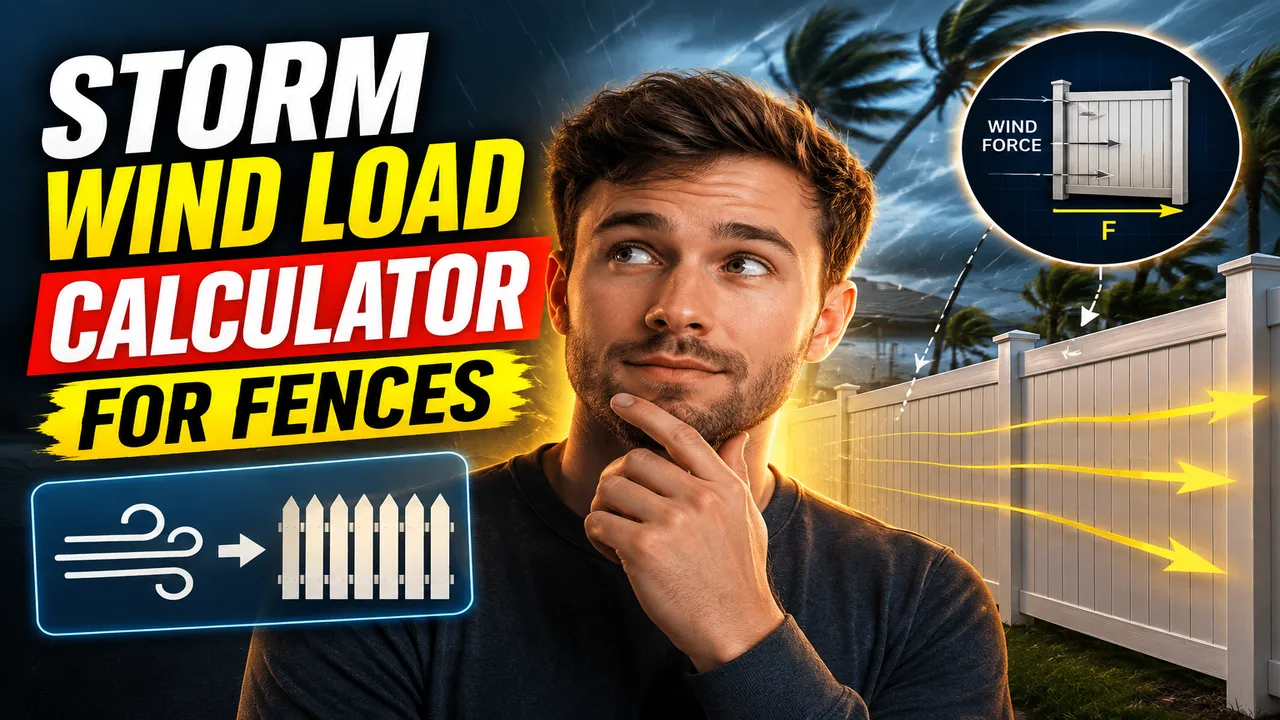
Use Storm Wind Load Calculator For Fences to estimate wind pressure and total fence force from wind speed, fence size, and key ASCE 7-22 factors for planning.
Please complete this field to continue.
Please complete this field to continue.
Please complete this field to continue.
Please complete this field to continue.
Please complete this field to continue.
Please complete this field to continue.
Please complete this field to continue.
Results
Storm Wind Load Calculator For Fences
TL;DR Summary
Storm Wind Load Calculator For Fences estimates wind pressure and the resulting horizontal wind force on a fence using wind speed, fence size, site exposure, and ASCE 7-22-style wind factors. Use the result for preliminary planning and checking, not as a substitute for a site-specific structural design or local code review; privacy behavior is not specified by the supplied tool information, so avoid entering sensitive information unless the page explains how it is handled.
About This Tool
The Storm Wind Load Calculator For Fences is designed to estimate the force that wind can apply to a fence. Wind creates pressure on the exposed face of a fence, and that pressure can place significant lateral demand on fence panels, posts, connections, footings, and surrounding soil. A useful wind-load estimate helps you understand the size of that demand before selecting or checking structural components.
This calculator is intended for preliminary U.S. wind-load calculations. It uses a wind-engineering approach based on the velocity-pressure and force relationships used by ASCE/SEI 7-22 for other structures, including solid freestanding walls and signs. ASCE 7-22 is the current edition identified by ASCE for general structural loading in the United States. Local building codes can modify or supplement the standard, so the calculator should not be treated as an automatic code-compliance determination.
The main inputs are the basic wind speed, fence height, fence length, exposure category, topographic factor, ground elevation, and net force coefficient. Wind speed is entered in miles per hour. Fence dimensions and elevation are entered in feet. The exposure category describes the surrounding terrain and affects the velocity pressure exposure coefficient, Kz. The topographic factor, Kzt, accounts for applicable wind-speed increases caused by hills, ridges, escarpments, or other qualifying terrain features. The ground elevation is used to calculate Ke, the ground-elevation factor. The net force coefficient, Cf, represents the aerodynamic effect of the fence geometry and must come from the applicable design provision or project-specific engineering data.
The calculator reports velocity pressure, gross projected fence area, design wind pressure, ultimate wind force, an ASD-equivalent wind force, and wind force per foot of fence. It also reports Kz and Ke so you can see important intermediate factors used in the estimate.
How to Use
- Step 1: Enter the applicable basic wind speed in mph. For a project using ASCE 7-22, obtain the site wind speed from the applicable wind-speed map or an appropriate site-specific design source.
- Step 2: Enter the fence height and total fence length in feet. The calculator uses these dimensions to determine the gross projected fence area.
- Step 3: Select the applicable Exposure Category B, C, or D based on the terrain around the site.
- Step 4: Enter the topographic factor Kzt. A value of 1.00 can be used where no applicable topographic speed-up effect is present.
- Step 5: Enter the ground elevation above sea level in feet. This value is used to calculate the ground-elevation factor Ke.
- Step 6: Enter the applicable net force coefficient Cf from the governing wind-load provision or project design information.
- Step 7: Review the velocity pressure, design pressure, total wind force, and force per foot. Compare the result with the structural capacity of the fence system and applicable local requirements.
Technical Explanation and Formula
The calculator uses the U.S. customary form of the ASCE 7-22 velocity-pressure relationship. The implementation combines the directionality factor into the calculated velocity pressure and then applies the gust factor and net force coefficient to determine the fence force.
Velocity pressure:
qh = 0.00256 × Kz × Kzt × Kd × Ke × V²
Here, qh is velocity pressure in pounds per square foot (psf). Kz is the velocity pressure exposure coefficient. Kzt is the topographic factor. Kd is the wind directionality factor, taken as 0.85 for the solid freestanding-wall calculation used here. Ke is the ground-elevation factor. V is the basic wind speed in mph.
For the exposure calculation, the calculator uses the ASCE 7-22 terrain constants for Exposure B, C, and D and evaluates Kz using the applicable reference height, including the minimum-height requirement for each exposure category.
The projected fence area is:
As = h × L
where As is gross projected area in square feet, h is fence height in feet, and L is fence length in feet.
The design wind pressure is calculated as:
p = qh × G × Cf
where p is the resulting wind pressure in psf, G is the gust-effect factor, and Cf is the net force coefficient. The calculator uses G = 0.85 for the rigid-structure assumption in this preliminary calculation.
The resulting ultimate wind force is:
F = p × As
or, equivalently:
F = qh × G × Cf × As
The calculator also reports an ASD-equivalent value using a 0.60 conversion from strength-level wind force. This is a reference value and should be used only when the applicable design method calls for that conversion.
Worked Example
Suppose a preliminary calculation uses a 100 mph basic wind speed, a 6 ft high and 50 ft long fence, Exposure C, Kzt = 1.00, ground elevation of 0 ft, and Cf = 1.50.
| Input or Result | Example Value |
|---|---|
| Basic wind speed | 100 mph |
| Fence height | 6 ft |
| Fence length | 50 ft |
| Gross projected area | 300 ft² |
| Exposure | C |
| Kzt | 1.00 |
| Cf | 1.50 |
Using the calculator's stated assumptions, the resulting velocity pressure is about 22.15 psf. The calculated design wind pressure is about 28.24 psf, producing an ultimate horizontal wind force of about 8,471 lb across the 300 ft² projected fence area. The corresponding 0.60 ASD-equivalent reference value is about 5,083 lb.
This example is illustrative only. The force coefficient, wind speed, exposure category, and site factors must match the actual project. Changing the wind speed is especially important because velocity pressure varies with the square of wind speed. For example, increasing wind speed by 10% increases the wind-speed portion of the pressure calculation by about 21% before other factors are considered.
Important Inputs and Their Effects
| Input | What It Controls | Unit |
|---|---|---|
| Basic wind speed | Base wind velocity used in the pressure equation | mph |
| Fence height | Projected area and reference height for exposure effects | ft |
| Fence length | Total projected area and total horizontal force | ft |
| Exposure category | Terrain-related velocity pressure coefficient | B, C, or D |
| Kzt | Topographic wind-speed adjustment | factor |
| Ground elevation | Ground-elevation factor Ke | ft |
| Cf | Net aerodynamic force effect | coefficient |
Why Use This Storm Wind Load Calculator For Fences & How Our Calculator Beats the Competition
| Method | Ease of Use | Calculation Speed | Best For | Limitations |
|---|---|---|---|---|
| Toolhox Calculator | Enter defined wind and fence inputs | Immediate calculation | Preliminary fence wind-load estimates | Requires the appropriate wind speed and Cf; does not replace a full engineering design |
| Manual Calculation | Requires formula and code knowledge | Depends on the user | Detailed engineering checks and independent verification | More opportunities for input or arithmetic errors |
| Spreadsheet Calculation | Requires spreadsheet setup | Fast after setup | Repeated project calculations and custom worksheets | Formula and input structure must be maintained by the user |
| Professional Engineering Software | Usually requires more setup | Depends on model complexity | Full structural analysis and engineered project design | More inputs and expertise are typically required |
Assumptions and Limitations
This calculator is a preliminary wind-load estimator. It does not automatically determine the correct site wind speed, risk category, local code adoption, local amendments, or site-specific wind hazards. The wind speed must be supplied by the user from an appropriate source. The net force coefficient Cf must also be selected from the applicable wind-load provision or engineering data for the fence geometry.
The calculation is based on a rigid-structure gust factor and a solid-freestanding-wall style force calculation. Open, porous, chain-link, slatted, fabric, lattice, or unusual fence systems may require different aerodynamic treatment and should not automatically be treated as solid walls. Fence openings, post spacing, end effects, corners, gates, attachment details, shielding, dynamic behavior, ice, debris, and foundation or soil capacity are not fully analyzed by this calculator.
The total wind force is not the same thing as the required capacity of a fence post or footing. Structural capacity also depends on member size, material, connections, embedment, soil conditions, load distribution, and the location where the wind force acts. A fence can have adequate panel strength but still have inadequate posts or foundations.
For a permit application, engineered fence, unusually tall fence, high-wind location, critical facility, or project with unusual terrain or structural conditions, have the result reviewed against the locally adopted building code and applicable engineering requirements. The governing jurisdiction may use a different standard, edition, amendment, or design procedure.
Use the result as a planning and calculation aid rather than as a guarantee of professional engineering or design accuracy.