Solar Array String Sizing Calculator
Use the Solar Array String Sizing Calculator to estimate panel counts per string from module voltage data, temperature effects, and inverter voltage limits.
Please complete this field to continue.
Please complete this field to continue.
Please complete this field to continue.
Please complete this field to continue.
Please complete this field to continue.
Please complete this field to continue.
Please complete this field to continue.
Please complete this field to continue.
Please complete this field to continue.
Please complete this field to continue.
Results
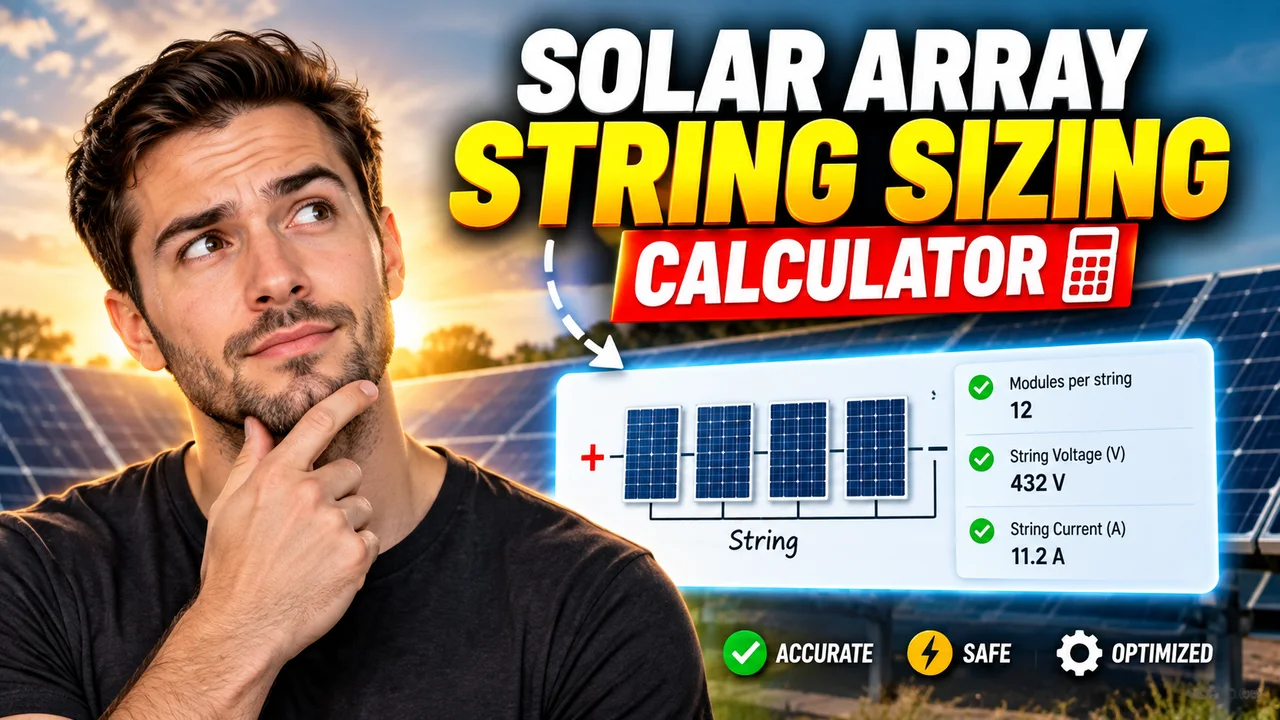
Solar Array String Sizing Calculator Tool
TL;DR Summary
The Solar Array String Sizing Calculator Tool estimates a practical range of solar modules that can be connected in series by checking cold-temperature Voc, hot-temperature Vmp, inverter MPPT limits, and the applicable system voltage limit. It is a design estimate based on the information entered and should be checked against the module and inverter documentation, the electrical code adopted for the project, local requirements, and qualified engineering review; privacy behavior is not specified by the supplied tool information.
About This Tool
The Solar Array String Sizing Calculator Tool helps users estimate how many photovoltaic (PV) modules can be placed in series in one solar string. String sizing is an important part of PV system design because the voltage of solar modules changes with temperature. A string that appears acceptable under standard test conditions can produce a higher open-circuit voltage in cold weather. The same modules can produce a lower maximum-power voltage when the cells become hot.
The calculator focuses on those voltage limits. It uses the module's open-circuit voltage (Voc), maximum-power voltage (Vmp), temperature coefficients, design temperatures, and inverter voltage specifications. The result shows the temperature-adjusted module voltages and the resulting minimum and maximum module counts for a series string.
This tool is intended for people working with PV system planning, including solar installers, designers, electricians, engineers, students, and technically informed system owners. It can also be useful when checking whether a proposed module and inverter combination has a workable voltage range before a detailed design review.
The calculator does not identify a module or inverter model for you. You enter the electrical values from the applicable equipment documentation. This is important because Voc, Vmp, temperature coefficients, maximum DC input voltage, and MPPT voltage ranges vary by product. Using the wrong datasheet value can change the calculated string range.
What You Enter
The calculator requires the module Voc and Vmp at standard test conditions. It also requires the module's Voc and Vmp temperature coefficients. These coefficients describe how voltage changes as cell temperature moves away from the 25°C standard reference temperature.
You also enter a lowest design temperature and a highest design cell temperature. The cold temperature is used to estimate the highest module Voc. The hot cell temperature is used to estimate the lower operating Vmp that the inverter must still be able to track.
On the inverter side, you enter the maximum DC input voltage, minimum MPPT voltage, and maximum MPPT voltage. Finally, you enter the applicable PV system voltage limit for the project. This last value is important because the equipment limit and the electrical-code limit are not necessarily the same thing.
What the Calculator Produces
- Cold-weather, temperature-adjusted module Voc.
- Hot-weather, temperature-adjusted module Vmp.
- Maximum modules per series string based on the lower applicable voltage limit.
- Minimum modules needed to reach the inverter's minimum MPPT voltage.
- Maximum modules allowed by the inverter's maximum MPPT voltage.
- A recommended module-count range when the calculated limits overlap.
- A warning-style result when no valid string range exists from the entered values.
How to Use
- Step 1: Read the module datasheet and enter the module's Voc and Vmp values at standard test conditions.
- Step 2: Enter the manufacturer's published Voc and Vmp temperature coefficients. Keep the sign shown by the manufacturer; voltage coefficients for many PV modules are negative.
- Step 3: Enter the lowest design temperature used for the cold-voltage check and the highest design cell temperature used for the hot-voltage check.
- Step 4: Enter the inverter's maximum DC input voltage and its minimum and maximum MPPT operating voltages.
- Step 5: Enter the applicable PV system voltage limit for the project after checking the electrical code adopted by the authority having jurisdiction and the equipment ratings.
- Step 6: Review the calculated cold Voc, hot Vmp, minimum and maximum module counts, and the resulting string range.
- Step 7: Compare the result with the actual module and inverter installation instructions before using the string count in a final design.
Technical Explanation and Formula
The standard calculation used by this tool is based on temperature-adjusted module voltage and the inverter's voltage window. The supplied tool information does not provide a hidden manufacturer-specific formula, so the implementation uses the standard temperature-coefficient method for PV string voltage checks.
Cold-weather Voc:
Voc_cold = Voc_STC × [1 + (βVoc / 100) × (T_cold − 25°C)]
Hot-weather Vmp:
Vmp_hot = Vmp_STC × [1 + (βVmp / 100) × (T_hot − 25°C)]
Maximum modules based on voltage:
Nmax_voltage = floor(V_limit / Voc_cold)
Here, Voc_STC is the module open-circuit voltage in volts at the 25°C standard reference temperature. βVoc is the manufacturer's Voc temperature coefficient in percent per degree Celsius. T_cold is the lowest design temperature in °C.
Vmp_STC is the module maximum-power voltage at the 25°C reference condition. βVmp is the manufacturer's Vmp temperature coefficient in percent per °C. T_hot is the design hot cell temperature.
The maximum-voltage limit used by the calculator is the lower of the entered inverter maximum DC input voltage and the applicable project system-voltage limit. This protects the calculation from recommending a string that exceeds either entered ceiling.
The minimum MPPT module count is calculated as:
Nmin_MPPT = ceil(VMPPT_min / Vmp_hot)
The maximum MPPT module count is calculated as:
Nmax_MPPT = floor(VMPPT_max / Vmp_hot)
The final recommended range is the overlap between the minimum MPPT requirement and the maximum limits. If the minimum required number is greater than the maximum allowed number, the calculator reports that no valid string range exists from the entered specifications.
Why Temperature Matters
Solar module voltage is temperature dependent. The U.S. Department of Energy explains that higher temperatures cause a much larger decrease in PV voltage than the corresponding current increase, while lower temperatures increase voltage. NREL also notes that cold conditions can significantly increase module Voc and that string sizing depends on module Voc, inverter maximum input voltage, and the site's low-temperature conditions. :contentReference[oaicite:3]{index=3}
The 2026 edition of NFPA 70, the National Electrical Code, is the current NEC edition as of September 2026. Section 690.7 addresses maximum PV voltage, including temperature correction of series-connected module Voc. The 2026 revision also changed the engineering-calculation provision in 690.7(A)(3), removing the former 100 kW threshold for that specific documented, stamped engineering method. :contentReference[oaicite:4]{index=4}
That does not mean every U.S. installation follows the 2026 NEC in exactly the same way. States and local authorities adopt electrical codes on their own schedules and may have amendments. The voltage limit entered into this calculator should therefore reflect the actual project requirements rather than an assumed nationwide value.
Preset Example
Consider a hypothetical module with a 37.2 V Voc and a 31.0 V Vmp at STC. Suppose its datasheet lists a Voc coefficient of −0.28%/°C and a Vmp coefficient of −0.30%/°C. If the design temperatures are −15°C and 60°C, the temperature-adjusted values are:
| Value | Calculation | Result |
|---|---|---|
| Cold Voc | 37.2 × [1 + (−0.28/100) × (−15 − 25)] | 41.37 V |
| Hot Vmp | 31.0 × [1 + (−0.30/100) × (60 − 25)] | 27.75 V |
If the inverter maximum DC voltage and applicable system voltage limit are both 600 V, the cold-voltage maximum would be floor(600 / 41.37) = 14 modules. If the inverter minimum MPPT voltage is 150 V, the hot-temperature minimum would be ceil(150 / 27.75) = 6 modules. If the inverter maximum MPPT voltage is 480 V, the hot-temperature MPPT maximum would be floor(480 / 27.75) = 17. The resulting range would therefore be 6 to 14 modules in series, subject to the actual equipment documentation and project requirements.
Quick Reference
| Specification | Why It Matters |
|---|---|
| Module Voc | Determines the maximum open-circuit string voltage. |
| Module Vmp | Determines the normal maximum-power operating voltage. |
| Voc temperature coefficient | Adjusts Voc for the cold-temperature voltage check. |
| Vmp temperature coefficient | Adjusts Vmp for the hot-temperature MPPT check. |
| Inverter maximum DC voltage | Sets the inverter's upper DC input limit. |
| MPPT voltage range | Defines the inverter's operating voltage window. |
| System voltage limit | Accounts for the applicable code and project voltage ceiling. |
Why Use This Solar Array String Sizing Calculator Tool & How Our Calculator Beats the Competition
| Method | Ease of Use | Calculation Process | Best For | Limitations |
|---|---|---|---|---|
| Toolhox Calculator | Enter the required module, temperature, and inverter values | Automatically checks temperature-adjusted voltage and string limits | Quick preliminary string-range checks | Does not replace a complete PV system design or local code review |
| Manual Calculation | Requires more arithmetic | User performs each temperature and voltage calculation | Designers who want to inspect every calculation directly | More opportunity for arithmetic or input errors |
| Spreadsheet | Requires spreadsheet setup | Depends on formulas created by the user | Repeated project calculations and custom worksheets | Formula quality depends on the spreadsheet design |
| Professional Engineering Software | Usually requires more setup | Can incorporate broader system and project models | Detailed engineering and system modeling | More information and technical setup may be required |
The main practical purpose of this calculator is to make the core series-string voltage check easier to review. It does not claim to replace professional engineering software. NREL's System Advisor Model, for example, uses inverter maximum DC voltage, minimum and maximum MPPT voltage, module voltage data, and additional system-sizing information when modeling PV systems. :contentReference[oaicite:5]{index=5}
Assumptions and Limitations
- The calculation uses 25°C as the standard reference temperature for the entered module voltage values.
- The temperature coefficients are assumed to be entered exactly as specified by the module manufacturer.
- The calculator does not determine the correct design temperatures for a project. Those temperatures must come from an appropriate design source or project methodology.
- The calculator does not select module or inverter equipment.
- The calculator does not calculate conductor ampacity, overcurrent protection, voltage drop, grounding, rapid shutdown, arc-fault protection, structural loading, or AC interconnection requirements.
- The calculator does not determine which NEC edition or local amendment has been adopted at a particular project site.
- For 2026 NEC projects, the applicable code provisions and equipment instructions should be reviewed by the responsible designer and authority having jurisdiction.
- Manufacturer installation instructions and listing or labeling requirements can impose additional conditions that are not represented by this calculator.
- A valid numerical string range does not by itself establish that a complete PV system is code compliant or suitable for installation.
Use the result as a planning and verification aid, not as the sole basis for construction. NREL notes that inverter manufacturers commonly provide their own PV string-sizing tools and that module and inverter parameters are central to string design. :contentReference[oaicite:6]{index=6}