Voltage Standing Wave Ratio Calculator Tool Online
Calculate VSWR from forward and reflected power with the Voltage Standing Wave Ratio Calculator Tool Online. Check reflection and transmission-line mismatch.
Please complete this field to continue.
Please complete this field to continue.
Results
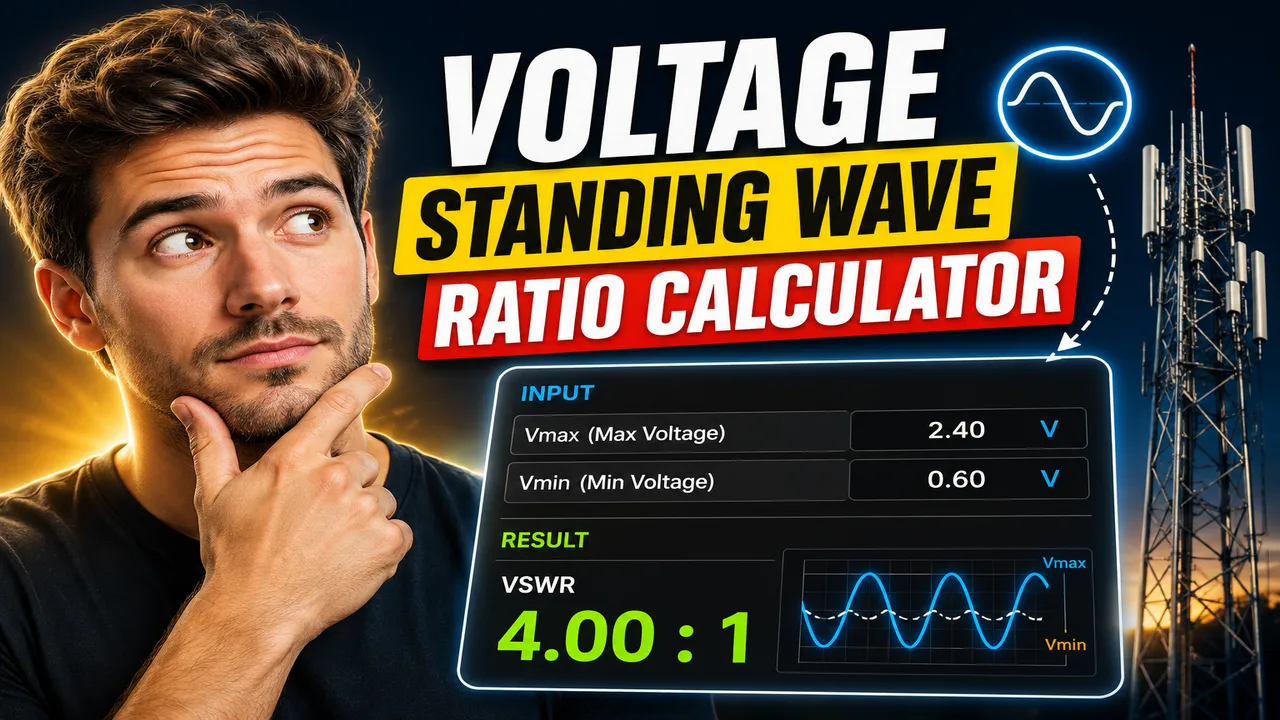
Voltage Standing Wave Ratio Calculator Tool Online
TL;DR Summary
The Voltage Standing Wave Ratio Calculator Tool Online calculates VSWR from forward and reflected RF power readings using the standard transmission-line relationship. It is intended for quick engineering estimates and measurement checks; privacy behavior is not specified by the supplied tool information, so avoid entering sensitive information unless the page explains how submitted data is handled.
What Is a Voltage Standing Wave Ratio Calculator?
The Voltage Standing Wave Ratio, usually called VSWR or SWR, describes the relationship between the highest and lowest voltage levels created by forward and reflected waves on a transmission line. A perfectly matched system has a VSWR of 1:1. A higher ratio indicates a larger mismatch between the source, transmission line, and load.
The Voltage Standing Wave Ratio Calculator Tool Online provides a simple way to calculate this ratio when you know the forward power and reflected power. These measurements are common in RF, antenna, microwave, radio, and transmission-line work. The calculation can help users turn power measurements into a VSWR value that is easier to compare with a system specification or measurement target.
The tool is designed around two inputs: forward power and reflected power. Both values should be entered in watts. Forward power is the power traveling toward the load. Reflected power is the portion of that power traveling back toward the source because of an impedance mismatch.
Who Can Use This Calculator?
This calculator can be useful for RF engineers, electronics students, radio operators, antenna builders, technicians, and anyone working with transmission-line measurements. It can also help when checking the relationship between readings from a wattmeter, directional coupler, antenna measurement setup, or other RF test equipment.
The result is a mathematical conversion from the two supplied power measurements. It does not replace the measurement process itself. The quality of the result depends on the quality, calibration, reference plane, and interpretation of the measurements used as inputs.
Inputs Required
- Forward Power (W): The incident or forward RF power traveling toward the load.
- Reflected Power (W): The RF power returning from the load toward the source.
Both values use watts in this calculator. If your instrument reports power in another unit, convert the readings to the same linear power unit before entering them. For example, do not directly combine a forward-power reading in watts with a reflected-power reading in dBm without first converting them to a compatible form.
What the Calculator Produces
The main output is VSWR, shown as a ratio such as 1.50:1 or 2.00:1. A value of 1:1 represents an ideal match with zero reflected power. As reflected power increases relative to forward power, the VSWR increases.
The calculator also handles the limiting case where reflected power equals forward power. In that situation, the reflection coefficient magnitude reaches 1 and the ideal mathematical VSWR tends toward infinity. The calculator displays this as an infinite ratio rather than attempting to represent it with a finite decimal number.
How to Use the Voltage Standing Wave Ratio Calculator Tool Online
- Step 1: Enter the forward RF power in watts. Use the forward or incident power measured at the relevant reference point in your RF system.
- Step 2: Enter the reflected RF power in watts. This value must be zero or greater and cannot exceed the forward power in the standard power-ratio calculation.
- Step 3: Review the calculated VSWR shown as a ratio such as 1.50:1.
- Step 4: Compare the result with the VSWR requirement for the transmission line, antenna, load, or RF equipment being evaluated.
- Step 5: If the result is unexpected, verify the power units, measurement setup, calibration, reference plane, connectors, cables, and instrument readings before drawing an engineering conclusion.
Technical Explanation and Formula
The standard calculation first obtains the magnitude of the voltage reflection coefficient from the ratio of reflected power to forward power:
|Γ| = √(Pr / Pf)
The VSWR is then calculated as:
VSWR = (1 + |Γ|) / (1 − |Γ|)
Here:
- |Γ| is the magnitude of the reflection coefficient and has no unit.
- Pf is forward power, measured in watts.
- Pr is reflected power, measured in watts.
- VSWR is a dimensionless ratio normally written in the form N:1.
For example, suppose the forward power is 100 W and the reflected power is 4 W. The reflection coefficient magnitude is √(4/100) = 0.20. The resulting VSWR is (1 + 0.20)/(1 − 0.20) = 1.50. The result is therefore 1.50:1.
This relationship is consistent with published RF engineering references from Keysight and Rohde & Schwarz. Those references define VSWR as the ratio of maximum to minimum standing-wave voltage and relate it to the magnitude of the reflection coefficient using the same formula.
Understanding the Result
| Forward Power | Reflected Power | Reflection Coefficient | VSWR |
|---|---|---|---|
| 100 W | 0 W | 0 | 1.00:1 |
| 100 W | 4 W | 0.20 | 1.50:1 |
| 100 W | 11.11 W | 0.3333 | 2.00:1 |
| 100 W | 25 W | 0.50 | 3.00:1 |
These examples show an important feature of VSWR: it is based on the relative amount of reflected power, not simply the absolute number of watts. A 4 W reflected reading has a different meaning when the forward power is 10 W than when it is 1,000 W.
Why VSWR Matters in RF Systems
VSWR is commonly used to describe impedance matching in antennas, feed lines, transmitters, receivers, amplifiers, and other RF systems. When a load is matched to the characteristic impedance of the transmission line, reflection is minimized. When the load and line are mismatched, part of the traveling wave is reflected.
A VSWR of 1:1 corresponds to zero reflection in the ideal model. Increasing VSWR corresponds to increasing reflection. However, VSWR by itself does not identify whether the load impedance is higher or lower than the characteristic impedance, nor does it provide the phase of a complex reflection coefficient.
Assumptions and Limitations
This calculator uses forward and reflected power as linear power quantities and assumes both readings refer to the same measurement reference and compatible units. It assumes that reflected power is not greater than forward power. Values that violate that condition are rejected because they do not produce a valid reflection-coefficient magnitude under this standard calculation.
The calculator does not determine a complex load impedance, reflection-coefficient phase, cable loss, connector loss, measurement uncertainty, or calibration error. It also does not determine whether an observed VSWR was caused by the antenna, feed line, connector, amplifier, or another part of the RF system.
Real RF measurements can be affected by instrument accuracy, coupler directivity, cable loss, connector condition, frequency, reference-plane location, and calibration. For high-power RF systems, antenna installations, regulated equipment, safety-critical systems, or final engineering decisions, use appropriate measurement procedures and professional engineering review rather than relying on a calculator result alone.
Why Use This Voltage Standing Wave Ratio Calculator Tool Online & How Our Calculator Beats the Competition
The practical benefit of this calculator is that it reduces the VSWR calculation to the two power measurements required by the standard power-based formula. It is useful when you already have forward and reflected power readings and need the corresponding standing-wave ratio without working through the equations manually.
| Method | Ease of Use | Calculation Speed | Best For | Limitations |
|---|---|---|---|---|
| Toolhox Calculator | Enter two power values | Immediate calculation | Quick VSWR checks from power readings | Does not perform full RF measurement or complex impedance analysis |
| Manual Calculation | Requires equation work | Depends on the user | Learning and checking the formula | More opportunity for arithmetic or unit errors |
| Spreadsheet | Requires setup | Fast after setup | Repeated calculations and custom records | Requires a spreadsheet and a correctly built formula |
| Professional RF Software | Usually more involved | Depends on the software and measurement workflow | Detailed RF analysis and measurement work | May provide capabilities beyond a simple VSWR calculation |
The choice of method depends on the task. A simple calculator is appropriate for a direct mathematical conversion. A spreadsheet may be more useful when many measurements must be recorded. Professional RF measurement software and instruments are more appropriate when the task requires frequency sweeps, complex S-parameters, calibration, uncertainty analysis, or detailed impedance characterization.
When Not to Rely on the Result Alone
Do not treat the calculated VSWR as a complete diagnosis of an RF system. A VSWR number tells you about the magnitude of the mismatch, but it does not tell you the complete electrical cause. If you need to locate a fault or design a matching network, additional measurements may be required.
For example, two different load conditions can produce the same VSWR while having different impedance characteristics. A complex impedance measurement or Smith chart analysis may therefore be necessary when the direction and phase of the mismatch matter.
Use the Voltage Standing Wave Ratio Calculator Tool Online as a focused calculation aid. Enter compatible forward and reflected power readings, check the resulting ratio, and use the result together with the measurement method and engineering context that produced the readings.