GPT-4o Token Counter & Cost Estimator
Calculate GPT-4o token usage and estimate API costs from your text. Use the Gpt-4o Token Counter And Cost Estimator for 2026 planning and budgeting.
+ System prompt (optional)
Result
No estimate yetLocal tokenizer: o200k_base via js-tiktoken; fallback heuristic with range. How was this calculated? Exact = local tokenizer count, Estimated = heuristic range.
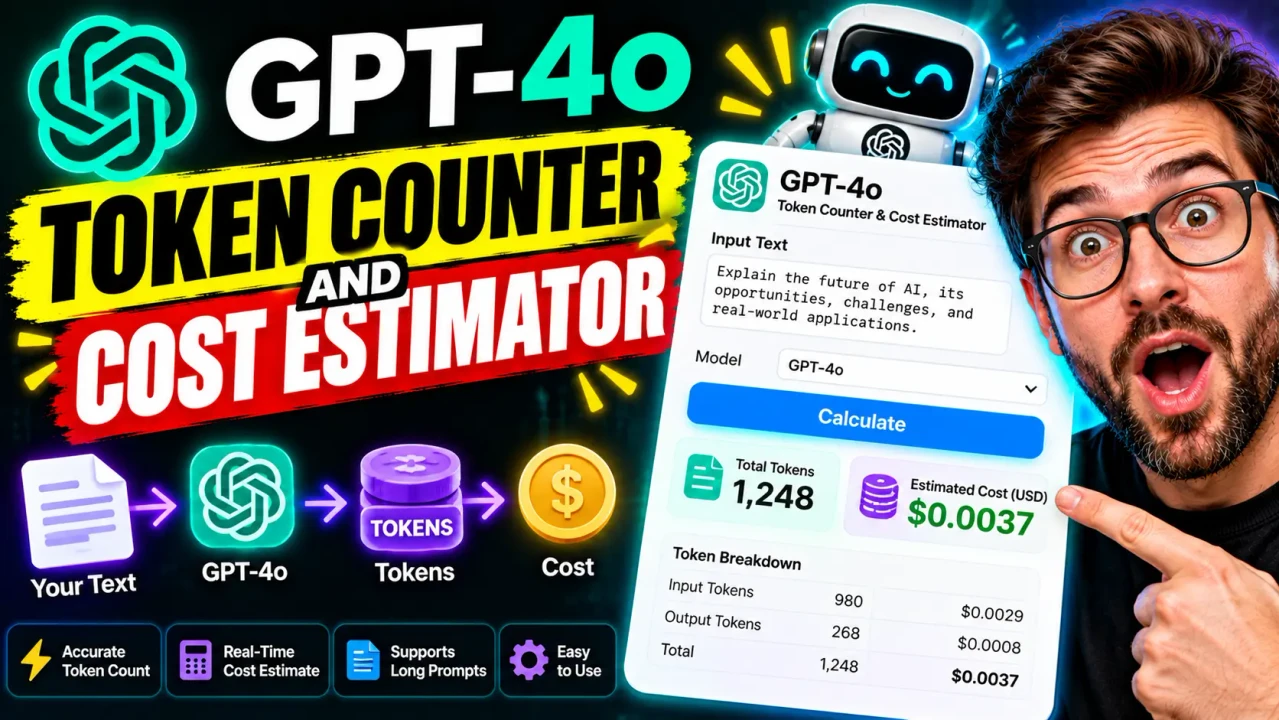
Gpt-4o Token Counter And Cost Estimator
TL;DR Summary
The Gpt-4o Token Counter And Cost Estimator helps estimate the number of GPT-4o tokens in text and the related API cost for input and output usage. It is intended for planning and budgeting, and token counts may be approximate rather than an exact tokenizer result; the supplied tool information does not establish a specific privacy or data-storage policy.
About This Tool
The Gpt-4o Token Counter And Cost Estimator is designed to help developers, writers, AI users, and API planners understand how much text may cost when processed with GPT-4o. It combines token estimation with GPT-4o API pricing so you can get a practical cost estimate before sending a request.
Tokens are the units used by OpenAI models to process text. A token may represent part of a word, a complete short word, punctuation, or other text. Token counts are not the same as word counts. OpenAI notes that tokenization depends on the model, encoding, language, spacing, and the exact text being processed. For English, OpenAI gives a rough guide of about four characters per token, or about three-quarters of a word per token. These are estimates, not exact conversion rules. OpenAI's token guide explains these differences.
For GPT-4o, OpenAI's current model documentation lists a 128,000-token context window and pricing of $2.50 per 1 million input tokens, $1.25 per 1 million cached input tokens, and $10.00 per 1 million output tokens. Pricing can change, so users should verify the current OpenAI pricing page before making a production budget or purchasing decision. OpenAI's GPT-4o model documentation provides the model-specific rates, while OpenAI's API pricing documentation provides the broader pricing reference.
This tool is useful when you are preparing prompts, estimating API spending, comparing prompt sizes, planning an application, or checking how a larger response could affect usage. For example, a developer may want to estimate the cost of sending a long system prompt repeatedly, while a content creator may want to understand the approximate token size of a large piece of text.
What You Enter
The primary input is the text you want to evaluate. The calculator can use the text length to produce a token estimate and apply GPT-4o pricing assumptions to that estimate. If an implementation provides separate input and output estimates, those values represent different billing categories: input tokens are supplied to the model, while output tokens are generated by the model.
The distinction matters because GPT-4o does not charge the same rate for input and output tokens. Cached input tokens can also have a different rate when prompt caching applies. OpenAI states that cached input pricing is separate from standard input pricing and that prompt caching is enabled for supported models. OpenAI's prompt caching documentation explains the cached-input concept.
What the Tool Produces
- Estimated token count: An approximation of how many tokens the supplied text may represent.
- Estimated input cost: A cost estimate based on GPT-4o input pricing.
- Estimated output cost: Where output tokens are estimated, the applicable GPT-4o output rate can be applied.
- Estimated total cost: A combined estimate when both input and output usage are provided or calculated.
The result should be treated as a planning estimate unless the tool is explicitly connected to an exact tokenizer. The OpenAI documentation makes clear that rough character-to-token and word-to-token relationships are only estimates. Exact token counts can differ because tokenization depends on the model's encoding and the exact text.
How to Use
- Step 1: Enter or paste the text you want to estimate.
- Step 2: Review the estimated token count produced for the text.
- Step 3: Review the applicable GPT-4o input or output cost estimate.
- Step 4: Use the estimate to plan prompt size, response size, or approximate API spending.
- Step 5: For production budgeting, compare the estimate with the current official OpenAI pricing and usage information.
Technical Explanation / Formula
When an exact tokenizer is not available, a common rough estimate for English text is:
Estimated Tokens ≈ Character Count ÷ 4
This is a rough approximation rather than an exact GPT-4o tokenization formula. OpenAI itself describes approximately four characters per token as an English-language estimate. The actual number can differ based on wording, punctuation, spaces, capitalization, encoding, and language.
For cost estimation, the general token-pricing relationship is:
Input Cost = Input Tokens ÷ 1,000,000 × Input Price per 1M Tokens
Output Cost = Output Tokens ÷ 1,000,000 × Output Price per 1M Tokens
Total Estimated Cost = Input Cost + Output Cost
Using the current GPT-4o rates documented by OpenAI, the standard input rate is $2.50 per 1 million tokens, cached input is $1.25 per 1 million tokens, and output is $10.00 per 1 million tokens. These rates are used as the current reference for this page and should be rechecked against OpenAI before production cost planning. :contentReference[oaicite:0]{index=0}
For example, if a rough estimate produces 10,000 input tokens, the standard input estimate at $2.50 per million is:
10,000 ÷ 1,000,000 × $2.50 = $0.025
If the same request generated 2,000 output tokens, the output estimate would be:
2,000 ÷ 1,000,000 × $10.00 = $0.020
The combined estimate would therefore be $0.045 under those pricing assumptions.
Preset Examples / Quick Reference
| Usage | Approximate Token Relationship | GPT-4o Pricing Reference |
|---|---|---|
| English text | About 4 characters per token as a rough estimate | Varies by input/output category |
| Standard input | 1,000,000 tokens | $2.50 |
| Cached input | 1,000,000 tokens | $1.25 |
| Output | 1,000,000 tokens | $10.00 |
These pricing figures are the current GPT-4o rates shown in OpenAI's model documentation. They are not a guarantee of future pricing. :contentReference[oaicite:1]{index=1}
Why Use This Gpt-4o Token Counter And Cost Estimator & How Our Gpt-4o Token Counter And Cost Estimator Beats the Competition
The practical difference between this tool and other calculation methods is the amount of manual work required. The comparison below describes general trade-offs rather than claiming superiority over a particular third-party product.
| Method | Ease of Use | Calculation Speed | Best For | Limitations |
|---|---|---|---|---|
| Toolhox Calculator | Enter text and review the estimate | Designed for interactive estimation | Quick token and cost planning | Approximate results depend on the supported calculation method and current pricing assumptions |
| Manual Calculation | Requires more steps | Depends on the person doing the calculation | Simple one-off estimates | Easy to make arithmetic or pricing mistakes |
| Spreadsheet | Requires setup | Fast after formulas are configured | Repeated estimates and custom budgeting | Requires maintaining formulas and pricing inputs |
| Professional/API Tooling | Can require technical setup | Can use exact usage data when connected to the relevant API or tokenizer | Production monitoring and detailed usage analysis | May require development work, API access, or additional configuration |
Assumptions and Limitations
The most important limitation is that a token estimate is not automatically an exact tokenizer result. A simple character-based estimate can be useful for planning, but actual tokenization can differ. OpenAI specifically notes that token counts vary by model, encoding, language, spacing, and capitalization. :contentReference[oaicite:2]{index=2}
Cost estimates also depend on the type and number of tokens used. Input, cached input, and output tokens can have different rates. The calculator should therefore be used as an estimate unless it has access to the exact token usage reported by the relevant OpenAI API response.
Pricing is another limitation. API pricing can change, and the applicable price can depend on the model and service being used. Always check the current OpenAI pricing documentation before using an estimate for a production budget, contract, invoice, or other financial decision. :contentReference[oaicite:3]{index=3}
The supplied tool information does not establish a specific privacy, retention, or server-processing policy. Avoid entering sensitive or confidential information unless the page clearly explains how that information is handled.
This calculator is intended for estimation and planning. It should not be treated as an official OpenAI billing statement or a substitute for actual usage data from your API account.