Gram To Cubic Inch Volume Calculator For Solids
Convert a solid
Please complete this field to continue.
Please complete this field to continue.
Please complete this field to continue.
Results
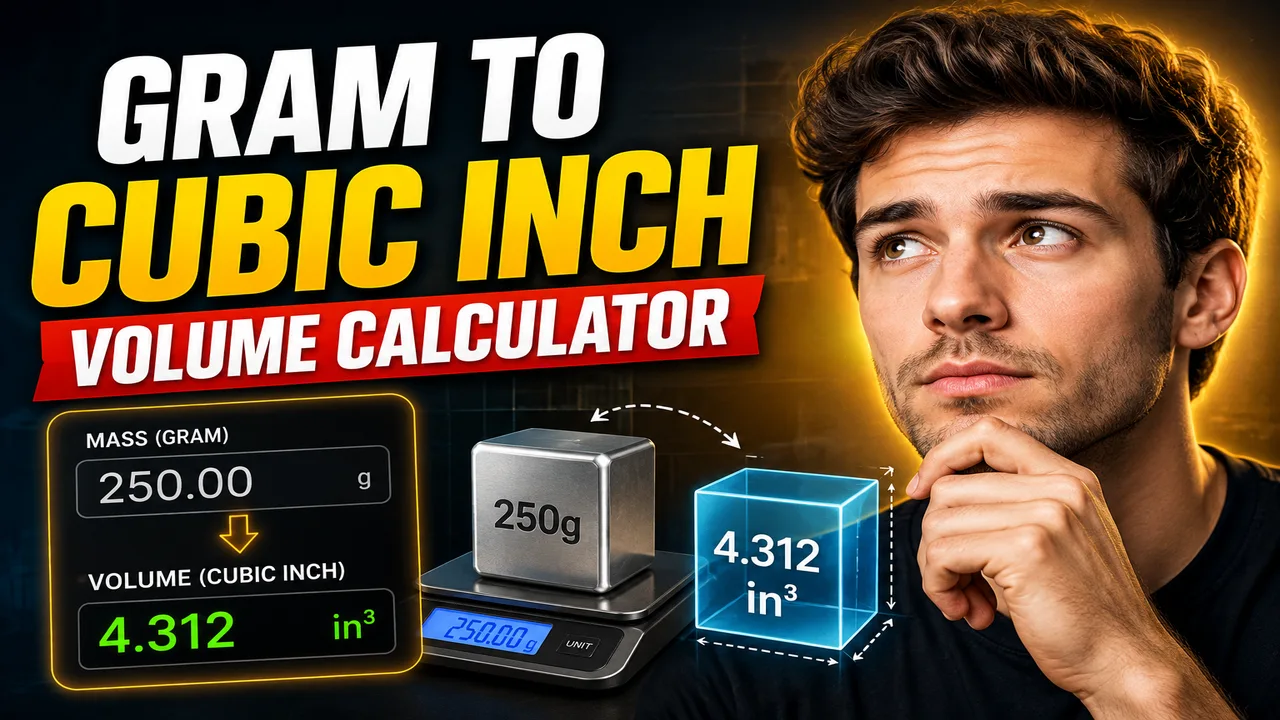
Gram To Cubic Inch Volume Calculator For Solids
TL;DR Summary
This calculator converts the mass of a solid in grams into an estimated volume in cubic inches when the material density is known. The result depends on the mass and density you enter, and the supplied tool information does not establish a specific server-side or local-processing privacy guarantee.
About This Tool
The Gram To Cubic Inch Volume Calculator For Solids helps you estimate the volume of a solid when you know its mass in grams and its material density. This is useful because mass and volume are different physical measurements. A gram tells you how much matter is present by mass, while a cubic inch tells you how much three-dimensional space the solid occupies.
Mass alone is not enough to determine the volume of a solid. Two objects can have the same mass but very different volumes if they are made from materials with different densities. For example, a dense metal and a less-dense solid can each have a mass of 500 grams while occupying very different amounts of space. The calculator therefore requires both the mass and the density of the material.
To use the calculator, enter the solid's mass in grams. Then enter its density and select the density unit. The supported density units are grams per cubic centimeter (g/cm³) and grams per cubic inch (g/in³). The calculator converts the density when needed and then calculates the corresponding volume in cubic inches (in³).
This tool can be useful for students, teachers, makers, engineers, designers, machinists, material researchers, hobbyists, and anyone who needs to convert the known mass of a solid into an estimated physical volume. It can also help with quick checks when working with material quantities, dimensional estimates, or geometry problems where density is known but the object's dimensions are not.
What You Need to Enter
- Mass: The mass of the solid in grams.
- Density: The density of the material.
- Density unit: Choose either g/cm³ or g/in³.
The density value should describe the material being measured. If you do not know the density, the calculator cannot determine a unique volume from mass alone. You should obtain the density from a reliable material specification, measurement, or other appropriate source before using the result.
What the Calculator Produces
The primary output is the estimated volume in cubic inches (in³). The result represents the amount of three-dimensional space corresponding to the entered mass at the entered material density.
The calculator accepts density in two common forms. If density is entered in g/in³, it can be used directly with the mass in grams. If density is entered in g/cm³, it is converted to g/in³ using the standard cubic-length conversion before the volume is calculated.
How to Use
- Step 1: Enter the mass of the solid in grams. For example, enter 500 for a solid with a mass of 500 grams.
- Step 2: Enter the material density and select whether the density is expressed in g/cm³ or g/in³.
- Step 3: Check the calculated volume in cubic inches.
- Step 4: Compare the result with the expected physical size of the solid and confirm that the density value and units were entered correctly.
Technical Explanation and Formula
The standard relationship between mass, density, and volume is:
Volume = Mass ÷ Density
When mass is measured in grams and density is measured in grams per cubic inch, the formula is:
V(in³) = m(g) ÷ ρ(g/in³)
Here:
- V is volume in cubic inches.
- m is mass in grams.
- ρ (rho) is material density in grams per cubic inch.
If density is supplied in grams per cubic centimeter, the calculator first converts it. One cubic inch equals 16.387064 cubic centimeters. Therefore:
ρ(g/in³) = ρ(g/cm³) × 16.387064
The calculator then applies the main volume formula. Combining the two steps gives:
V(in³) = m(g) ÷ [ρ(g/cm³) × 16.387064]
This is the standard calculation appropriate for converting the mass of a solid to volume when its density is known. The implementation should not be interpreted as knowledge of any hidden calculation process beyond this stated mathematical relationship.
Worked Example
Suppose a solid has a mass of 500 grams and a density of 2.70 g/cm³.
First convert the density:
2.70 × 16.387064 = 44.2450728 g/in³
Then calculate the volume:
500 ÷ 44.2450728 ≈ 11.3007 in³
So the estimated volume is approximately 11.3007 cubic inches.
Quick Reference
| Input or Output | Unit | Meaning |
|---|---|---|
| Mass | g | Amount of matter by mass |
| Density | g/cm³ | Mass contained in one cubic centimeter |
| Density | g/in³ | Mass contained in one cubic inch |
| Volume | in³ | Estimated three-dimensional volume |
Why Density Matters
Density is the key value that connects mass to volume. A higher-density material requires less physical space for the same mass. A lower-density material requires more physical space for the same mass. This means that changing the density while keeping the mass fixed will change the calculated volume.
The quality of the result therefore depends heavily on the density value. If the material is porous, contains voids, is a mixture, or has a density that changes significantly with conditions, a simple density value may not fully represent the physical object. The result should then be treated as an estimate based on the density supplied.
Why Use This Gram To Cubic Inch Volume Calculator For Solids & How Our Calculator Beats the Competition
The practical difference between this calculator and other calculation methods is mainly the amount of manual work required. The tool is designed around the standard mass-density-volume relationship and returns the result in cubic inches. Other methods can still be useful when a user needs a larger model, repeated calculations, or a more specialized engineering workflow.
| Method | Ease of Use | Calculation Process | Best For | Limitations |
|---|---|---|---|---|
| Toolhox Calculator | Enter mass, density, and unit | Applies mass ÷ density with unit conversion when needed | Quick solid-volume estimates | Requires a suitable density value and does not replace physical measurement |
| Manual Calculation | Requires formula and unit work | User performs the conversion and division | Learning and checking calculations | More opportunity for unit or arithmetic errors |
| Spreadsheet | Requires spreadsheet setup | Formula can be entered and reused | Repeated calculations and custom records | Requires creating or maintaining the spreadsheet |
| Professional Engineering Software | Often requires a more involved workflow | May support broader engineering models | Detailed engineering and design work | May provide functionality beyond what is needed for a simple mass-to-volume calculation |
Assumptions and Limitations
- The solid is represented by a single density value.
- The entered mass is measured in grams.
- The entered density is greater than zero.
- The density unit is correctly selected.
- The conversion uses 1 in³ = 16.387064 cm³.
- The result is a mathematical estimate based on the supplied inputs.
- The calculator does not independently identify the material or verify the density entered by the user.
- The calculation does not account for unknown internal voids, porosity, mixed materials, or other physical characteristics unless those effects are already reflected in the density supplied.
For precise manufacturing, engineering, laboratory, trade, or safety decisions, do not rely on the calculated value alone when the actual physical dimensions or material properties need to be verified. Use appropriate measurements, specifications, or professional review when the application requires a verified result.
Privacy and Input Guidance
The supplied tool information does not establish a specific privacy or data-storage policy for this calculator. Avoid entering sensitive information unless the page clearly explains how submitted information is handled. The calculator's mathematical result is based on the values provided by the user.