Grams Of Sugar To Cubes Calculator
Convert grams of sugar into an estimated number of sugar cubes using a simple grams-to-cubes calculation for quick reference.
Please complete this field to continue.
Results
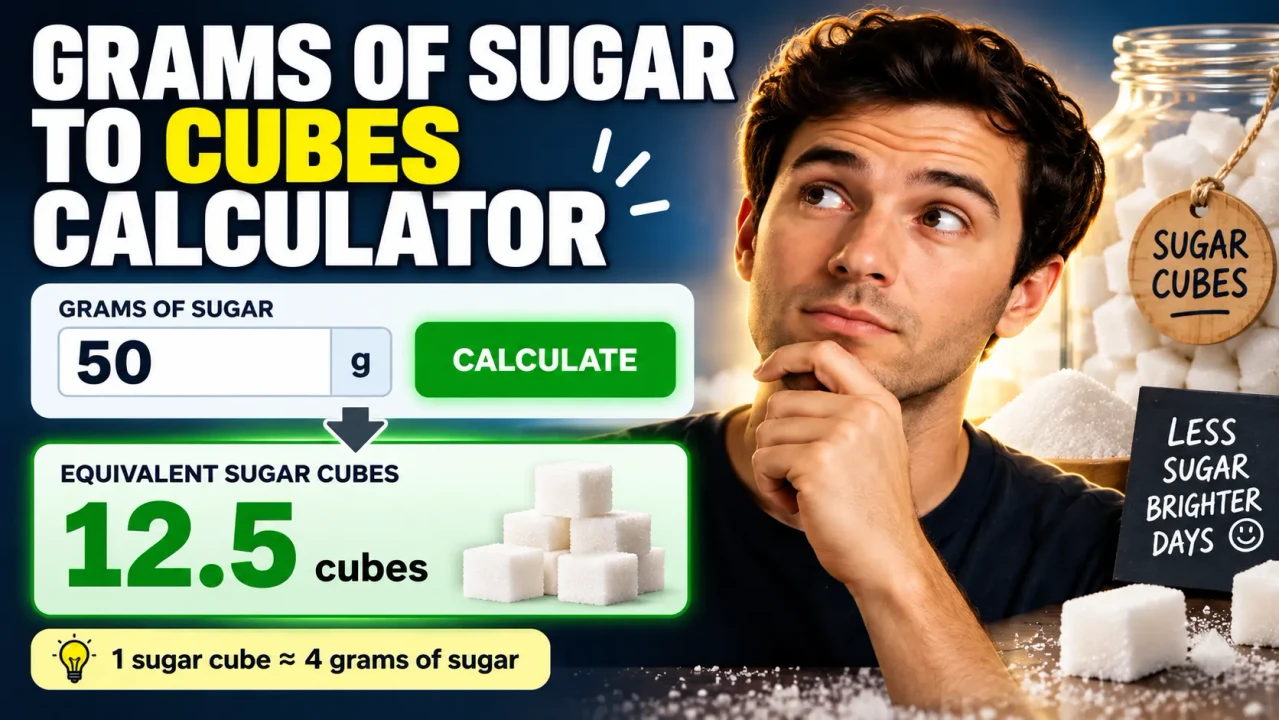
Grams Of Sugar To Cubes Calculator
TL;DR Summary
The Grams Of Sugar To Cubes Calculator converts a quantity of sugar in grams into an estimated number of sugar cubes using a stated sugar-cube weight assumption. Use the result as a practical estimate rather than an exact measurement for a specific brand or cube size; the supplied tool information does not document a specific data-storage or server-processing policy.
About This Tool
The Grams Of Sugar To Cubes Calculator is a simple sugar conversion tool for people who want to understand a sugar amount in a familiar visual form. Instead of thinking only about a number of grams, you can estimate how many individual sugar cubes that amount represents. This can make nutrition information, recipes, drinks, and everyday sugar quantities easier to picture.
The calculator is designed around a straightforward conversion: sugar in grams is divided by the assumed weight of one sugar cube. The result represents the approximate number of cubes equivalent to the entered amount of sugar. Because sugar cubes can differ in size, density, shape, and manufacturer specifications, the result should be treated as an estimate unless the weight of the particular sugar cube being used is known.
This type of calculator can be useful when reading a nutrition label, checking a recipe, comparing sweetened foods or drinks, or explaining sugar quantities. It can also help students, parents, teachers, cooks, and general users visualize how a gram-based sugar measurement translates into individual pieces of sugar.
What You Enter
The primary value for this calculator is the amount of sugar expressed in grams. Grams are a unit of mass, so the input represents the total mass of sugar rather than the number of servings or the volume of sugar.
The supplied tool information does not document additional user-selectable cube sizes, brands, or package-specific weights. Therefore, the conversion should not be interpreted as a brand-specific measurement unless the actual calculator provides such an option. If your sugar cubes have a different stated weight, that difference can materially change the result.
What the Calculator Produces
The main output is an estimated number of sugar cubes equivalent to the entered grams of sugar. The result may be a decimal because the mathematical conversion can produce a fraction of a cube. For example, a calculation may show that an amount corresponds to approximately 3.5 cubes. That does not mean a physical half-cube must be used; it simply describes the mathematical equivalent.
For practical counting, users may choose to round the result when appropriate. However, rounding is different from the underlying conversion. A decimal result preserves more information about the calculated equivalent, while a whole-number result is easier to use when discussing complete cubes.
How to Use
- Step 1: Enter the amount of sugar you want to convert, using grams as the unit.
- Step 2: Check that the entered value represents the total sugar amount you want to compare with sugar cubes.
- Step 3: Run the calculator to convert the gram amount into an estimated sugar-cube equivalent.
- Step 4: Read the calculated cube equivalent and remember that actual cube sizes can vary.
- Step 5: If you need an exact physical comparison, check the package or manufacturer information for the weight of the specific sugar cube you are using.
Technical Explanation and Formula
The exact internal implementation of the supplied calculator is not documented in the provided tool materials. For that reason, the following is the standard calculation for a grams-to-sugar-cubes converter rather than a claim about an undocumented internal formula.
Formula:
Estimated Sugar Cubes = Sugar in Grams ÷ Grams per Sugar Cube
There are two important variables:
- Sugar in Grams: the total mass of sugar entered into the calculator, measured in grams.
- Grams per Sugar Cube: the assumed mass of one sugar cube used as the conversion reference.
The formula works because the total sugar mass is divided into equal portions represented by the assumed cube weight. For example, if a reference value of 4 grams per cube is used, 20 grams of sugar would correspond to:
20 g ÷ 4 g per cube = 5 cubes
This example illustrates the calculation method. The actual cube equivalent depends on the cube-weight assumption used by the calculator. A different cube weight produces a different result.
Why Cube Weight Matters
A sugar cube is not a universal unit of mass. Different products can use different cube dimensions and weights. Some cubes are compact, while others are larger or shaped differently. Packaging and product specifications can therefore matter when you need a precise conversion.
U.S. nutrition-label guidance also shows why gram weights are important: food serving information can pair household measures or individual units with a metric gram equivalent. The FDA explains that serving information can include a household measure followed by the metric amount in grams. :contentReference[oaicite:0]{index=0}
USDA food-reference material also demonstrates that sugar measurements can vary by the particular measure being used. Historical USDA reference data, for example, lists sugar measures in grams for teaspoons and other forms, showing why a single universal physical sugar-cube weight should not automatically be assumed for every product. :contentReference[oaicite:1]{index=1}
Preset Examples and Quick Reference
| Sugar Amount | Illustrative Cube Weight | Estimated Cubes |
|---|---|---|
| 4 g | 4 g per cube | 1 cube |
| 8 g | 4 g per cube | 2 cubes |
| 12 g | 4 g per cube | 3 cubes |
| 20 g | 4 g per cube | 5 cubes |
| 40 g | 4 g per cube | 10 cubes |
These examples use 4 grams per cube only to demonstrate the division formula. They are not a claim that every commercially available sugar cube weighs exactly 4 grams.
Sugar Grams and Nutrition Labels
It is useful to keep this calculator separate from nutritional advice. A grams-to-cubes conversion changes the way a quantity is represented; it does not change the amount of sugar. Twenty grams of sugar remains 20 grams whether it is described as grams, teaspoons, or an estimated number of cubes.
The FDA distinguishes between total sugars and added sugars on Nutrition Facts labels. Added sugars include sugars added during processing or preparation, while naturally occurring sugars in foods such as fruit and milk are treated differently. :contentReference[oaicite:2]{index=2}
That distinction matters if you are using this calculator to understand a nutrition label. Do not automatically treat the calculated cube equivalent as the amount of added sugar unless the original gram value specifically represents added sugar.
Why Use This Grams Of Sugar To Cubes Calculator & How Our Calculator Beats the Competition
| Method | Ease of Use | Calculation Speed | Best For | Limitations |
|---|---|---|---|---|
| Toolhox Calculator | Simple input-and-result workflow | Immediate calculation | Quickly converting grams into an estimated cube equivalent | Depends on the cube-weight assumption used by the tool |
| Manual Calculation | Requires division by the selected cube weight | Depends on manual work | Users who already know their cube weight | More opportunity for arithmetic or unit-entry mistakes |
| Spreadsheet | Requires setup | Fast after setup | Repeated conversions or custom reference values | Requires a spreadsheet and a correctly configured formula |
| Product Packaging | Depends on available product information | Manual comparison | Checking the exact weight of a specific product | Does not necessarily provide a direct grams-to-cubes conversion |
The practical value of the calculator is that it turns a simple division task into a direct conversion workflow. It is especially useful when the goal is to visualize a sugar quantity rather than perform a larger nutritional analysis. Manual calculation remains useful when you want to select your own cube-weight reference, while product packaging is more appropriate when the exact weight of a particular brand or cube is important.
Assumptions and Limitations
- The conversion represents an estimate unless the exact weight of the sugar cube is known.
- Sugar-cube sizes and weights can vary by product and manufacturer.
- The tool does not establish whether sugar is naturally occurring or added sugar.
- A calculated fractional cube is a mathematical equivalent, not necessarily a physically available portion.
- The supplied materials do not document a specific privacy, storage, or server-processing policy, so users should avoid entering sensitive information unless the page separately explains how entered data is handled.
- The result should not be treated as a medical, dietary, or individualized nutrition recommendation.
For everyday estimation, the result can help make a gram amount easier to picture. For nutrition planning or other health-related decisions, use the original nutrition label and consider the complete nutritional context rather than relying on a cube-equivalent number alone.
Q: What does the Grams Of Sugar To Cubes Calculator do? A: It converts a quantity of sugar measured in grams into an estimated number of sugar cubes based on the cube-weight reference used by the calculation. Q: What formula does the Grams Of Sugar To Cubes Calculator use? A: The standard conversion is estimated sugar cubes = sugar in grams ÷ grams per sugar cube. Q: Is one sugar cube always the same number of grams? A: No. Sugar cubes can vary in size, shape, density, and weight, so the cube equivalent should be treated as an estimate unless the exact cube weight is known. Q: Can I use this calculator with sugar listed on a Nutrition Facts label? A: Yes. You can use the gram amount as the input, but remember that the conversion only changes the way the amount is expressed and does not distinguish between total sugar and added sugar. Q: Why might my actual number of sugar cubes differ from the calculator result? A: The actual cubes may have a different weight from the reference value used by the calculation, so a brand-specific package weight can produce a different result. Q: Does the calculator tell me how much added sugar I should consume? A: No. It only converts a gram amount into an estimated sugar-cube equivalent and does not provide an individualized dietary recommendation. Q: Can the result be a fraction of a sugar cube? A: Yes. The mathematical result can be a decimal when the entered sugar amount is not an exact multiple of the assumed cube weight. HTML
:contentReference[oaicite:6]{index=6}ttps://i.postimg.cc/hvDq2Sn1/Grams-Of-Sugar-To-Cubes-Calculator.webp">