Voltage Source To Current Source Transformation Calculator
Use the Voltage Source To Current Source Transformation Calculator to convert voltage and series resistance into equivalent current and parallel resistance.
Please complete this field to continue.
Please complete this field to continue.
Results
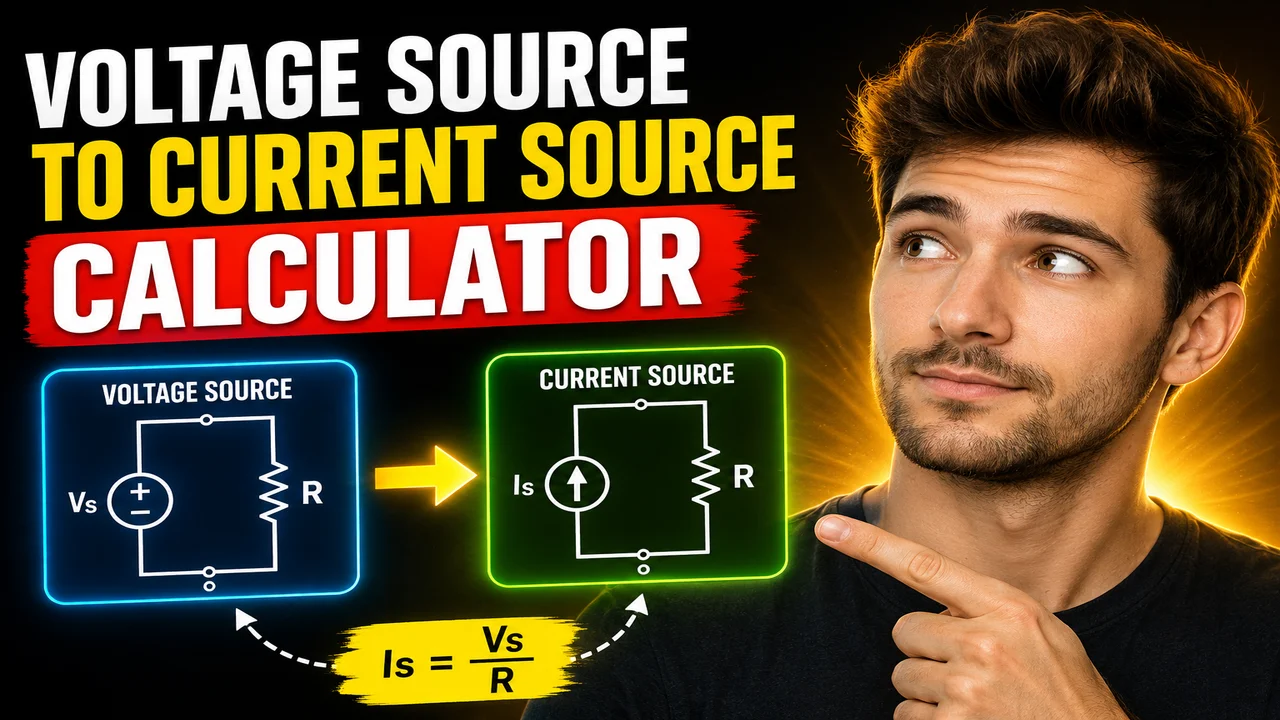
Voltage Source To Current Source Transformation Calculator
TL;DR Summary
The Voltage Source To Current Source Transformation Calculator converts a voltage source with a series resistance into its equivalent current-source form, giving the current in amperes and the unchanged resistance in ohms. It is intended for circuit analysis and source-conversion work; the page does not establish any special privacy guarantee, so avoid entering sensitive information unless the page clearly explains how entered data is handled.
About This Tool
The Voltage Source To Current Source Transformation Calculator helps you change one common circuit representation into another equivalent representation. A voltage source with a resistor in series can be represented as a current source with the same resistance in parallel. The conversion is useful when simplifying electrical circuits, combining sources, applying circuit-analysis methods, or changing a circuit into a form that is easier to solve.
The calculator requires two values: the voltage source value and the series resistance. Enter the source voltage in volts (V) and the resistance in ohms (Ω). The calculator then determines the equivalent current-source value in amperes (A). It also reports the resistance that belongs in parallel with the current source.
The key result is the source current. For a voltage source of V volts and a series resistance of R ohms, the equivalent current is V divided by R. The resistance itself does not change during the ideal source transformation. Only the source representation changes: the voltage source and series resistor become a current source and parallel resistor.
This tool is useful for students learning circuit analysis, electronics learners working through equivalent circuits, technicians checking circuit calculations, and engineers or designers performing quick hand-calculation checks. It can also be useful when solving networks in which a Norton-style current-source representation is more convenient than a voltage-source representation.
What You Enter
- Voltage Source: Enter the voltage supplied by the original source in volts (V).
- Series Resistance: Enter the resistance connected in series with the voltage source in ohms (Ω).
The calculator uses positive voltage and a resistance greater than zero. A zero resistance cannot be used with the basic V/R conversion because division by zero is undefined.
What You Get
- Equivalent Current Source: The calculated source current in amperes (A).
- Parallel Resistance: The resistance used with the equivalent current source in ohms (Ω).
The calculator does not attempt to model a complete circuit around the source. It performs the source transformation from the two values you provide. If you need branch currents, load voltage, power, frequency response, transient behavior, or a complete circuit solution, those require additional circuit information and analysis.
How to Use
- Step 1: Enter the voltage of the original voltage source in volts (V).
- Step 2: Enter the resistance connected in series with that voltage source in ohms (Ω).
- Step 3: Review the equivalent current-source value shown in amperes (A).
- Step 4: Use the reported resistance as the parallel resistance in the transformed circuit.
Technical Explanation and Formula
The standard source-transformation relationship is:
I = V / R
where:
- I = equivalent current source, measured in amperes (A)
- V = original voltage source, measured in volts (V)
- R = original series resistance, measured in ohms (Ω)
The transformed circuit uses the same resistance value, but its connection changes. The original form has a voltage source in series with R. The equivalent form has a current source of V/R in parallel with R.
This relationship follows directly from Ohm's law, V = IR. Rearranging that equation gives I = V/R. Source-conversion references also express the converted current source as the source voltage divided by the associated impedance or resistance. :contentReference[oaicite:3]{index=3}
For a purely resistive DC source transformation, the units are straightforward. Dividing volts by ohms produces amperes:
V / Ω = A
For example, if the voltage source is 12 V and the series resistance is 6 Ω:
I = 12 V / 6 Ω = 2 A
The equivalent circuit therefore has a 2 A current source in parallel with a 6 Ω resistor.
Preset Examples / Quick Reference
| Voltage Source | Series Resistance | Equivalent Current | Parallel Resistance |
|---|---|---|---|
| 12 V | 6 Ω | 2 A | 6 Ω |
| 10 V | 5 Ω | 2 A | 5 Ω |
| 24 V | 12 Ω | 2 A | 12 Ω |
These examples show an important point: the resistance is retained during the source transformation. Only the source type and connection change.
Why Use This Voltage Source To Current Source Transformation Calculator & How Our Calculator Beats the Competition
| Method | Ease of Use | Calculation Speed | Best For | Limitations |
|---|---|---|---|---|
| Toolhox Calculator | Enter voltage and resistance | Immediate calculation | Quick source-conversion checks | Handles the stated source transformation rather than a complete circuit analysis |
| Manual Calculation | Requires the formula and arithmetic | Depends on the user | Learning the relationship or checking work by hand | Arithmetic and unit-entry mistakes are possible |
| Spreadsheet | Requires a prepared formula | Fast after setup | Repeated calculations or larger sets of values | Requires spreadsheet setup and maintenance |
| Professional Engineering Software | Usually requires more setup | Depends on the model | Complete circuit and engineering analysis | More capability than needed for a simple V/R source transformation |
The practical advantage of a dedicated source-transformation calculator is that the user only needs the two values required by the basic relationship. A manual calculation can produce the same mathematical result, while a spreadsheet can be useful when many calculations are needed. Professional circuit software is appropriate when the task extends beyond a simple equivalent-source conversion.
Assumptions and Limitations
This calculator uses the standard ideal source-transformation relationship for a voltage source with a series resistance. The resistance is treated as a positive real resistance, and the calculation uses the source voltage divided by that resistance.
The calculator does not determine the direction of current in a larger circuit, solve a load connected to the transformed source, or analyze an entire network. Source polarity and current-reference direction still need to be interpreted from the circuit diagram. A signed source or a circuit with a particular reference direction may require the user to apply the appropriate sign convention separately.
The basic calculator also does not model frequency-dependent impedance, reactive components, dependent sources, nonlinear devices, temperature effects, source limitations, or parasitic elements. For AC circuit analysis involving complex impedance, the simple real-number V/R calculation is not sufficient.
The result should therefore be treated as a circuit-analysis calculation based on the supplied voltage and resistance, not as a complete electrical design or safety assessment. For real-world electrical systems, especially systems involving hazardous voltages or equipment ratings, use the applicable circuit specifications and professional engineering review where required.