Voltage Across Capacitor Calculator Differential
Use Voltage Across Capacitor Calculator Differential to find capacitor voltage change rate from current and capacitance, with results shown in volts per second.
Please complete this field to continue.
Please complete this field to continue.
Results
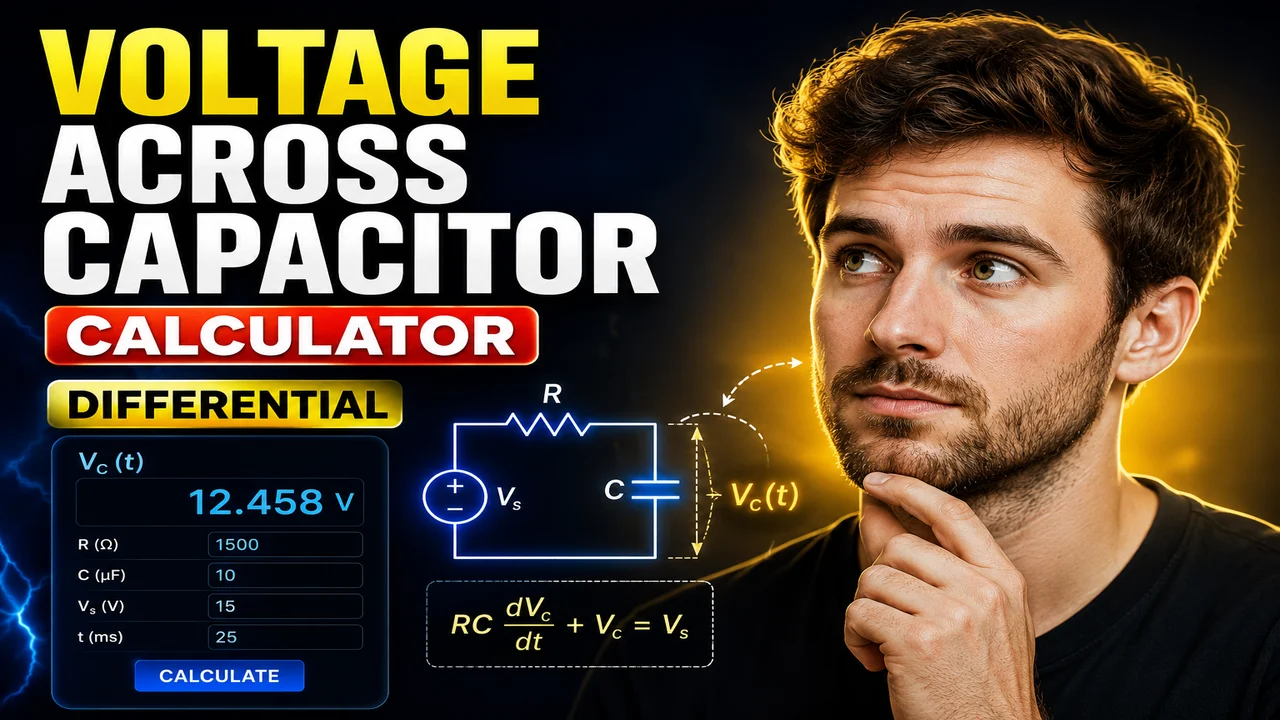
Voltage Across Capacitor Calculator Differential
TL;DR Summary
Voltage Across Capacitor Calculator Differential calculates the instantaneous rate of voltage change across a capacitor from its current and capacitance using the standard capacitor differential equation. It is a focused circuit-analysis calculation, not a complete circuit simulator or substitute for detailed engineering analysis; the available tool information does not specify how user data is stored or transmitted.
About This Tool
The Voltage Across Capacitor Calculator Differential is designed for a specific capacitor calculation: finding how quickly the voltage across a capacitor is changing at a given instant. It uses capacitor current and capacitance as the two inputs and reports the voltage change rate in volts per second.
This calculation is useful because capacitor voltage does not change independently of current. For an ideal capacitor, the current through the component is related to the rate of change of voltage by the differential equation i = C × dv/dt. Rearranging that relationship gives dv/dt = i/C. This rearranged form lets you calculate the voltage slope directly when current and capacitance are known. Engineering LibreTexts documents the same relationship and notes that voltage change rate is current divided by capacitance. :contentReference[oaicite:3]{index=3}
The tool can be useful for students learning circuit analysis, electronics hobbyists checking a calculation, engineers doing an initial component-level calculation, and anyone working through a differential-equation problem involving an ideal capacitor. It is especially useful when the desired result is the instantaneous voltage slope rather than the capacitor voltage at a later time.
Inputs and Outputs
The calculator uses two required inputs:
- Capacitor Current: Enter the current through the capacitor in amperes (A). The value may be positive or negative. The sign represents the selected current direction.
- Capacitance: Enter the capacitance in farads (F). The value must be greater than zero.
The output is Voltage Change Rate, expressed in volts per second (V/s). This is the differential quantity dv/dt. A positive result means the capacitor voltage is increasing according to the chosen current and voltage reference directions. A negative result means the voltage is decreasing under those same reference directions.
Capacitance values are often specified using prefixes in practical electronics. For example, 100 microfarads is 0.0001 farads, and 10 microfarads is 0.00001 farads. The calculator input is expressed in farads, so convert a component value to farads before entering it if necessary.
How to Use
- Step 1: Enter the capacitor current in amperes. Use a negative number when the current direction is opposite to the positive reference direction.
- Step 2: Enter the capacitance in farads. Make sure the capacitance is greater than zero.
- Step 3: Calculate the result to obtain the capacitor voltage change rate in volts per second.
- Step 4: Use the sign and magnitude of the result to interpret how quickly the capacitor voltage is increasing or decreasing.
Technical Explanation and Formula
The standard ideal-capacitor differential equation is:
i = C × dv/dt
Solving for the voltage differential gives:
dv/dt = i/C
| Symbol | Meaning | Unit |
|---|---|---|
| i | Instantaneous capacitor current | ampere (A) |
| C | Capacitance | farad (F) |
| dv/dt | Instantaneous rate of capacitor voltage change | volt per second (V/s) |
The units also confirm the relationship. An ampere is a coulomb per second, while a farad is a coulomb per volt. Therefore, A/F reduces to V/s. Engineering LibreTexts describes the capacitor relationship as i = C dv/dt and its rearranged form as dv/dt = i/C. :contentReference[oaicite:4]{index=4}
The calculator does not need a calendar year or a U.S. state rule because this is a basic electrical relationship rather than a jurisdiction-dependent calculation. The formula is based on the ideal capacitor model and does not depend on a 2026 tax, legal, financial, or regulatory rule.
Worked Example
Suppose a capacitor has a capacitance of 100 microfarads and carries an instantaneous current of 2 milliamperes.
First convert the values:
- Current = 2 mA = 0.002 A
- Capacitance = 100 µF = 0.0001 F
Apply the formula:
dv/dt = 0.002 / 0.0001 = 20 V/s
The resulting voltage change rate is therefore 20 V/s. If the current were -0.002 A with the same capacitance and reference direction, the result would be -20 V/s.
Understanding the Result
The result is a slope, not the capacitor's final voltage. A value of 20 V/s means the voltage is changing at a rate of 20 volts for every second at the instant represented by the input current. It does not, by itself, tell you the voltage after a specified time unless the current remains constant or the current waveform is otherwise known.
For a constant current, the differential relationship can also be integrated. Starting with dv/dt = i/C, if both current and capacitance are constant, the voltage change over an interval can be written as ΔV = IΔt/C. To determine an actual capacitor voltage, however, you also need an initial voltage or another appropriate circuit condition.
Preset Examples and Quick Reference
| Current | Capacitance | Voltage Change Rate |
|---|---|---|
| 0.001 A | 0.0001 F | 10 V/s |
| 0.002 A | 0.0001 F | 20 V/s |
| -0.002 A | 0.0001 F | -20 V/s |
| 0.001 A | 0.001 F | 1 V/s |
These examples illustrate two important points. Increasing current increases the magnitude of the voltage change rate. Increasing capacitance decreases the voltage change rate for the same current. A negative current produces a negative voltage slope when the stated current and voltage reference directions follow the standard passive sign convention.
Why Use This Voltage Across Capacitor Calculator Differential & How Our Calculator Beats the Competition
| Method | Ease of Use | Calculation Speed | Best For | Limitations |
|---|---|---|---|---|
| Toolhox Calculator | Enter current and capacitance | Direct calculation | Quick capacitor differential calculations | Uses the ideal capacitor relationship and does not model a complete circuit |
| Manual Calculation | Requires applying and rearranging the formula | Depends on the user | Learning and checking equations | More opportunity for unit or arithmetic mistakes |
| Spreadsheet | Requires setup | Depends on the spreadsheet model | Repeated calculations or custom analysis | Requires building and maintaining formulas |
| Professional Engineering Software | Requires a more detailed model | Depends on the software and circuit model | Detailed circuit simulation and engineering analysis | More setup than this component-level calculation |
The practical purpose of this calculator is narrow. It provides the differential capacitor relationship directly, while manual work, spreadsheets, and full engineering software serve different needs. A complete circuit analysis may require resistors, sources, switches, parasitic effects, initial conditions, frequency-dependent behavior, or a system of differential equations. Those details are outside the stated scope of this calculator.
Assumptions and Limitations
This calculator uses the standard ideal-capacitor relationship. It assumes that the entered capacitance represents the capacitance relevant to the calculation and that the entered current is the current through that capacitor at the instant being considered.
The calculation does not model capacitor equivalent series resistance, leakage, dielectric losses, temperature effects, tolerance, parasitic capacitance, nonlinear capacitance, aging, or other real-component behavior. It also does not solve an entire circuit or determine capacitor current from a circuit automatically.
The result is a voltage rate of change, not a complete transient waveform. If current varies with time, the instantaneous result changes with current. To determine capacitor voltage over time, the current waveform and an appropriate initial voltage are also needed. The integral form of the capacitor relationship is v(t) = v(t₀) + (1/C)∫i(t)dt over the relevant interval. The differential form used by this calculator is the local relationship at the specified current.
Use additional circuit analysis when the result will affect a safety-critical, high-voltage, high-energy, production, or regulated design. For engineering decisions, verify the result against the actual circuit, component specifications, tolerances, operating conditions, and applicable design requirements.